
Adapt an article into a comic and export it as a PDF
Follow a practical workflow to convert an article into a comic: analyze content into a storyline, design characters and panels, generate image prompts per page, use AI image generation, and assemble a shareable comic PDF. Includes prerequisites and verification checklist.
Image Analysis
1. Facts (directly visible/readable content and clearly defined visual elements)
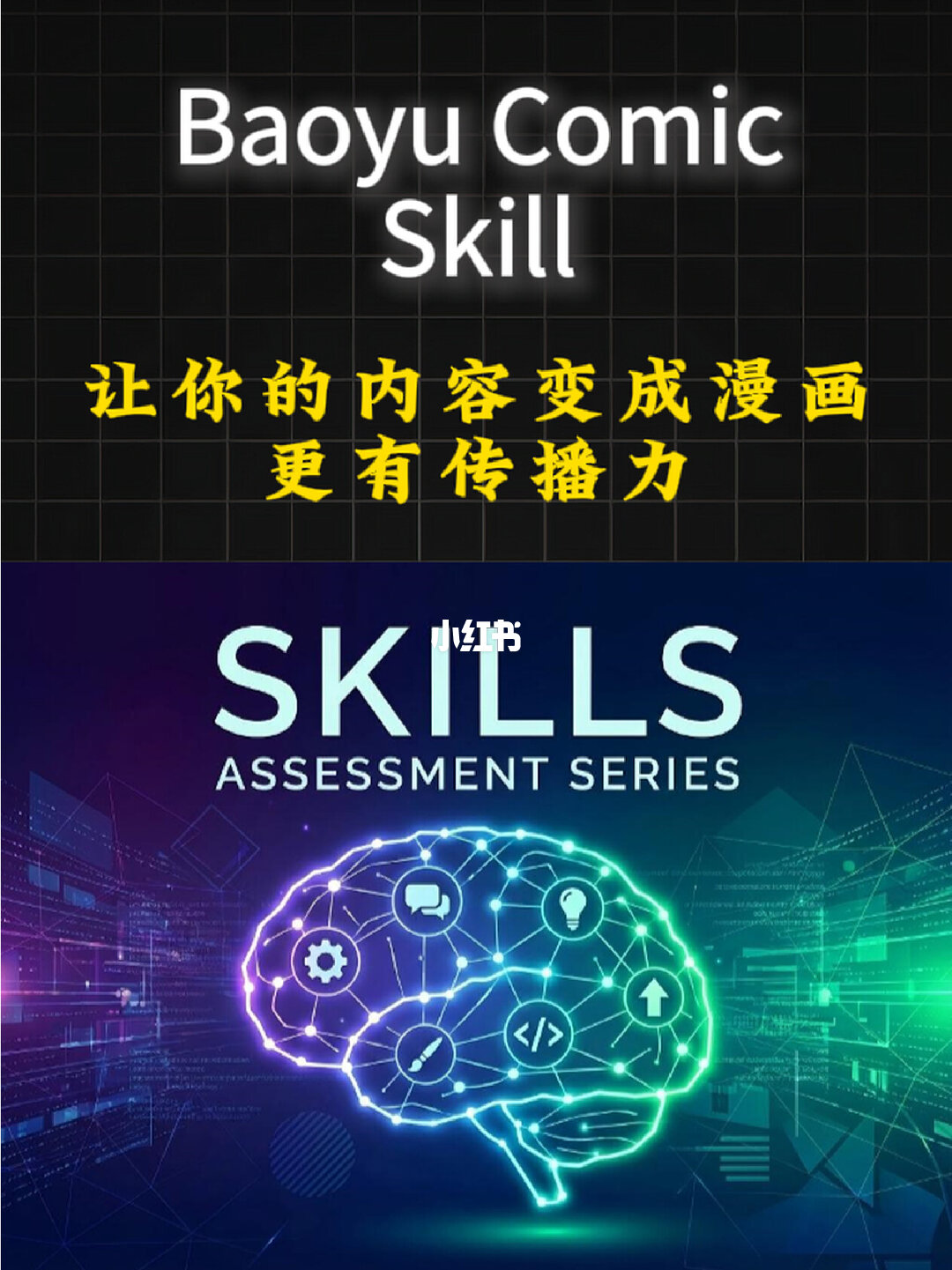
- Top text (English, mixed case, two lines):
- Line 1: Baoyu Comic
- Line 2: Skill
- Middle yellow Chinese slogan (two lines):
- Line 1: 让你的内容变成漫画
- Line 2: 更有传播力
- Lower-center large English text:
- SKILLS
- Smaller text below: ASSESSMENT SERIES
- Small white text centered above (overlaid on SKILLS): 小红书
- Lower half of the image shows a glowing neural-network/brain outline with several icons inside (presented as circular nodes):
- Left node: gear icon
- Top node: chat bubble icon
- Upper-right node: light bulb icon
- Lower-middle node: paintbrush icon
- Middle/right node: code symbol (</>)
- Right node: upward arrow (upload/arrow up)
- Background is clearly divided:
- Upper half: black grid (square) background
- Lower half: blue–purple–green gradient tech-style background with data/line light effects and irregular geometric lines
- Color and visual effects:
- Yellow handwritten/calligraphic Chinese slogan
- White/light English title text
- Brain outline rendered as neon glow (purple/blue/green gradients)
- Numerous connection points (small light dots) and lines connect brain nodes, forming a network structure
2. Unreadable or blurred content (marked as 'unreadable')
- Many very small English/number texts at both lower background sides (tech UI style); font too small and blurred to read — marked: unreadable background small text/code fragments
- There may be additional small icons or text inside/around the brain outline that are very small or partially obscured by glow — marked: some node details unreadable
3. Chart data / UI steps
- No numerical charts, axes, percentages, or table data are visible — conclusion: no readable chart data
- No UI operation steps, button sequences or clear UI step prompts are visible — conclusion: no interface step information
4. Inferences (reasonable judgments based on image content, not directly visible)
- The image may be a promotional poster or cover for a skill/course or assessment series (inference: promotional use).
- 'Baoyu Comic Skill' may be a project or brand name; the yellow Chinese slogan suggests converting content to comics to boost reach (inference based on visible text).
- The term '小红书' likely indicates a relation to the Xiaohongshu platform (inference: platform logo or publisher).
- The brain with icons likely symbolizes the linking of multiple skills (e.g., communication, creativity, design, coding) (inference: visual metaphor).
5. Additional observable phenomena (pure description)
- Overall style mixes tech/futuristic aesthetics with comic/creative theme
- Strong contrast between upper and lower styles: upper grid black with yellow Chinese text (more formal); lower neon tech style is more dynamic
- Visual focus centers on the glowing brain and the word 'SKILLS'
SkillPI Creation Analysis
Use case and overview:
- The source (URL: https://www.xiaohongshu.com/discovery/item/69c27953000000001a02494b) presents a capability described as converting content-rich articles into professional comics to improve shareability. The source names it 'baoyu-comic skill' and outlines an automated comic creation pipeline.
Image evidence highlights (from image_text):
- Prominent texts: "Baoyu Comic / Skill", Chinese slogan "让你的内容变成漫画 / 更有传播力", and "SKILLS / ASSESSMENT SERIES".
- Main visual: glowing brain/neural-network outline with nodes containing icons (gear, chat bubble, light bulb, paintbrush, code symbol, upload arrow); split background with upper black grid and lower neon gradient.
- No readable numeric charts or UI step sequences present; many small background texts are blurred.
Steps associated with the reported skill (as described by the source; presented here as a reproducible workflow rather than verified tool behavior):
1. Content analysis: ingest the article and extract core points and a storyline (theme, conflict, key takeaways).
2. Storyboarding/script: convert the content into visual narrative units (scenes, dialogues, captions).
3. Character & panel design: auto-generate character concepts and split the narrative into panels (panel allocation and composition suggestions).
4. Prompt generation: produce image-generation prompts for each page/panel (detailing style, composition, character descriptions, mood, perspective).
5. AI image generation: feed prompts to an image-generation model/service to create each panel's artwork.
6. Layout & export: assemble the generated panels into a paginated comic layout and export as a comic PDF.
Prerequisites and practical considerations:
- Text input: a complete article or structured bullet-points to convert.
- Image-generation capability: access to an image-generation model or service that accepts prompts and returns images; ensure licensing and usage terms are compatible with your distribution intent.
- Prompt engineering skills: ability to craft and refine prompts for consistent visual style across panels.
- PDF/layout tooling: tools or libraries to compose images and text into a print-ready or shareable PDF (with control over resolution, margins, and text layers).
- Legal/ethical checks: confirm usage rights for generated images, and review privacy/data handling if uploading user content to third-party services.
Items to verify before relying on the named offering:
- The actual existence, availability, and interface (API or UI) of 'baoyu-comic skill'—whether it is an available product/service, documentation, or a concept.
- Which image-generation models or services it uses, their quality, cost, rate limits, and style control features.
- Output specifics: PDF resolution, editable text layers versus baked-in raster, and any branding or watermarking.
- Data handling and privacy policies for uploaded source content.
Alternative implementation path (if the named skill is not available):
- Use an NLP step to extract storyline and split content into panels.
- Use templated character/profile generation and a prompt generator to standardize style.
- Use an image-generation service to create panel images, then assemble with a layout tool or PDF library to produce the final comic PDF.
Note: The summary and image provide the basis for these steps. The term 'baoyu-comic skill' is reported by the source and has not been independently verified here; confirm service details, API, and licensing before production use.