
In the AI era, one skill can help you break the information bubble
An actionable outline for preparing to use an AI skill to reduce filter-bubble effects: define the bubble, choose multi-source retrieval, design prompts, aggregate and evaluate results. The source video does not name a specific tool, so this describes general steps, prerequisites and verification items you should confirm before attempting reproduction.
Image Analysis
Image 1 — Evidence record
Facts (recording only text, visible UI elements, chart data and observable phenomena):
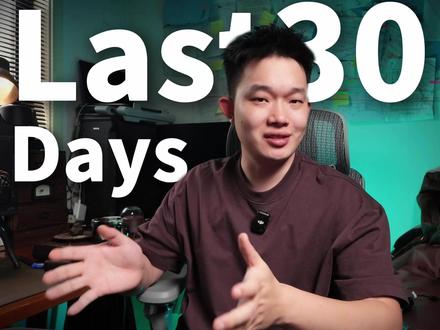
- Readable text (large text overlaid above/left of the foreground person):
- Large white text arranged in three lines, visually readable letters: "Las't30 Days"
- There is no obvious space between "Las't" and "30" (the text may be "Last 30 Days", but the image shows an apostrophe-like mark; see “Uncertain/blurred” below).
- Interface steps: no obvious interface buttons, menus, or step indicators visible (no typical software UI elements seen).
- Charts/data: no charts or numeric data visible.
- Observable objects and phenomena (objective description):
- The frame centers on a young person seated in a chair, shown from the waist up, facing the camera with hands gesturing in front.
- The subject wears a clip-on lavalier microphone attached at the center of the shirt.
- The subject wears a dark (approx. coffee or dark brown) short-sleeve shirt.
- The background is an indoor scene with a dominant turquoise/teal lighting or wall light effect.
- On the left of the background is a desk or shelf with camera or lens equipment, a gear case, and other small items (details blurred).
- The chair’s back appears to be mesh or perforated.
- The light source comes from the subject's left (more shadow on the right side of the frame); overall lighting is soft/key-lit.
- Composition resembles a common video thumbnail: large overlaid text and a centered/slightly right-aligned person.
- On the right side of the frame there is a dark cushion or folded fabric; in the upper-left corner there are dark horizontal blind or curtain details.
Inferences (marked as inference, not as fact):
- The frame may be a video cover/thumbnail because of the overlaid large text and the person facing the camera, which is typical of thumbnails (inference).
- The turquoise background may be a lighting effect rather than the wall's inherent color (inference).
- The items on the desk may be photo/recording equipment (inference).
Uncertain or not identifiable items (clearly marked as blurred/illegible):
- It is uncertain whether the exact text is "Last 30 Days" (common phrase) or the shown "Las't30 Days" (with an apostrophe and no space); the apostrophe-like mark might be a typographic effect or an artifact from compression/cropping.
- Specific models or brands of desk items cannot be identified (blurred or insufficient resolution to read labels).
- The brand/model of the lavalier microphone cannot be identified.
- The identity of the person (name or other personally identifiable information) cannot be identified and is not determined.
I have recorded visible text and phenomena in the image, separated facts and inferences, and marked blurred or unreadable parts.
SkillPI Creation Analysis
Use / Purpose:
The video's title claims that in the AI era a single “skill” can break an information bubble. The provided material is a thumbnail-like image and a short title; it can serve as promotional content or a conversation starter about diversifying information sources, but it does not provide concrete, reproducible instructions or the name of any specific skill or tool. The material is therefore useful as an idea prompt or lesson introduction but not as a step-by-step tutorial.
Image evidence and what it supports:
- The visible overlaid large text (possibly reading “Last 30 Days”) and the framed presenter support the interpretation that this is a video thumbnail, not a methodological breakdown. The image contains no operational details (no commands, UI flows, or explicit procedural text).
- Visible recording equipment and a lavalier mic suggest the creator produces explanatory video content; this is a contextual clue but does not validate any technical claims made in the title.
Related Skill — usage steps (to be verified / example workflow):
Note: the source does not provide the specific skill name or details. If the goal is to use an AI skill to reduce effects of an information bubble, a typical, verifiable high-level workflow might include:
1) Define the target bubble type: identify whether the bubble arises from recommendation algorithms, search bias, social network clustering, or other causes.
2) Identify and list multiple data sources: RSS feeds, diverse news outlets, academic databases, different social communities, regional media, etc.
3) Choose an AI skill or tool category: e.g., multi-source retrieval, retrieval-augmented generation (RAG), clustering/topic modeling, or advanced prompt templates. The actual tool name must come from the author and be verified.
4) Design prompts/retrieval templates to solicit diverse perspectives (explicitly request outputs from different political/ideological leanings, geographic regions, or publication types).
5) Aggregate and evaluate: compare outputs, perform topic alignment, and run fact-checks or credibility assessments; include human review for reliability.
6) Iterate on sources, prompts and aggregation rules based on evaluation metrics.
These steps are illustrative and require the author's specific skill/tool, prompts, and data sources to reproduce the claimed effect.
Prerequisites for reproduction (example requirements):
- Knowledge of the exact skill name and the platform or API used (some skills may be paid or proprietary).
- Access to the listed data sources (which may require API keys, subscriptions, or scraping permissions).
- Capabilities to run prompts, call APIs, or execute retrieval and aggregation workflows (scripting, a runtime environment, or an orchestration platform).
- Resources for manual verification or evaluation of outputs (to assess accuracy and diversity).
Items to verify before attempting reproduction:
- The specific “skill” referred to in the video: name, provider, availability and cost.
- Whether the author provides sample prompts, templates or configuration files; if so, obtain the originals for faithful reproduction.
- The exact list of data sources and how they are accessed.
- Any evaluation evidence the author presents to substantiate the claim (test cases, before/after examples, or metrics).
- Legal or platform constraints for accessing or reusing the proposed data sources.
Conclusion:
The material is suitable as a topic prompt or marketing hook but lacks technical details needed to reproduce the claimed method. To implement or evaluate the claim, obtain the concrete skill/tool name, sample prompts and data-source list from the author and prepare the technical environment and verification plan outlined above.