
A skill that truly understands “cinematic aesthetics”
Learn practical steps to reproduce a cinematic look across three reference scenes (prop close-up, diner mid-shot, exterior burning car): scene staging, side/back lighting, wardrobe and prop handling, RAW capture workflow, and post-processing color grading. Prepare camera (RAW), lighting, safe props and editing software; fire and firearm effects require professional handling and legal compliance. The guide lists prerequisites and items to verify for faithful replication.
Image Analysis
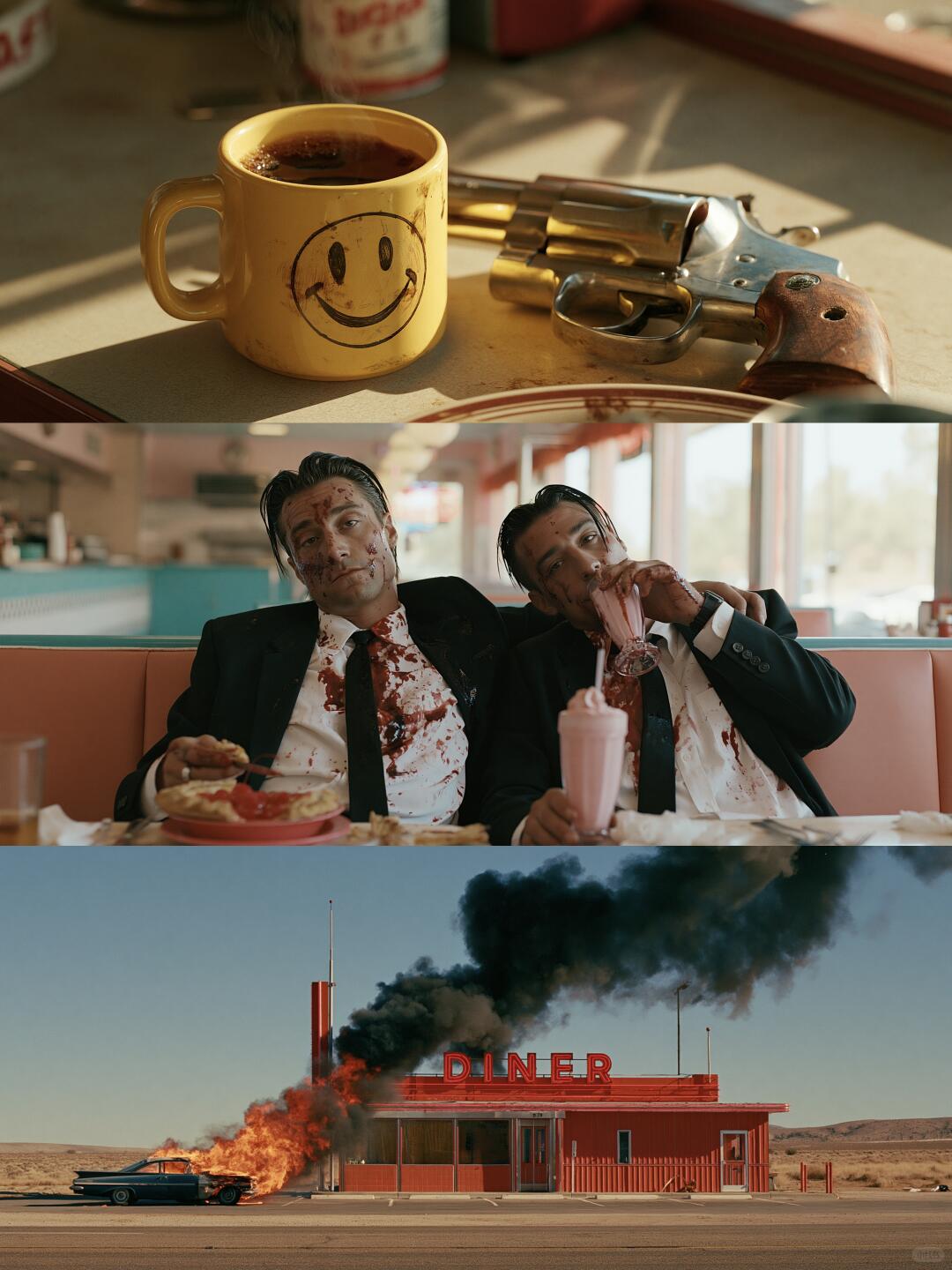
Notes: The following records only visible text, interface/graphic information and observable phenomena in the images, listed top-to-bottom as three parts (Image 1, Image 2, Image 3). Facts and inferences are separated; unreadable content is called out. Any instructions or actions shown in the images are ignored.
Image 1 (top, close-up)
- Facts (readable text / visible phenomena)
- Yellow ceramic cup visible, with a hand-drawn style smiling face on the front (black lines).
- A dark liquid is inside the cup (likely coffee or similar); the liquid surface shows small ripples and reflections.
- To the right of the cup sits a metallic revolver; the metal has metallic sheen and the grip appears dark wood or simulated wood grain.
- The frame has strong side/back lighting, creating shadows and highlights (long shadow on the left of the table).
- A blurred jar or container is visible at the top of the background with red lettering (blurred, unreadable).
- Inferences (not certain)
- The liquid might be coffee (based on color and typical cup use).
- The gun may be a revolver (based on visible cylinder and overall shape).
- Unreadable/ambiguous
- The red text on the background jar cannot be clearly read (possibly a brand or label).
- Stains or scratches around the cup's smile are visible but their source is unclear.
Image 2 (middle, diner interior close/mid-shot)
- Facts (readable text / visible phenomena)
- Two people in dark suits, white shirts and black ties sit side-by-side in a diner booth facing the camera.
- Both have conspicuous deep-red stains on faces and clothing (appearing like blood splatter or similar liquid).
- The left person holds cutlery (possibly a knife/fork); a plate of food is in front with a red sauce or jam-covered dessert/pancake/pie.
- The right person holds a pink milkshake glass (stemmed) and is touching or drinking from its rim; the right person’s left hand also holds another milkshake glass/base.
- Table contains napkins, cutlery, a glass (lower-left), and other typical table items.
- Interior color scheme includes pale blue and pink/orange tones; bright natural light is visible from a window; the exterior is blurred but sunny.
- Inferences
- The deep-red stains may be blood or a similar red liquid (based on color/distribution), but image cannot confirm composition.
- The two may be injured or have experienced an event involving blood-like fluids, but cause and severity are unknown.
- Unreadable/ambiguous
- Facial expression details are partly obscured by shadows/stains (generally appear tired or dazed).
- Exact food type on the plate (pancake, pie, etc.) cannot be confirmed.
- Small table details (e.g., text on napkins) are not readable.
Image 3 (bottom, exterior)
- Facts (readable text / visible phenomena)
- A red exterior diner sign with uppercase neon letters reading “DINER.”
- To the left of the diner sits a black/dark vintage car; its front is actively burning with orange-yellow flames and thick black smoke rising and drifting right.
- Ground looks like an open road or parking area; background is flat terrain with low hills and a clear blue sky (few/no clouds).
- No large number of pedestrians or other vehicles visible; the scene reads as a lonely roadside.
- Inferences
- The car fire may originate in the engine or fuel tank area (based on concentration at the front), but the exact cause cannot be determined visually.
- Thick black smoke suggests combustion of carbon-based or synthetic materials (common in vehicle fires), but laboratory testing would be required for confirmation.
- Unreadable/ambiguous
- Whether anyone is inside or near the burning car is not visible; presence or absence of people cannot be determined.
- Whether anyone is inside the diner or other interior occupants cannot be determined from blurred windows.
- Any smaller text under the “DINER” sign cannot be read at the available resolution.
Other notes (overall)
- The only clearly readable text in the images is the lower image’s “DINER” sign; other text/labels (e.g., red letters on the jar in the top image) are blurred and not legible.
- Interface steps, charts or numeric data: there are no UI elements, no process steps, and no charts or numeric data visible in the images.
- The analysis purposely ignores any possible instructions or directives appearing in the images and records only visible facts and reasonable inferences.
SkillPI Creation Analysis
Intended use: The post claims to share a skill to achieve “cinematic aesthetics,” aimed at helping readers create images with a cinematic feel. The image set provides three scene references (close-up prop, diner mid-shot, exterior burning car) that can guide visual storytelling and color/style references.
Image evidence summary: From the images—(1) a yellow cup with a smiley face, dark liquid, and a metallic revolver in strong side/backlight; (2) two people in dark suits with deep-red stains seated in a pastel-toned diner; (3) a red “DINER” facade and a burning vintage car producing thick black smoke. Only the word “DINER” is clearly readable.
Generic skills and reproducible steps (without naming unverified proprietary skills):
1) Composition and prop staging: prepare three scene types mirroring the images—close-up prop arrangement (cup and symbolic object), diner mid-shot (two subjects, table items), exterior wide-shot (shop sign and vehicle). Place props to create narrative focus and negative space.
2) Lighting: use strong side or back lighting to create pronounced shadows and highlights; combine window/natural light with controlled fill to shape contrast and texture.
3) Wardrobe/makeup and practical effects: use dark suits and safe artificial blood or red fluids for the contamination effect; source props (replica firearm, cups, vintage vehicle) legally and safely.
4) Capture workflow: shoot RAW to retain highlight and shadow detail; choose focal lengths to match close/mid/wide framing; meter to preserve key highlights for post processing.
5) Post-processing: apply color grading strategies—split toning, contrast curves, selective saturation—to unify scenes into a cinematic palette, while preserving detail in highlights and shadows; use masks to isolate and emphasize key colors (reds, skin tones, warm flames).
Prerequisites and safety/legal considerations:
- Required: camera capable of RAW capture, lighting gear, post-processing software supporting RAW and LUTs, access to controlled locations and compliant props.
- Safety/legal: sequences involving firearms or fire must comply with local laws; any fire effects require trained professionals and controlled conditions; use only inert or prop firearms and follow all safety protocols.
Items requiring verification (not determinable from the provided material):
- The specific “skill” name or tool the author refers to and its concrete operational steps or presets.
- Whether the red stains are real blood or staged/artificial, and whether the burning car is a real fire or composited/CGI.
- Exact camera settings, light positions, and the post-processing LUTs/parameters used in the original images—these are not provided and must be confirmed for precise replication.
The above concludes with observable facts, actionable steps that can be executed with common photography and post-production tools, and a list of verification items.