
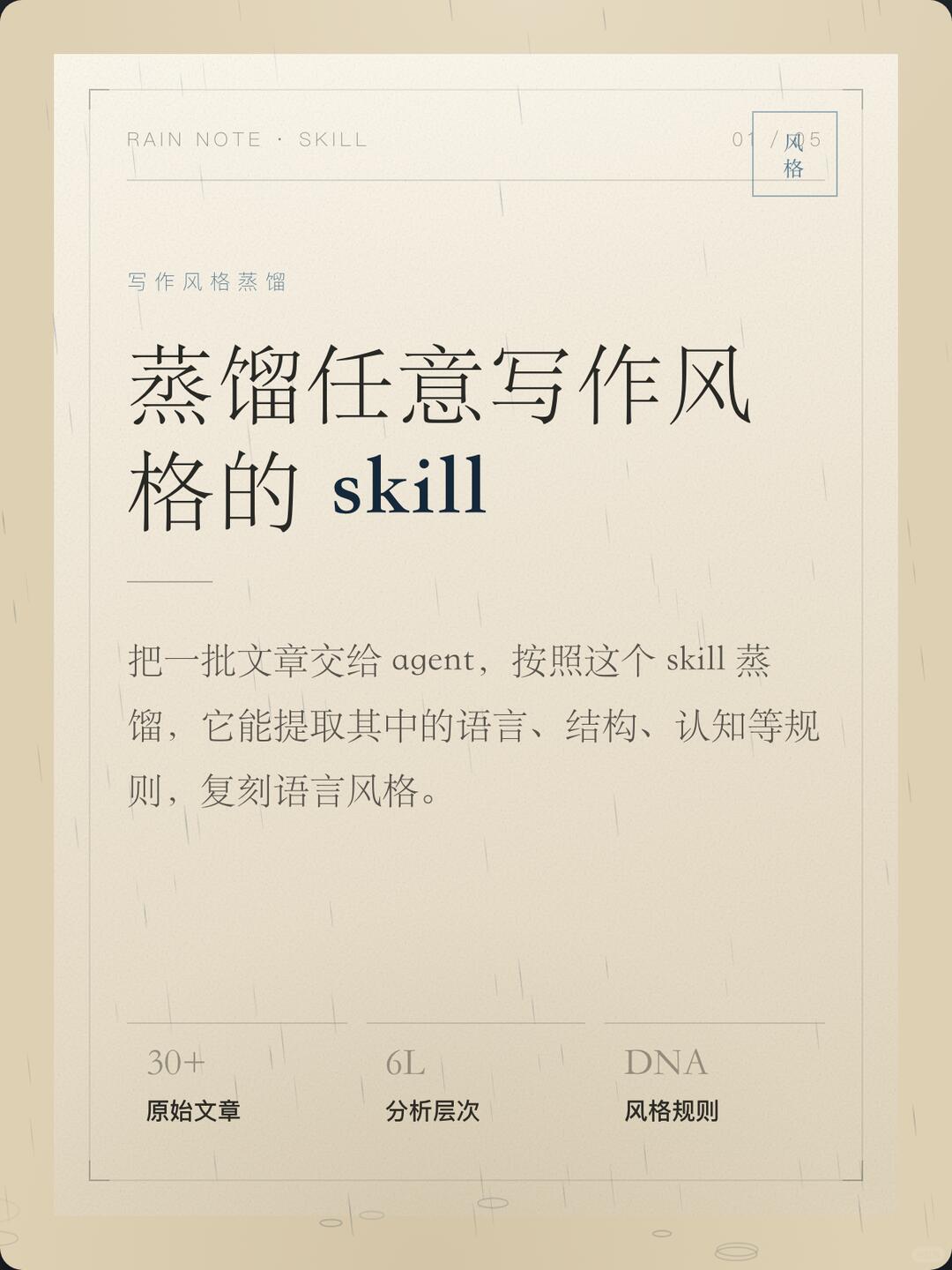
This skill can replicate any writing style
Step-by-step guide to prepare a sample corpus (20+ articles), use an agent-driven distillation skill to extract a writer's Language-DNA and templates, and obtain deliverables like Language-DNA.md, article-structure-template.md and visual-style-guide.md. Includes a note to verify copyright and implementation details.
Image Analysis
Slide 1 — Image evidence summary
1) Facts (directly readable text, UI elements, and visible phenomena)
- Top-left of the page (English): RAIN NOTE · SKILL
- Top-right of the page inside a box: 01 / 05 (there is also the word “风格”/“style” near or inside the box)
- Subheading (left, above main title): 写作风格蒸馏 (Writing style distillation)
- Main title (large, centered): 蒸馏任意写作风格的 skill (A skill to distill any writing style)
- “skill” is in Latin letters (mixed with Chinese, in dark blue or dark color)
- Body paragraph (below the main title):
- "Give a batch of articles to an agent and distill them using this skill; it can extract the language, structure, cognitive rules, etc., to replicate the language style."
- The words “agent” and “skill” are in Latin letters mixed with Chinese
- Footer has three columns (left to right):
- “30+” (above) / “原始文章” (original articles) (below)
- “6L” (above) / “分析层次” (analysis levels) (below)
- “DNA” (above) / “风格规则” (style rules) (below)
- Visible UI/visual elements:
- Beige paper-style background with faux-paper border lines
- Multiple vertical fine rain lines in the background (visual “rain” effect)
- Several circular water stains/droplets drawn near the bottom
- Fine horizontal lines used as layout separators (e.g., above main title and footer)
2) Unclear or ambiguous items (explicitly noted where not fully legible)
- The boxed top-right text reads approximately “01 / 05”; spacing and slash may differ slightly (readable but slightly blurred)
- Footer middle top shows “6L”; the character “L” might be uppercase L (not 1 or lowercase l), visually similar to uppercase L (noted as likely “6L”)
- The exact placement of the word “风格” relative to the box at the top is uncertain due to scaling/shadow
3) Inferences (reasonable deductions from image content, not directly readable text)
- “01 / 05” likely indicates page 1 of 5 (common pagination)
- The page appears to be a product/feature card describing a “writing style distillation/replication” skill
- “30+ 原始文章” likely indicates the sample article count used for distillation is at least 30
- “6L 分析层次” likely means analysis is performed at 6 levels (L may represent levels)
- “DNA 风格规则” could be a label or module name for extracted style rules
4) Items ignored
SkillPI Creation Analysis
Use cases:
- The material documents a skill/concept for "writing style distillation/replication." Intended users are those who want to extract a target author/account's linguistic and structural features into reusable artifacts (templates, style rules, visual guidelines).
Key image evidence (from image_text):
- Headings explicitly reference “writing style distillation” and a “skill” to distill any writing style; the page label reads “RAIN NOTE · SKILL.”
- Footer items show “30+ original articles,” “6L analysis levels,” and “DNA style rules,” implying the product describes sample quantity, analysis levels, and output modules.
- The design uses a beige paper background with rain and water-stain visuals, indicating a designed product/feature card.
Steps to use the associated skill (based on the source summary and image description, limited to what the source states):
1) Prepare corpus: provide or have an agent fetch 20+ articles (the summary specifies “20+”; the image shows “30+ original articles”).
2) Trigger distillation: have an agent run the skill's distillation flow on the corpus (the source claims distillation can take ~10 minutes; the overall workflow is suggested to fit within ~30 minutes).
3) Retrieve artifacts: the distillation produces files such as “Language-DNA.md”, “article-structure-template.md”, “writing-perspective-and-cognitive-framework.md”, “visual-style-guide.md”, and “Writing-DNA.md”.
4) Pre-write step: before each writing task, have the agent reread the distillation artifacts and then write in the targeted style to reduce obvious “AI-ness.”
Prerequisites and verifiable conditions:
- Access to the target author's or account's sample texts (the source specifies 20+ samples; the image suggests 30+).
- An agent capable of fetching and processing the corpus as described.
- Access to or implementation of the referred “skill” that performs the distillation (the source mentions methods like corpus annotation, script analysis, and deep reading).
- The expected output file formats (the .md filenames noted) are deliverables that can be inspected.
Items requiring verification (not asserted by current materials):
- Exact skill name, repository, or installation/source URL (the summary is descriptive; no concrete repository or download link is provided).
- Implementation details of the distillation pipeline: how “corpus annotation,” “script analysis,” and “deep reading” are implemented (models, tools, parameters) are not specified.
- Reproducibility of the stated timings (“10 minutes” distillation, “within half an hour” full process) depends on data size and compute and must be validated in practice.
- The recommended minimum sample size: the summary says “20+,” but the image shows “30+”; the correct recommended count should be confirmed.
- The meaning of “6L analysis levels” and what each level produces needs clarification.
Compliance and risk note:
- The source explicitly advises paying attention to copyright boundaries. Using others' texts for training or distillation requires checking licensing and rights.
Conclusion (what can be delivered based on available material):
- Following the described workflow—collecting samples, running an agent-driven distillation, and producing the listed .md artifacts—appears feasible in principle. However, the concrete code, tools, parameters, timing, and precise sample-count recommendations are not provided here and must be obtained from the original project artifacts or documentation before attempting replication.