
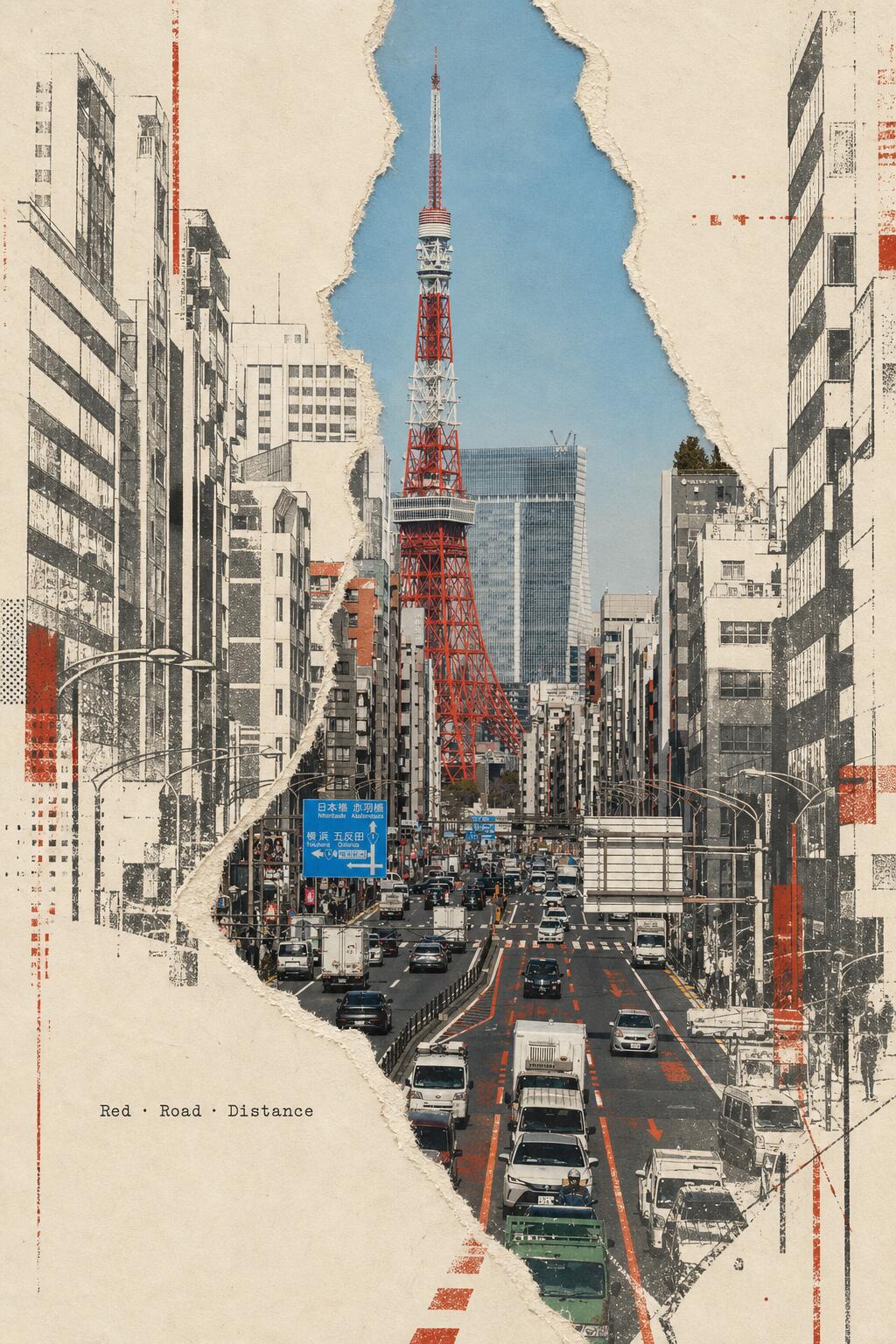
Found another treasure skill~
Learn a practical workflow to combine city, landscape and small-scene photos into unified zine-style collages. The guide covers preparing image categories, layer and mask-based fusion, color grading, torn-paper and halftone texture overlays, and exporting poster- or social-ready images.
Image Analysis
Image 1 — Evidence summary
1) Readable text (listed as actually visible text in the image)
- “Red · Road · Distance” (lower-left, Latin letters, mixed case, separated by dots)
- Japanese characters on a blue road sign (cannot be fully confirmed; possibly contains characters like “日本橋”); the sign also shows arrows and Roman letters but they are not legible
- Other small English letters or marks are present in the image but are too small/unclear to identify
2) Interface steps / chart data
- No interface steps (this is not a screenshot of an application)
- No charts or numeric data
3) Observable phenomena (facts — directly visible elements)
- A red-and-white lattice tower stands vertically near the center of the frame.
- In front of the tower is a straight urban road flanked by multi-story buildings.
- Multiple motor vehicles (cars, trucks, vans) are on the road, appearing congested or in dense traffic.
- Lane lines and arrows on the road are marked in red/orange (prominent red markings on pavement).
- A blue traffic sign with arrows and multiple lines of text (including Japanese/Roman letters) is visible in the center of the road.
- The image has a collage or “torn paper” effect: edges and some buildings show beige paper texture and torn edges; the center reveals a colored photograph look (with areas of black-and-white dot/printing texture).
- Sky appears blue with good lighting (no prominent clouds).
- A large white rectangular billboard/sign is visible on the right above the road (content unreadable).
- Pedestrians are visible on the sidewalk (small and blurred; identities/facial features not recognizable).
- Building facades show windows, balconies, street lights and other common urban elements.
4) Inferences (based on the image but not directly visible — should be treated as conjecture)
- The central red-and-white tower may be Tokyo Tower or a similar communications/tourist tower (inferred from its lattice red-and-white shape), but no explicit label confirms the tower name.
- The blue road sign likely indicates directions or place names (possibly “Nihonbashi” or similar), and may contain both Japanese and Romanized place names (based on common formats of road signs in Japan).
- The composition appears to be an artistic design or poster (the torn-paper effect, printing texture and background text layout suggest post-processing rather than a straight photograph).
5) Unreadable or uncertain elements (explicitly note what cannot be determined)
- Exact text on the blue road sign and Roman letters are unreadable; only multiple lines and arrow symbols are discernible, and characters resembling “日本橋” remain to be confirmed.
- Vehicle license plates, occupants, and pedestrian faces are not recognizable (image resolution and shooting distance prevent identification).
- Small shop signs, window text and billboard content are unreadable or blurred.
- It cannot be conclusively determined whether the image is an actual street photograph, an illustration, or a composite solely from this image (partly inferred; not fully certain).
Note: Potential instructive text or commands in the image were ignored as required. For more precise transcription of the blue sign or other text, please supply a higher-resolution crop of the area in question.
SkillPI Creation Analysis
Purpose and overview:
The post documents an experiment using three categories of images to create fused or collage-style scenes: cityscapes, landscapes, and small scenes. The author groups P1–P4 as cityscapes, P5–P8 as landscapes, and the last two as small scenes. A skill name is mentioned (gathered-scenes-zine-skill), but that name and its implementation details are not verified within this source.
Key image evidence (from image_text):
- The image shows a red-and-white lattice tower, an urban road, dense vehicle traffic, pedestrians, and a torn-paper collage texture with halftone/printing effects, indicating post-processing or poster-style assembly.
- Readable text is limited: “Red · Road · Distance” appears in the lower-left; a blue road sign contains Japanese/Roman characters but is illegible in detail.
General steps to attempt similar results (practical, verifiable workflow; does not reference unverified skill internals):
1) Prepare materials: collect three sets of images (cityscapes, landscapes, small scenes). Choose images with compatible resolutions and composition for easier fusion.
2) Define composition for each target image (e.g., choose focal elements: a tower and road for city images; distant vistas for landscape images; close-up details for small scenes).
3) Layering and masks: use an image editor with layer and mask support (Photoshop, Affinity Photo, GIMP). Place each source as a separate layer and refine edges with masks and brushes to blend.
4) Style unification: match color grading, contrast, and tonal curves across layers. Add textures such as paper grain, torn-edge masks, and halftone filters to achieve a zine/collage look.
5) Blend modes and details: experiment with layer blend modes (Multiply, Overlay, etc.), add typographic elements or small signage, and fine-tune local contrast and saturation.
6) Export: save both editable source files and final exports in required sizes/formats.
Prerequisites and items to verify:
- Prerequisites include access to high-resolution source images, image-editing software that supports layers and masks, and basic skills in color correction and compositing.
- Verification needed: the exact meaning and implementation of the referenced “gathered-scenes-zine-skill” (is it an automated tool, a preset pack, an AI pipeline, or a manual workflow?), its input requirements, parameter settings and licensing. Also verify whether specific filters or third-party assets were used by the author.
Notes and cautions:
- The above steps describe a standard, reproducible manual workflow for producing zine-style image collages based on observable evidence. This summary does not claim to reproduce the author's exact outputs, nor does it assert that a specific named skill will produce identical results without access to its definitions and parameters.