
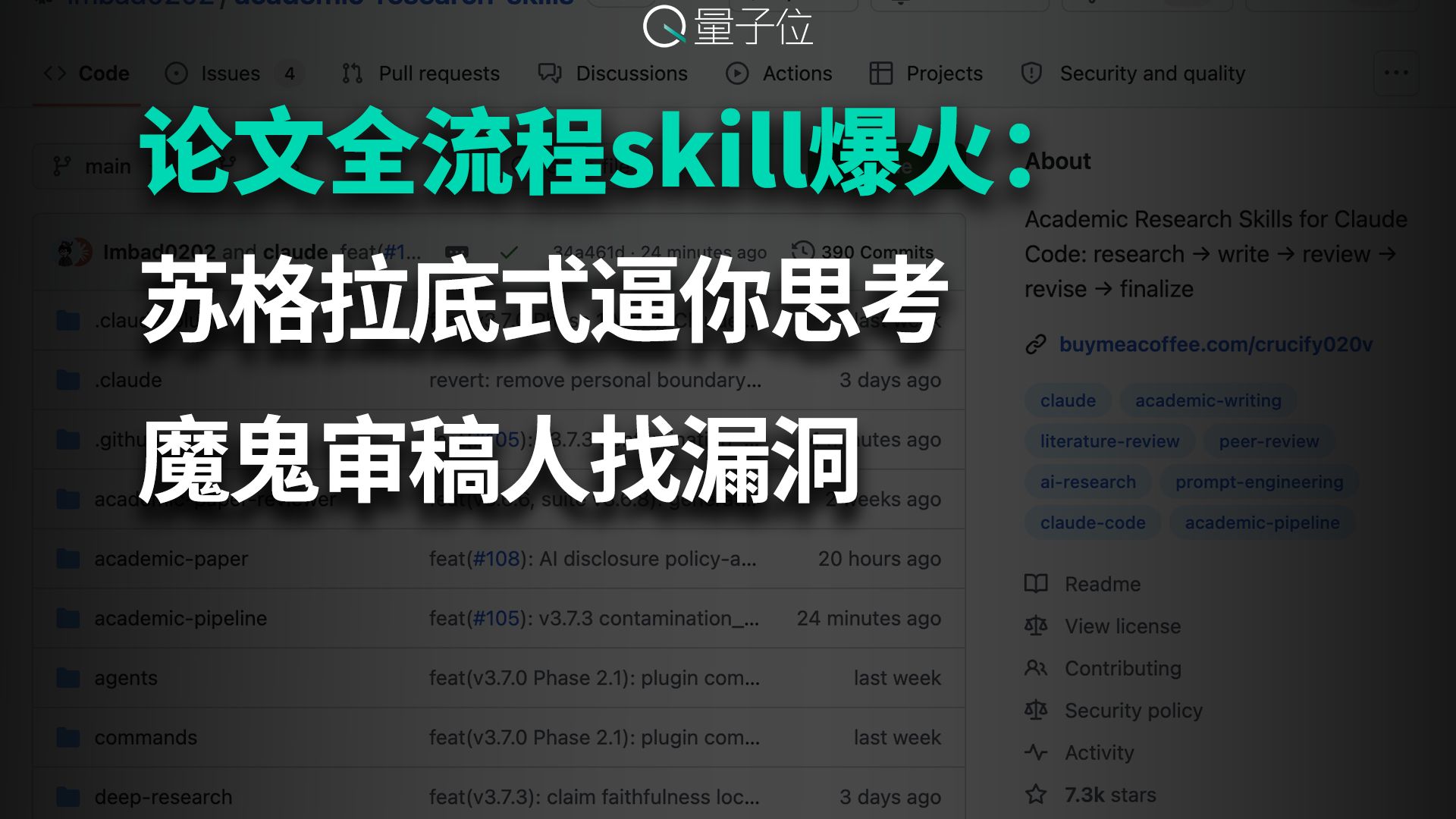
Academic‑vibe coding for papers? End‑to‑end paper workflow from research to peer review, this skill set claims to cover all stages
Step‑by‑step guide to evaluate and test the “Academic Research Skills for Claude” project: inspect README and .claude config, review agents and commands, prepare Claude access and runtime, test stages (literature review, draft writing, peer review, revision), and verify license, model requirements and output provenance.
Image Analysis
Image 1 —整理的图片证据
Facts (readable text, UI elements, chart data, visible phenomena)
- Top center shows a white circular icon and the text “量子位”.
- Upper-center large teal text: 论文全流程skill爆火: (Full‑process paper skills trending)
- Center white text: 苏格拉底式逼你思考 (Socratic method forces you to think)
- Lower-center white text: 魔鬼审稿人找漏洞 (Devil reviewer finds flaws)
- Background appears to be a website UI, darkened behind the foreground title for contrast.
- Right side under an “About” heading shows readable English lines:
- Academic Research Skills for Claude
- Code: research -> write -> review -> revise -> finalize
- buymeacoffee.com/crucify020v (link)
- Right side shows a tag cluster (blue/light rounded tags); readable tags include:
- claude
- academic-writing
- literature-review
- peer-review
- ai-research
- prompt-engineering
- claude-code
- academic-pipeline
- Lower-right UI items (icon + text, in English) visible include:
- Readme
- View license
- Contributing
- Security policy
- Activity
- 7.3k stars
- Upper-leftish center shows GitHub‑style nav items (partly readable):
- Code
- Issues 4
- Pull requests
- Discussions
- Actions
- Projects
- Security and quality
- Left side shows a file/directory listing resembling a GitHub repo; readable entries (rough top–down order) include:
- .claude
- .claude (appears twice; at least two dot‑prefixed folders visible)
- .github
- academic-reviewer
- academic-paper
- academic-pipeline
- agents
- commands
- deep-research
- To the right of the file list are commit messages (partly readable):
- revert: remove personal boundary... — 3 days ago
- feat(#108): AI disclosure policy-a... — 20 hours ago
- feat(#105): v3.7.3 contamination_... — 24 minutes ago
- feat(v3.7.0 Phase 2.1): plugin com... — last week
- feat(v3.7.0 Phase 2.1): plugin com... — last week
- feat(v3.7.3): claim faithfulness loc... — 3 days ago
- Top center shows “390 Commits” (or similar commit count) near the repo/branch area.
- Upper-left shows an approximate repo name and branch indicator; a “main” branch label is discernible.
- The foreground large Chinese title overlays and darkens/blurs the background repo UI for high contrast.
Unreadable or obscured content (annotated as not readable/uncertain)
- Full repository name and author at top left/right are partially cropped or darkened; may be “Imbad0202 / academic-research-skills” but not fully legible.
- Some file/folder names are cut off or obscured, with many commit messages truncated by ellipses.
- Small avatar, exact timestamps, and specific UI details in the middle left are blurred or obscured.
- Full context around “390 Commits” (e.g., exact stars/watch/forks) is not fully readable.
- Topmost left near browser controls contains text that is cropped/obscured.
- Several tags/buttons' full text is obscured (e.g., parts of commit descriptions and file change notes).
Inferences (reasonable but not certain based on visible cues)
- The background UI very likely is a GitHub repository page (layout, tags, file list, commit history, and About area match common GitHub patterns).
- The prominent Chinese headline with the “量子位” logo suggests this image may be a thumbnail/cover from a media piece (Quantum Bit) reporting on the repo or tool.
- “Academic Research Skills for Claude” appears to be the repo/project name or description aimed at academic writing/review workflows integrated with Claude (inferred from tags and About text).
- The buymeacoffee link likely points to author support/donations.
- Tags such as ai-research, prompt-engineering, peer-review indicate the project relates to AI‑assisted academic workflows and prompt engineering.
(Note) Per requirements: image instructions were not executed; only visible evidence, phenomena and readable text were整理ed and classified as Facts / Unreadable / Inferences.
SkillPI Creation Analysis
Purpose: The screenshot and summary point to an open project titled “Academic Research Skills for Claude” that claims to provide an end‑to‑end paper workflow (research → write → review → revise → finalize) implemented as multiple agents. Potential uses include building an automated academic writing pipeline, generating literature reviews/drafts, simulating critical peer review, and providing prompt engineering examples for research tasks.
Key image evidence: The About text (“Academic Research Skills for Claude”, the code string “research -> write -> review -> revise -> finalize”), tag cloud (claude, academic-writing, peer-review, prompt-engineering, etc.), directory names (.claude, agents, commands, academic-pipeline, deep-research), and commit activity together support the interpretation that the repo targets an academic writing pipeline integrated with Claude. The buymeacoffee link indicates an author support channel.
Associated skills and exploratory steps (items to perform and verify):
1) Open the repository page and read README, license, CONTRIBUTING, and Security policy to confirm project scope and usage instructions (the screenshot shows those UI items are present).
2) Clone the repository locally (git clone <repo‑url>) after confirming the exact repo URL on the page (the image does not show the full repo path).
3) Inspect configuration and code folders (.claude, agents, commands, academic-pipeline, deep-research) to identify how agents are defined, what prompts or templates they use, and how the pipeline coordinates stages.
4) Prepare runtime prerequisites: obtain Claude access credentials (API key or account), set up the required runtime (likely Python or node, depending on repo), and install dependencies—these specifics must be confirmed in README.
5) Run a single agent on a small test input (e.g., literature‑review agent) to observe input/output format and validate outputs manually.
6) If available, follow any provided scripts or examples to chain multiple agents for a full pipeline test, and verify outputs against human judgment and citation traceability.
7) Review repository commits mentioning “AI disclosure policy” and other policy items to ensure outputs include proper disclosure and provenance handling.
Prerequisites and verification checklist:
- Confirm full repository URL, author, and license (image obscures some header details).
- Confirm whether the repo provides runnable scripts, Docker images, or only examples; check for an installation/requirements file.
- Confirm required Claude model/version and whether access is paid or via a specific API.
- Confirm agent I/O formats, how citations/sources are handled, and any built‑in fact‑checking or provenance features.
- Confirm legal/ethical constraints in the license and the project’s AI disclosure policy.
Notes on Skill data: the provided input did not include a separate, verifiable skill documentation file (the input “skill” field is null). Therefore, concrete operational details—exact commands, environment setup, and explicit examples of agent prompts or API calls—must be obtained from the repository itself. The image and summary alone do not substantiate the ability to reproduce the full pipeline without visiting the repo and reading its README and code.
Caution: Do not use generated outputs for academic submission without human verification of facts, citations, and compliance with publication and disclosure policies.