
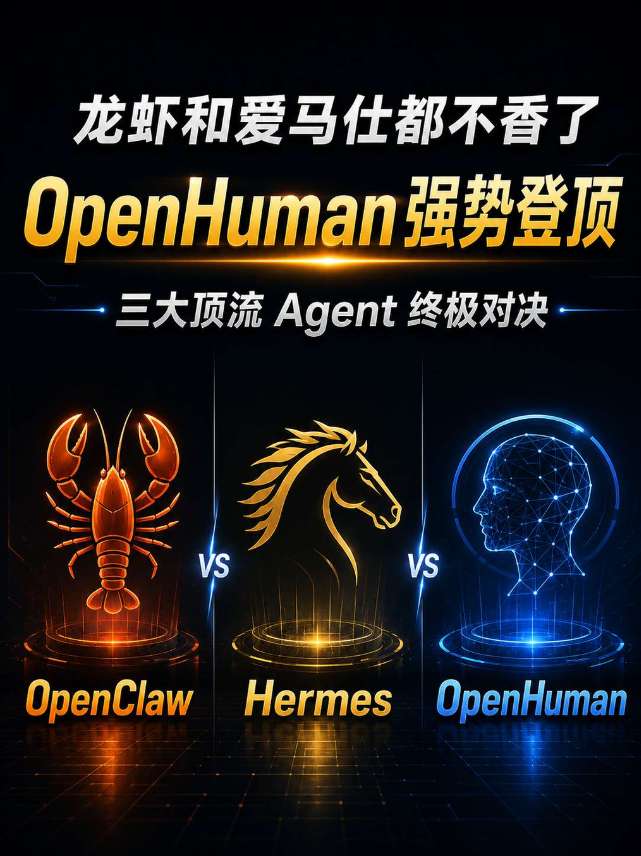
Lobsters and Hermes Lose Appeal — OpenHuman Tops the Chart; AI Scene Embraces “Raising People”! OpenHuman Leads in Three-Top-Agent Showdown.
Step-by-step method to use image analysis and OCR to identify readable text, list direct facts, mark unreadable microtext, and produce a structured visual evidence list and verification checklist for an AI agent comparison poster. Deliverables: facts list, unreadable items, inferences with rationale, and items to verify.
Image Analysis
Organize the image (Image 1) as requested.
SkillPI Creation Analysis
Intended use of the image:
- The image functions as a promotional/comparative poster emphasizing that “OpenHuman” is leading among three highlighted “Agents.” Its design is suited for social media thumbnails, short-video covers, or promotional banners.
Key visual evidence (from the facts list):
- Extractable evidence: main headlines, three-column iconography with English labels (OpenClaw, Hermes, OpenHuman), ‘VS’ connectors, dominant color scheme, glow/light effects, and absence of clearly readable credits or timestamps.
- Evidence that cannot be confirmed without higher-resolution source: tiny copyright lines, QR codes, or small-footnote text.
Related skills and practical steps (actions you can perform to reproduce the analysis):
1. Obtain the highest-resolution original image available (higher resolution helps recover small text and details).
2. Perform a manual visual inspection to record large and medium-size text, iconography, color schemes, and layout (create a facts list).
3. Use OCR tools to attempt reading small or medium-sized text; manually verify OCR outputs for accuracy.
4. Classify extracted items into: Facts (directly visible), Unreadable (requires original/higher-res or metadata), and Inferences (reasonable contextual interpretations). For each inference, state the supporting visual cues.
5. Produce a visual evidence list that includes: screenshot coordinates or crop references, transcribed text, color and icon descriptions, and a verification checklist of items needing source confirmation.
6. To validate authorship or claims, search for the original posting page or contact the content publisher for metadata and context.
Reproduction prerequisites:
- Access to the original or a higher-resolution image, an OCR-capable tool or manual reading ability, and a method for recording element coordinates or crops (for evidence traceability).
Items to verify (cannot be concluded from this image alone):
- The image’s original source, publication date, and author or copyright attribution (not visible in current image).
- What the labels OpenClaw, Hermes, and OpenHuman specifically refer to (products, agent software, brands, or metaphors)—the image labels them “Agents” but gives no definition.
- Any tiny text or logos in image corners or bottoms that may alter interpretation (requires higher-res/original file).
Notes:
- This analysis is limited to observable visual elements and reasonable inferences from them. It does not assert external facts about the named entities nor claims functional verification.