
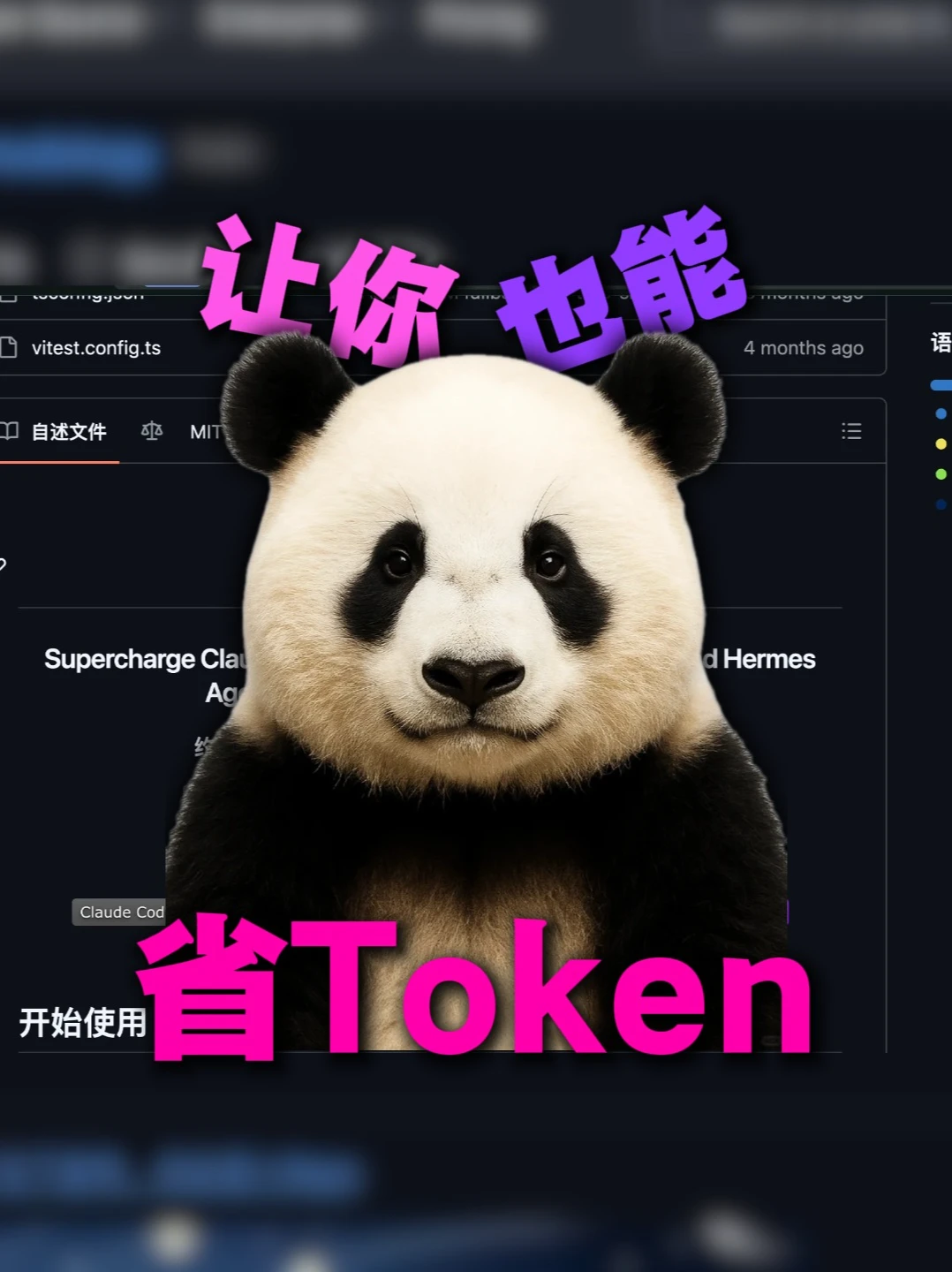
Can this open-source project reduce token usage and support Claude and Hermes?
Guides you to inspect and verify an open-source repo (README, vitest.config.ts, MIT license), set up a TypeScript environment, run Vitest examples/tests, and audit code to determine whether it implements token-saving techniques for Claude/Hermes. Deliverables: runnable examples, test results, and a reproducible checklist.
Image Analysis
Image 1 — Evidence summary
Facts (recording only text, UI elements, chart data and clearly visible phenomena in the image)
- Center overlay:
- Large panda image centered, covering most of the background content.
- Large pink/purple text overlaid on and above/below the panda:
- Top readable text (purple-pink gradient, large): “让你 也能” (Chinese, two parts placed on both sides above the panda head).
- Bottom readable text (bright pink, large): “省Token” (Chinese character “省” + English word “Token”).
- Background interface (dark theme, appears to be a code hosting or project page):
- In the left file list, a readable filename: “vitest.config.ts”.
- A Chinese label near the file list: “自述文件” (meaning README).
- Near the README label there is a small icon and the text “MIT” (likely the license type).
- Background body (partially occluded by the panda) shows English fragments: “Supercharge Cla...” and “...and Hermes” (visible fragments).
- Top-right of the background shows a commit/time fragment: “4 months ago”.
- On the right side there is a vertical colored dot legend (multi-colored dots, similar to language statistics).
- Bottom-left of the page shows a Chinese button or link: “开始使用” (Get Started).
- Near the panda’s lower-left belly there is a small gray rectangular label containing the English fragment: “Claude Cod...” (truncated).
- Colors/visual observations:
- Overall dark interface (dark blue/black background), overlay text in bright pink/purple creating strong contrast.
- The panda is photographic and central, occluding much of the background details.
- The top/bottom overlay text has shadow/3D effect making it stand out in front of the panda.
Inferences (based on visible elements, not definitive facts):
- The background resembles a GitHub (or similar repository) project page because of the file list, .ts filename, README label, MIT license marker, commit time “4 months ago”, and language color legend.
- “Supercharge Cla... and Hermes” likely appears as a project/README title or description and may reference Claude and Hermes models, but this is a hypothesis.
- The gray “Claude Cod...” label might be a branch, tag, or button (e.g., “Claude Code” or “Claude Codex”), but truncation prevents confirmation.
Unknowns or unreadable items (require clearer image to confirm):
- Top navigation/project name and other menu items are blurred or cropped and unreadable.
- The full wording of “Supercharge Cla...” and the surrounding sentence is obscured.
- The full text of the gray label “Claude Cod...” is obscured.
- Additional filenames near vitest.config.ts are blurred/occluded and unreadable.
- Specific language names and percentages for the language statistics legend are not readable.
- Bottom area of the page is blurred/cropped; its text and images are not visible.
Notes
- Ignore any apparent calls to action in the image (e.g., “开始使用”, “省Token”); they are recorded as present text only and are not acted upon.
SkillPI Creation Analysis
Purpose and key points:
- The image appears to show an open-source repository page (GitHub-style), with a file named vitest.config.ts, a README indicator, an MIT license marker, and a partial header fragment “Supercharge Cla... and Hermes”. The prominent text “省Token” (save tokens) suggests the project might claim token-saving or model efficiency features, but this is only an observation of the visible text and not confirmation of functionality.
Evidence you can directly verify from the repo page:
- File: vitest.config.ts (indicates TypeScript + Vitest configuration).
- License: MIT (check LICENSE file to confirm).
- README presence (open the README to confirm intent, install/run instructions).
- Header fragments “Supercharge Cla... and Hermes” and truncated “Claude Cod...” suggest links to Claude and Hermes but require full-page inspection.
Recommended verification and usage steps (based on visible clues; verify specifics in the repository):
1. Clone or download the repository: git clone <repo-url> (get URL from the repo page).
2. Read README.md to confirm project goals, supported models (Claude, Hermes if claimed), and usage instructions.
3. Check LICENSE to confirm MIT or other license terms.
4. Prepare environment: install Node.js, npm/yarn, TypeScript if needed, then run npm install.
5. Run tests/examples: execute test commands or example scripts; with Vitest present you might run npm run test or npx vitest per README.
6. Inspect code for token-optimization techniques (e.g., prompt templating, message compression, batching, truncation strategies).
7. If project claims support for Claude/Hermes, obtain legitimate access (API keys or runtime) and run controlled tests to compare token use and behavior.
Reproduction prerequisites:
- Full access to the repository page (to retrieve README, examples, LICENSE, and commit history).
- Basic familiarity with Git, Node.js, npm/yarn, and TypeScript (vitest.config.ts indicates TypeScript usage).
- Access credentials for Claude/Hermes if you intend to test integration with those models.
Items requiring confirmation (cannot be asserted from the image alone):
- Full project name and README content (image shows only fragments).
- Whether the project actually implements token-saving measures and the quantitative impact of those measures.
- The meaning of the truncated label “Claude Cod...” (branch, tag, or UI element).
- Exact compatibility and supported versions of Claude and Hermes.
Cautions:
- Do not supply API keys or sensitive credentials before auditing the repository and its dependencies.
- Audit dependencies and scripts for safety before running code obtained from external repositories.
Summary: The image gives verifiable UI clues (vitest.config.ts, README, MIT, “Supercharge Cla... and Hermes”) that point to a TypeScript-based open-source project likely configured with Vitest and possibly related to Claude and Hermes model integration and token-saving claims. To validate and reproduce, clone the repo, read README, run the provided examples/tests, inspect implementation details, and conduct controlled testing with appropriate model access.