
Beginner's Hands‑On Tutorial for Distilling a Book (Save This)
Practical workflow to extract a book's core ideas and turn them into usable outputs: select sources, preview and map structure, active reading and annotation, extract claims and evidence, cluster themes, formulate principles, and produce structured notes, action lists, and flashcards. Applies to books and other high‑value materials; verify original sources for templates or tools.
Image Analysis
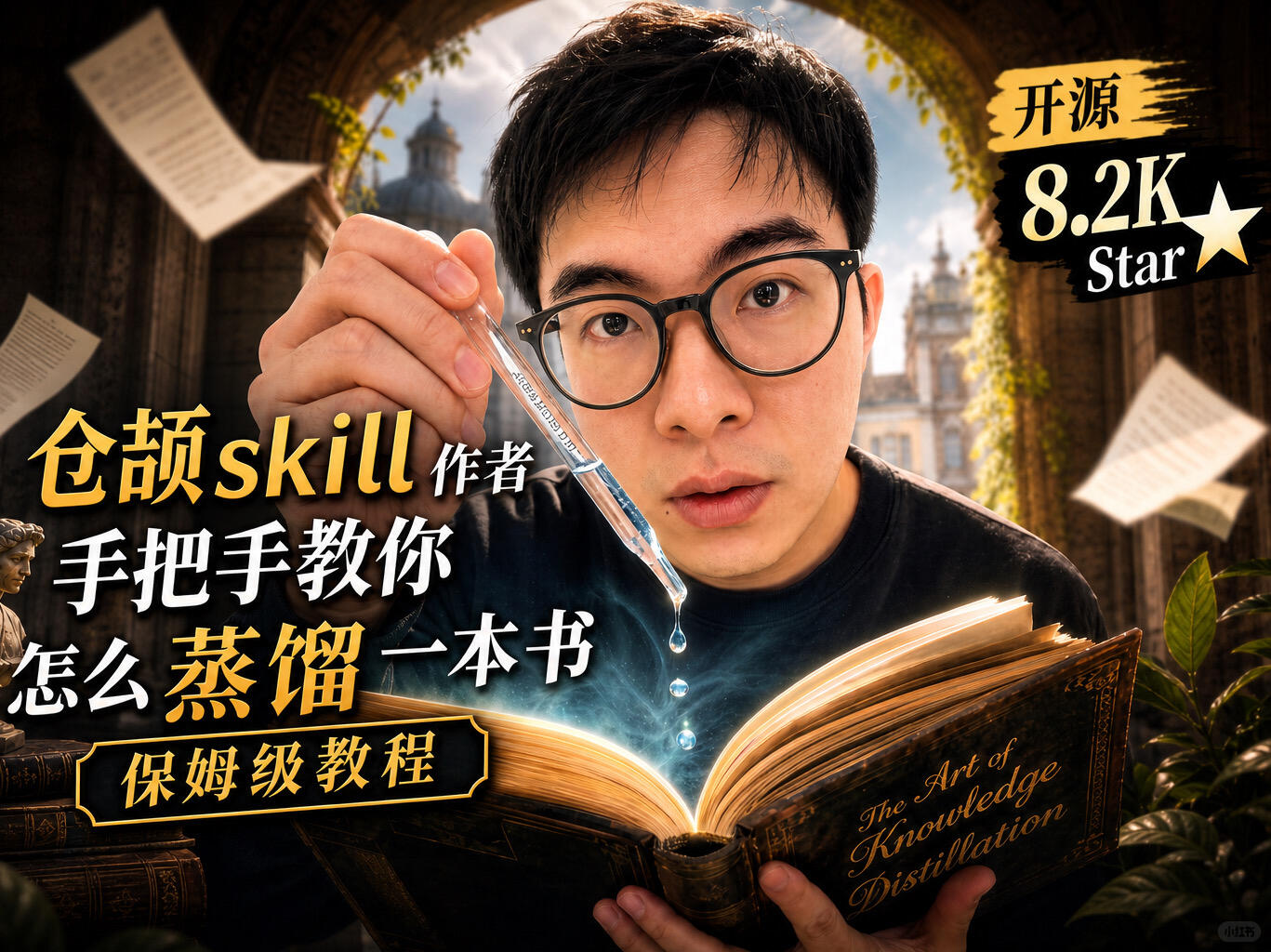
Image 1 — Organized notes (translated)
Visible facts (readable or directly observable content):
- Major readable text (verbatim, with approximate positions):
- Left large text (yellow + white mixed layout):
- “仓颉 skill 作者” ("skill" is in English after the Chinese characters “仓颉”, with “作者” positioned to the right or lower-right)
- “手把手教你” (white, upper-mid left)
- “怎么 蒸馏 一本书” ("怎么" in white, "蒸馏" in yellow with outline, "一本书" in white; overall mid-left lower)
- Gold framed bottom text:
- “保姆级教程” (gold decorative frame, lower-mid left)
- Upper-right badge area:
- Chinese at top: “开源” (yellow background, black text, upper-right)
- Number and English: “8.2K” and “Star” ("8.2K" larger with a white star icon to the right; "Star" in white)
- Lower-right open book cover readable title:
- “The Art of Knowledge Distillation” (gold script on the lower-right open book cover)
- Visible UI elements/objects (factual description):
- Close-up of a man wearing black-framed glasses looking at the camera (no identification inferred).
- The person's right hand (camera-left perspective) holds a dropper/pipette; several droplets are visible separating and falling.
- The falling liquid lands on the center of the open book at lower right; a blue glow or light effect emanates from the page.
- Background shows large arched columns/architecture and a dome or tower in the distance (classical architectural style).
- Multiple pages of paper are floating/flying in the air (left/right and upper areas contain drifting pages with small printed text that is not legible).
- Lower-left shows a statue or bust and a stack of ancient books (sculpture facing right; decorated spines visible).
- Lower-right edge shows green plant leaves.
- The overall image appears composited (person, light effects, background, flying pages and glowing book appear post-processed).
- Other visible text/logos:
- Several printed textures and decorative English on the book cover and pages (apart from “The Art of Knowledge Distillation”, other English is small or ornamental and not fully legible).
- A small circular/oval stamp or logo in the lower-right corner (very small and blurred; content unreadable).
Unreadable or uncertain contents (marked where text/ detail is blurred):
- Any inscriptions or labels on the dropper (the dropper surface may contain small text but is blurred).
- Printed text on the drifting pages (text exists but is not legible due to resolution/blur).
- Small English or Chinese on book spines or corners (other than the main cover title).
- The small circular stamp/logo in the lower-right (too blurred to identify).
- Exact layout spacing between “作者” and “skill” in “仓颉 skill 作者” (legible overall but fine layout details unclear).
Inferred (not facts; require separate verification if used for decisions):
- The image likely serves as a cover/thumbnail for a video or article about “how to distill a book” (based on title text and visual metaphor).
- The dropper applying liquid to the book with a glow likely symbolizes “knowledge purification/distillation” (visual metaphor).
- The “8.2K Star” badge may indicate community/star counts for an open‑source project or work on a code or sharing platform ("开源 + 8.2K Star" suggests this, but the image does not specify a platform).
- The overall style is a designed promotional or instructional cover image (based on strong light effects, composition and text layout).
SkillPI Creation Analysis
Purpose of the item:
- The post claims to be a hands‑on tutorial that teaches how to "distill" a book—i.e., extract and condense a book’s knowledge and methodologies into usable artifacts. The cover art and copy emphasize a metaphor of "knowledge purification." The summary states the method can apply to books and other high‑value materials.
Image evidence (what the image supports as visible facts):
- Readable cover text includes phrases indicating a step‑by‑step tutorial: the Chinese phrases translating to “hand‑held taught,” “how to distill a book,” and “nanny‑level tutorial.” A badge area shows “开源” and a numeric star count style (“8.2K Star”); the lower‑right book cover reads “The Art of Knowledge Distillation.”
- Visual elements (person with dropper, droplet landing on a glowing open book, flying pages, classical background) provide a strong visual metaphor for extracting and concentrating knowledge from texts.
Related skill / suggested workflow steps (inferred, not verbatim from the source; these are common, actionable steps one would expect in a book‑distillation workflow—verify against the original tutorial before following exactly):
1. Choose and document the source material (title, author, chapters, purpose for distillation).
2. Skim and map the structure (table of contents, chapter summaries, key questions).
3. Active reading and annotation (highlight claims, examples, methods; capture page/paragraph references).
4. Extract claims and evidence into atomic notes (one idea per note where possible).
5. Cluster notes by theme and identify recurring principles or methods.
6. Condense each cluster into a concise principle, with supporting evidence and a short example.
7. Produce deliverables: TL;DR summary, structured chapter outlines, SOPs/templates, action lists, or spaced‑repetition flashcards.
8. Verify conclusions against the source text and iterate.
Prerequisites to reproduce a similar distillation workflow:
- Access to the full source material (book or document);
- Ability to read and judge domain content (background knowledge helps);
- A note‑taking or knowledge management tool to capture and organize extracted items;
- Time and effort for iterative verification against the source.
Items to verify before relying on the tutorial:
- Whether the original tutorial provides concrete templates, example outputs, or downloadable assets (the provided input is a summary only).
- The existence, availability and capabilities of the named “仓颉Skill” (transliterated as “Cangjie Skill”) referenced in the summary—its repository/location, license, and what it automates, if anything.
- The meaning and source of the badge “8.2K Star” on the cover (which platform it refers to, if any).
- Any included automation, scripts, or tool dependencies (if the tutorial promises software assistance).
Source link for verification:
- https://www.xiaohongshu.com/discovery/item/6a8574a8000000002701c25f?source=webshare&xhsshare=pc_web&xsec_token=ABvV-vaY_ElSe-Et-UhN1ofZaH8YVUkYg3tZAlJ_X4ZzU=&xsec_source=pc_share
Note:
- The input provided was a source summary (textKind not original full text), so the full tutorial steps and any tool names need to be confirmed from the original page or full text. The workflow steps above are derived from standard knowledge‑distillation practices and should be validated against the actual tutorial before claiming exact reproducibility.