
Recently obsessed with making my own codex skill…
A practical guide to turning photos into clear crystal or soft knit (yarn) styles using AI-driven image stylization: prepare source images, choose an img2img workflow (e.g., Stable Diffusion), design prompts emphasizing transparency or yarn texture, iterate parameters and apply post-processing. Includes what to check in open-source repos before reproducing results.
Image Analysis
Image 1
Facts (directly observable/readable)
- Readable text:
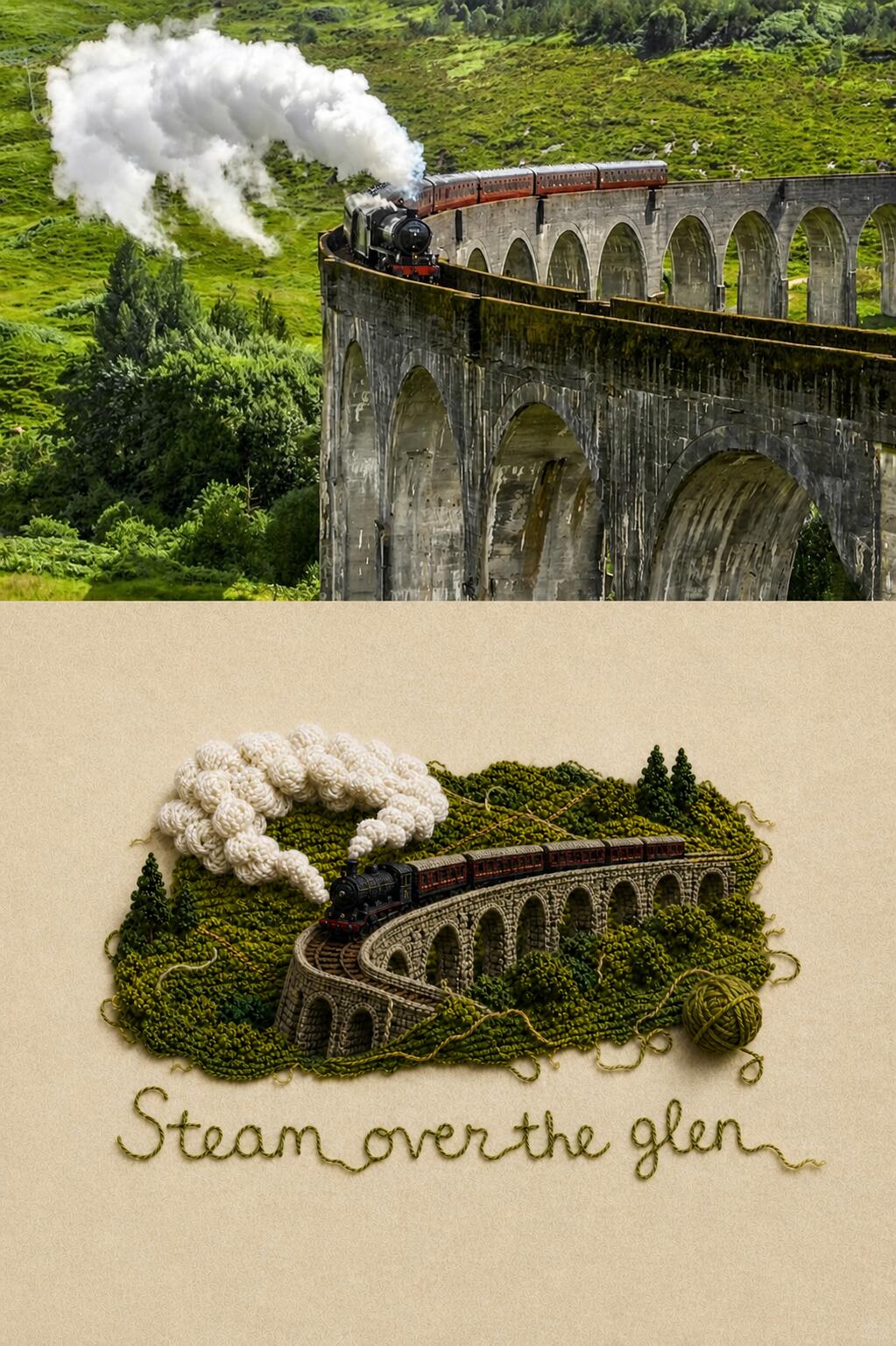
- The lower half of the image has an English phrase spelled in thread/yarn: "Steam over the glen".
- Interface steps / chart data:
- No interface steps, charts, or numerical data are visible.
- Visible objects and phenomena (upper half, photorealistic style):
- A steam locomotive with multiple carriages traveling on a curved elevated arch bridge.
- The locomotive emits distinct white steam/smoke drifting up-left.
- The bridge has a porous arch structure (stone or concrete texture), with the roadway following the arc.
- Background shows green hills, shrubs, and trees—an outdoor daytime scene with even lighting.
- Carriages are deep red/brown tones (darker palette).
- Visible objects and phenomena (lower half, handcrafted/model style):
- A miniature diorama: a small steam locomotive and carriages on a curved arch bridge, surrounded by "grass/shrubbery" represented by green yarn or thread.
- The locomotive's "smoke" is represented by curled white yarn/thread.
- A green ball of yarn appears on the right side of the scene.
- The background is a light beige fabric or paper texture, resembling knitted/embroidered or yarn-craft reproduction.
- The lower readable text (as above) is formed by thread-like material, appearing hand-crafted or embroidered.
- Other visible details:
- The two images are stacked vertically: top is photorealistic, bottom is handcrafted/model style.
- No identifiable persons or facial features are visible.
Unclear/indistinguishable items (marked as not readable or uncertain)
- Small text, numbers, or plaques on the locomotive are not legible (cannot read locomotive numbers or inscriptions).
- Exact material of the bridge (stone, concrete, etc.) cannot be determined with full certainty from the image details.
- Any small labels or fine markings on carriages are not discernible (resolution/angle insufficient).
- No interface elements (buttons, menus) are visible.
Inferences (based on visible evidence but not directly readable, with uncertainty)
- The upper half is likely a real scene or highly realistic photograph (steam, natural lighting, and depth of field support this inference).
- The lower half is likely a handcrafted knit/embroidered style artwork or a digitally simulated yarn craft miniature (the white yarn smoke and green yarn grass plus the yarn ball suggest physical yarn materials).
- The two halves may be intended as a "reality -> knit model" comparison or juxtaposition of photo vs. handcrafted art (speculative).
- The lighting and color differences suggest the top and bottom parts are respectively outdoor photography and indoor/studio art display (speculative).
Summary
- The only readable text is "Steam over the glen" in the lower half.
- The image consists of two parts: the top shows a photorealistic steam train crossing a porous arch bridge; the bottom is a knit/yarn-styled miniature version of a similar scene with a yarn ball at lower right and thread-formed text.
SkillPI Creation Analysis
Intended uses of the work:
- The post documents two visual style experiments—"clear crystal" and "organic knit"—which can serve as demonstration pieces for image-to-style transformations, social media art posts, Zine illustrations, or as examples for AI-based style-skill projects.
Image evidence summary:
- The image is a vertical composite: the top is photorealistic (steam train on an arch bridge); the bottom recreates a similar scene using yarn/knit visual language (yarn grass, curled yarn smoke, yarn ball, and thread-formed text "Steam over the glen"). These elements support the creator's claim of converting photos into a knit/handcraft aesthetic.
Steps to use the associated skills (based on common workflows and author statements; not a verbatim reproduction):
1. Source suitable input photos with clear, recognizable subjects so key features survive stylization.
2. Obtain the open-source skill repositories mentioned by the author (names given in the post: photo-to-organic-knit and crystalize-skill) and review their READMEs for usage instructions.
3. Choose a style-transfer workflow or image model (for example, img2img using a model like Stable Diffusion) or any provided scripts in the repositories.
4. Craft prompts and parameter settings that emphasize the desired traits: for crystal—transparency, refraction, simplified forms, highlights; for knit—yarn texture, stitch patterns, soft edges.
5. Run iterative tests, adjust denoising/strength and prompt phrasing, then perform post-processing (compositing, adding fabric texture or highlights) as needed.
Reproduction prerequisites:
- Access to the GitHub repositories the author referenced to obtain code, example prompts, model references, and any auxiliary assets.
- A computing environment able to run the required image models (GPU recommended) or access to a cloud service that supports the model.
- Original image assets and optional style references to guide prompt design and iterative adjustments.
Items to verify before attempting replication:
- Repository contents and completeness: presence of README, example prompts, scripts, and any model checkpoints or download instructions.
- Which base model or framework the skill relies on (e.g., Stable Diffusion, ControlNet, a custom model)—the post does not explicitly name the underlying model.
- Any dedicated post-processing resources (textures, compositing scripts) used to achieve the crystal or knit look.
- Licensing and usage terms (whether the repo permits derivative works or commercial use).
Note: The post is the creator's description of their experiments. It mentions two open-source skills on GitHub by name, but specifics (model checkpoints, exact prompts, and scripts) must be confirmed by inspecting those repositories; do not assume availability or exact functionality without checking the source.