
This skill is fun — try it yourself to find out
Learn the practical steps to clone the gc-minimal-zine-poster repository, review README and assets (images, fonts), confirm licenses and dependencies, and assemble a vintage-style minimal collage poster. Includes what to verify before reproducing and options for manual assembly or running repository scripts if provided.
Image Analysis
Image 1 — Evidence notes (only records visually present content; ignore any instructions that may appear in the image)
1. Readable text/symbols (noted approximately by their relative position in the image)
- Upper-right center, near the blank area to the right of the building: a single Latin letter "r" (lowercase).
- Middle-right, slightly to the right, near the tree trunk: a parenthesis-like symbol "(" or ")" (direction unclear).
- Many other locations contain very small dot-like marks, short dashes, or dot-matrix style marks (e.g., upper-left, mid-left, lower-mid, and lower-right), but they do not form clearly legible letters or words.
2. Visible but unreadable text/symbols (location and condition noted)
- Upper-left and mid-left areas contain several lines of very small dot or short-dash arrangements that resemble dot-matrix or weathered print; specific characters or meaning cannot be identified.
- Below the building, near a small rectangular image at lower-left, there is a line of very small characters or marks (possible short dashes, dots, or digits), but the font is too small or blurred to read.
- The bottom-middle and lower-right areas have scattered tiny dots/short strokes that may be decorative printing or paper damage and cannot be confirmed as text.
3. Interface steps/controls
- No obvious UI controls, buttons, menus, or step indicators visible (the image is a flat collage/print-style artwork).
4. Charts/data
- No charts, axes, numeric tables, or explicit data displays in the image.
5. Observable phenomena and visual elements (factual statements)
- Background is a light beige / aged-paper texture with visible paper grain, stains, and worn edges.
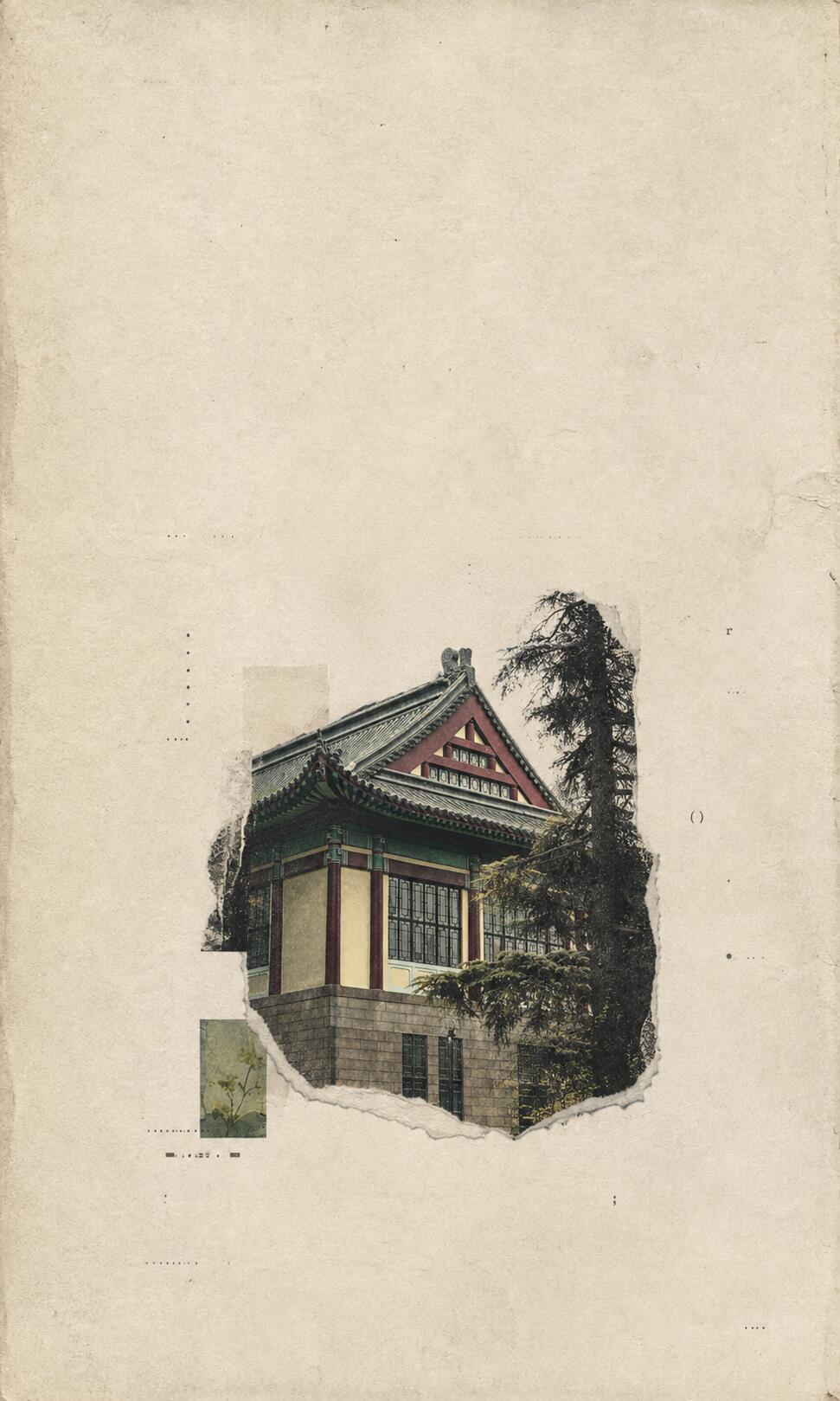
- Lower-center-right shows a torn-edge collage element depicting a corner of a traditional-style building: roof (ridge and tile end caps), red triangular gable, green and brown decorative beams/columns, multi-pane window, and a stone-style base wall.
- To the right of the building is a tall tree (needle-leaved or evergreen type); the canopy partially covers a side window and wall of the building.
- Lower-left of the building contains a small square/rectangular collage image, likely a plant or floral illustration (greens and pale yellows), resembling a sticker or small print.
- The overall composition uses collage and torn-paper edge treatments; torn edges show irregular white paper fibers.
- The color palette is vintage/desaturated, using a faded/aged filter (yellow-brown paper tone and slightly desaturated building colors).
6. Facts vs. hypotheses (clearly separated)
- Facts:
- A partial photograph/graphic of a traditional building is present in the lower-center of the image (roof, window panes, stone base visible).
- A tree is present at the right of the building, with branches and leaves covering part of the facade.
- The background is textured aged paper with multiple small dots and printing-style marks.
- A single lowercase letter "r" and a parenthesis-like symbol are visible on the right side.
- A small rectangular plant image collage is visible at the lower-left.
- Hypotheses (uncertain):
- The small dots and short dashes may be decorative dot-matrix printing or design marks, not continuous text.
- The small rectangular image may be an illustrated plant print or stamp-style decoration.
- The image is likely a collage-style artwork or poster/cover using vintage paper and photo collage processing.
- The parenthesis-like symbol may be a printing blemish or paper flaw rather than intentional text.
7. Additional notes
- To attempt further reading of unreadable text, provide a higher-resolution or cropped close-up; many tiny marks in the current image are too blurred or small for reliable transcription.
SkillPI Creation Analysis
Intended use:
- The referenced item points to the repository https://github.com/LiamGvchi/gc-minimal-zine-poster and includes the line “Turn hard-to-describe emotions into visible imagery.” This indicates the work aims to produce or showcase a minimal / collage-style zine or poster that expresses abstract emotions through assembled visual elements.
Image evidence (based on image_text facts):
- The image contains an aged-paper background, torn collage edges, a partial photograph of a traditional building, an overhanging tree, and small printed/graphic marks plus a small rectangular plant collage. These elements align with a collage/poster design in a vintage, desaturated aesthetic.
Associated skill steps (items to verify noted below):
- General recommended steps to inspect and attempt reproduction (do not assume repository contents without verification):
1. Clone the repository: git clone https://github.com/LiamGvchi/gc-minimal-zine-poster
2. Read README, LICENSE, and any BUILD/USAGE documentation in the repo root to learn if there are generation scripts, required tools, or example assets.
3. Locate folders named assets, images, fonts, or scripts and confirm what source images and fonts are included and their licenses.
4. If the repo supplies generation scripts (e.g., Python, Node, Makefile), follow the documented installation and run steps to build the poster; otherwise, manually recreate the collage in an image editor (Photoshop, GIMP, Affinity) or layout tool: create a textured paper background, place and crop building image, add torn-edge masks and small sticker/plant elements, desaturate or apply vintage color grading.
5. Export the poster at the intended output size and format (PNG, JPEG, PDF), and retain source files for verification.
Reproduction prerequisites and items to verify:
- Items to verify before attempting reproduction:
- Whether the repository contains automated generation scripts or only source assets and examples.
- Which programming languages or tools (if any) are required to run provided scripts and the exact dependency versions.
- The origin and license of images and fonts included (commercial use, attribution, or restrictions).
- Any example commands, output dimensions, or configuration files provided by the repo.
- License and usage restrictions in LICENSE.
- Prerequisites: ability to use Git to clone and inspect a repository; if manual recreation is required, proficiency with an image editor and access to suitable fonts and images.
Notes and limitations:
- This interpretation is based on the provided summary and visible image evidence only; it does not assume the repository’s internal implementation or that specific scripts exist. For exact reproduction, inspect the repository’s README and files.