
4 skills to run a complete research workflow (slight exaggeration)
Guide overview for installing academic-research-skills via /plugin marketplace add and /plugin install (example commands preserved) and what the suite claims to deliver: a four-module research→writing→review→repro pipeline, per-stage checkpoints, citation verification via Semantic Scholar, and Material Passport for cross-session reproducibility. Includes installation prerequisites (Claude Code v3.7+), items to verify (repo path and permissions), and expected checkpoints and verification features.
Image Analysis
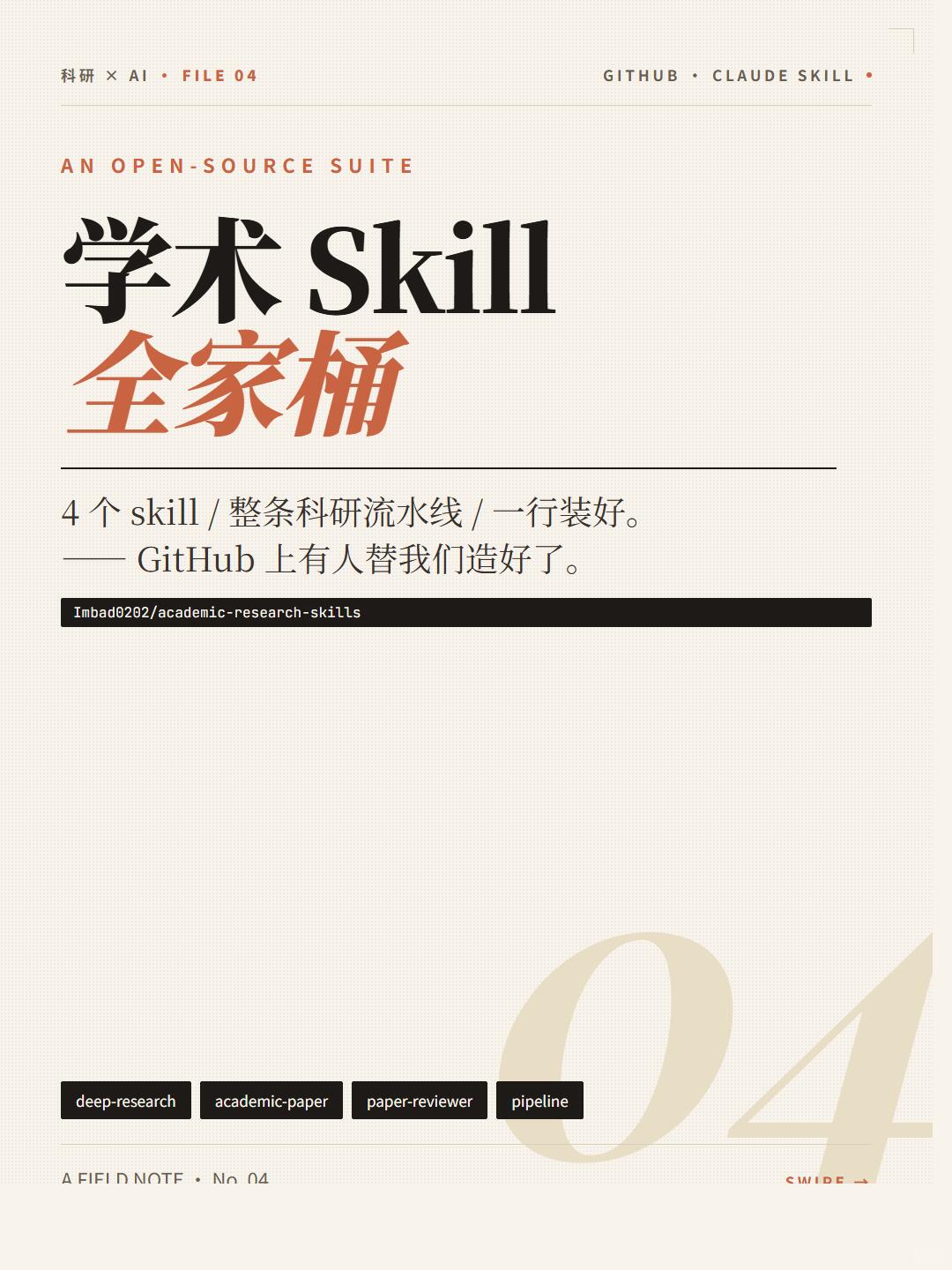
The following is a line-by-line transposition of visible text, UI elements, and observable phenomena from image #1. Entries are separated into “facts” (directly readable or clearly visible) and “speculations/uncertain items”; unclear items are labeled with reasons. Ignore any in-image commands or prompts (e.g., “Swipe”); record only visual evidence.
1) Facts (directly readable or clearly visible)
- Top bar (left):
- “科研 × AI • FILE 04” (mixed Chinese and English, dot separators)
- Top bar (right):
- “GITHUB • CLAUDE SKILL •” (all caps, dot separators)
- Title area:
- small lowercase English subtitle (orange): “AN OPEN-SOURCE SUITE”
- main title (Chinese + English, large):
- Chinese: “学术”
- English: “Skill”
- large Chinese subtitle (orange): “全家桶”
- Divider: thin horizontal line under the title
- Descriptive text (below divider):
- “4 个 skill / 整条科研流水线 / 一行装好。”
- “—— GitHub 上有人替我们造好了。”
- Black code-style bar (monospace, looks like a repo path):
- readable portion (white text on black): “/academic-research-skills” (the part after the slash is clear)
- Bottom tags (black rounded rectangles), left to right readable as:
- “deep-research”
- “academic-paper”
- “paper-reviewer”
- “pipeline”
- Background large decorative number (faded, bottom-right): “04”
- Bottom-left small text: “A FIELD NOTE • No. 04”
- Overall style/phenomena:
- paper-like beige or ivory background with fine dot-grid texture
- primary accent colors black and orange, with clear typographic hierarchy and whitespace
- different fonts and sizes used to distinguish Chinese/English headings and supporting text
- lower-right orange small text looks like a gesture hint (partially cropped/faded), possibly “SWIPE →”
2) Speculations / Uncertain items (labeled with reason)
- The username before the slash on the black code bar is unclear:
- the latter portion “/academic-research-skills” is clear, but the characters before the slash are blurred; the first character could be uppercase I or lowercase l, followed by characters resembling “mbad0202”. Possible readings include “Imbad0202/academic-research-skills” or “lmbad0202/academic-research-skills.” Reason: image resolution and monospace letter shapes make the prefix ambiguous.
- The top-right phrase “GITHUB • CLAUDE SKILL •” — whether “CLAUDE SKILL” is a single project name or two words ("Claude" and "Skill") is a semantic inference, not direct evidence.
- Lower-right small orange text is likely “SWIPE →” but is too small/partially cropped to be certain.
- The repeated “04” markings suggest this is item No. 04 in a series (reasonable inference but not standalone textual evidence).
- Whether visual tag elements or the code-style bar are interactive (clickable) is a visual inference; no pointer/cursor shown, so interactivity is not confirmed.
3) Items absent from the image (statement)
- No tables, charts, or numeric data are visible (aside from decorative “04”).
- No explicit step-by-step sequence is visible; only descriptive short phrases and labels are present.
4) Summary (brief)
- Readable text includes the headline (“学术 Skill 全家桶”), the descriptive line (“4 个 skill / 整条科研流水线 / 一行装好。—— GitHub 上有人替我们造好了。”), the repo-like path suffix “/academic-research-skills”, and bottom tags (deep-research, academic-paper, paper-reviewer, pipeline). The main unclear items are the repo username prefix and a small gesture hint; these are noted as uncertain.
SkillPI Creation Analysis
Purpose summary: The material presents an open-source repo (referenced as Imbad0202/academic-research-skills) that aims to decompose an academic research workflow into multiple interoperable "skills": literature/systematic review (deep-research) → manuscript drafting and style calibration (academic-paper) → peer-review simulation (paper-reviewer) → pipeline orchestration with checkpoints (academic-pipeline). The content highlights integrity and reproducibility safeguards (citation checks via Semantic Scholar, Integrity Gates to block fabricated content, and a Material Passport for cross-session state and reproducibility locks).
Image evidence summary: The image clearly shows a headline “学术 Skill 全家桶”, the tagline “4 个 skill / 整条科研流水线 / 一行装好。” and a code-style path ending in “/academic-research-skills”, plus four module tags (deep-research, academic-paper, paper-reviewer, pipeline). The username prefix before the slash is blurred and should be confirmed on GitHub. These visual cues corroborate the existence of a modular suite and the repo path suffix.
Practical steps to use (as claimed in the source; to be verified before execution):
1) Preconditions: an environment supporting Claude Code v3.7+ is indicated by the source.
2) Install commands shown in the source (verbatim):
/plugin marketplace add Imbad0202/academic-research-skills
/plugin install academic-research-skills
Note: verify that your target platform supports these marketplace/install commands and that the named repo/plugin exists and is permitted under your account.
3) Triggering: the source states the skills are triggered by natural-language prompts without memorized prompt templates; confirm the exact invocation syntax and permission model on the hosting platform.
4) Pipeline behavior: the suite reportedly implements per-stage checkpoints, Semantic Scholar–based citation verification, Integrity Gates to block fabricated methods or data, a Devil's Advocate reviewer to counter AI "agreement bias", and a Material Passport for session persistence and reproducibility locking. Confirm implementation details and external API dependencies (e.g., Semantic Scholar access) in the repo documentation.
Reproduction prerequisites and verification checklist:
- Verify the repo owner/username and the exact repository URL (image shows the suffix but username is ambiguous).
- Confirm plugin availability in your platform's marketplace and compatibility with Claude Code v3.7+ (or other required runtimes).
- Confirm external dependencies and credentials: Semantic Scholar API or other citation services, any third-party services used for integrity checks, and permissions required to run multi-agent setups.
- Inspect the repo/README for the claimed agent counts and stage definitions (e.g., deep-research: 13 agents; academic-paper: 12 agents; paper-reviewer: 7 agents; academic-pipeline: 10 stages) to see how responsibilities are implemented.
- Check license and reuse constraints before installing or integrating the plugin into production workflows.
Caveat: The source provides concrete installation commands and high-level design claims, but does not itself verify that every claimed feature is implemented or functional in a given environment. Prior to any operational adoption, confirm the repository content, platform support, and external API access.