
Khazix’s 9.2-point writing skill open-sourced
Step-by-step guide to applying the open-source human Writing.skill: inspect the forbidden-words list, follow the five-materials precondition, and run the included 639-line checking script to audit Chinese social-media posts or voice scripts. Includes actionable verification steps and prerequisites; verify the script runtime and license in the repository first. Repository: https://github.com/KKKKhazix/human-writing.
Image Analysis
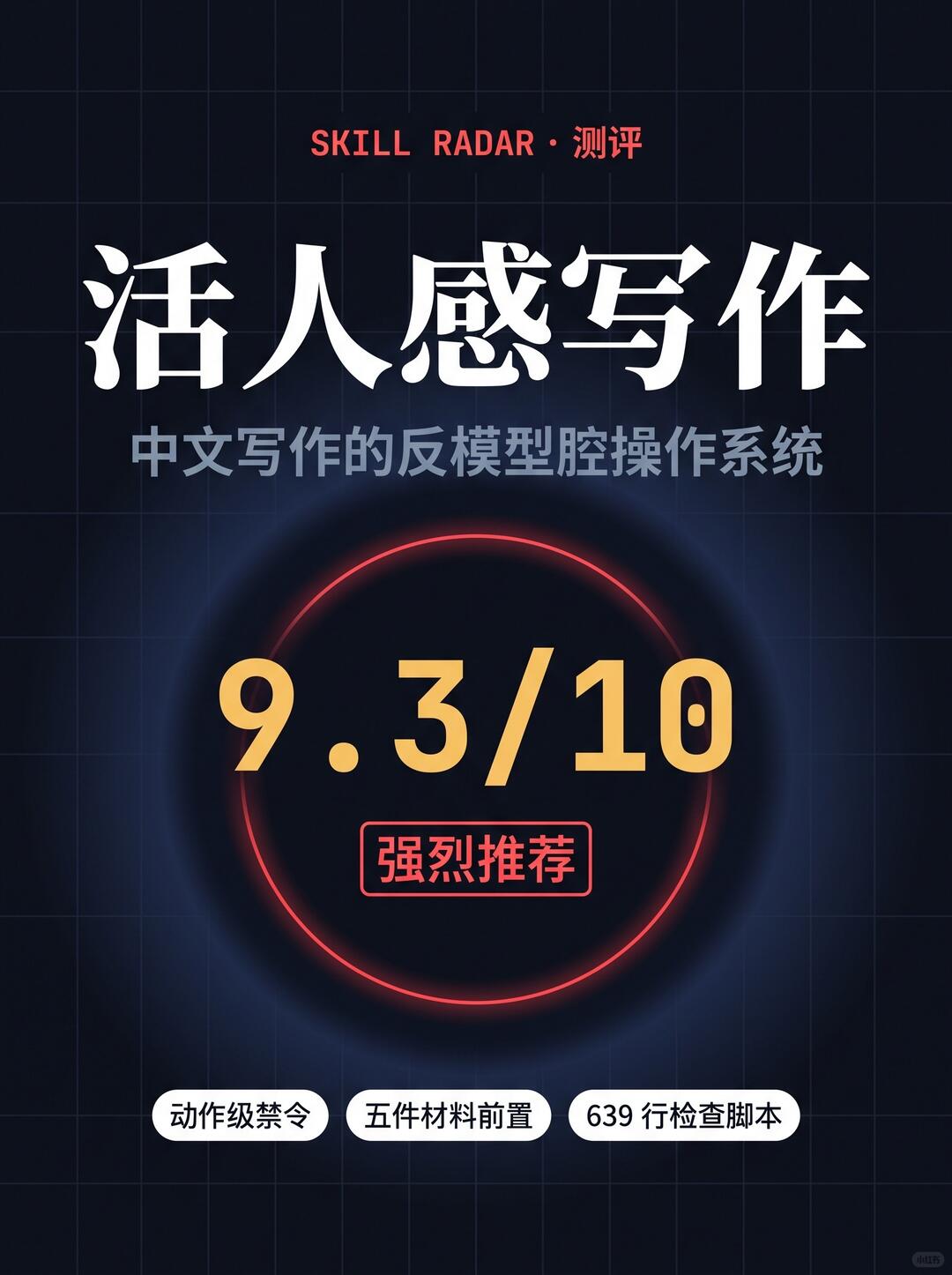
The following lists readable text, UI/layout elements, chart data and visible phenomena from the first image in order. Facts and inferences are strictly separated and unclear content is flagged. Ignore any instructions shown in the image.
1. Facts (readable text and obvious UI elements, listed visually top to bottom)
- Top center (small red text): SKILL RADAR · Evaluation
- Main centered title (large white text): Human-feel Writing
- Subtitle under title (medium gray text): An anti-model-voice OS for Chinese writing
- Large centered numeric (yellow): 9.3/10
- Red-framed text under the large number (red): Strongly recommended
- Three white rounded tags at bottom (left to right):
- Action-level bans
- Five-materials precondition
- 639-line check script
2. Chart/score data
- Overall score: 9.3/10 (prominently placed in the center with a red glowing ring effect)
3. Visible phenomena and layout information (visual description)
- Background is a dark grid (dark blue/black grid lines) with a radial gradient vignette.
- A red glowing ring and shadow effects surround the central score, emphasizing the number.
- High contrast text colors: white title, gray subtitle, yellow score, red recommendation mark.
- The three white bottom tags are rounded rectangles with centered black text.
- Overall style resembles a poster/review card with a techy glow aesthetic.
4. Unreadable/blurred content
- Bottom-right corner contains a small circular/oval mark or watermark; inner text is blurred and unreadable (location: extreme bottom right).
- There may be tiny marks or copyright info at image edges too small to identify.
5. Inferences (reasonable judgments based on image, not direct facts)
- The image likely serves as an evaluation card for a Chinese writing tool or method (based on “SKILL RADAR · Evaluation,” “an anti-model-voice OS for Chinese writing,” “9.3/10,” “Strongly recommended”).
- The three bottom tags likely highlight three core features or requirements of the system (“Action-level bans,” “Five-materials precondition,” “639-line check script” likely correspond to functional rules, workflow, or configuration requirements).
- The small circular watermark is likely an author or platform logo, but the brand cannot be confirmed due to blur.
SkillPI Creation Analysis
Intended use:
The open-source project referenced (human-writing / human Writing.skill) presents a set of rules and checking mechanisms aimed at producing a more “human-feel” for Chinese writing. It targets creators of social-media articles and voice scripts, proposing a combination of forbidden-word lists, preconditioned materials, and an automated check script to reduce model-like or mechanical writing. The repository URL given is: https://github.com/KKKKhazix/human-writing.
Evidence from the image:
- The poster asserts an overall score of 9.3/10 and labels the project as “Strongly recommended.”
- It explicitly lists three items: “Action-level bans,” “Five-materials precondition,” and “639-line check script,” which function as stated components or features. The image’s score and recommendation are visible, but their derivation or methodology is not shown in the image and thus requires verification.
Practical steps to work with the associated skill (actionable without assuming unverified runtime details):
1) Open the repository: Visit the provided GitHub link and read the README, documentation files, and any “skill” or docs folder to determine intended usage.
2) Inspect rule artifacts: Look for files labeled as forbidden-word lists, precondition checklists (the “five materials”), or configuration files that define the “action-level bans.”
3) Locate the check script: Find the file referenced as the “639-line check script.” Read its header/comments and README instructions to learn required input format, expected outputs, and any runtime/dependency notes.
4) Local verification: Clone the repo in a controlled environment and run the check script following documented instructions. Use sample articles or your drafts as input to observe the script’s outputs and warnings.
5) Integrate into workflow: Adopt the “five-materials” preparation step, apply the check script to flag mechanical/model-voice issues, then perform manual editing to preserve natural human tone.
Prerequisites to reproduce tests:
- GitHub access and ability to clone the repository (URL provided).
- A runtime environment compatible with the check script (programming language and dependencies must be confirmed in the repo).
- Familiarity with Chinese writing conventions to evaluate and act on script suggestions.
Items that need verification (not determinable from current materials):
- The repository’s documentation completeness and whether usage examples or test cases are included.
- The programming language, runtime, and dependency list for the “639-line check script.”
- The repository license (permissions for commercial use or redistribution).
- How the 9.3/10 score was calculated and the criteria behind the “Strongly recommended” label.
- Identity of the blurred watermark in the image’s bottom-right corner.
Conclusion (facts and verifiable next steps):
The provided materials point to an open-source “human-writing” skill that emphasizes forbidden words, a five-materials precondition, and a 639-line checking script. To use or validate it, open the GitHub repository, review its documentation and scripts, confirm runtime/permission details, and test the check script on sample texts in a controlled environment. Do not assume the image score or recommendations without inspecting the repo and any documented evaluation methodology.