
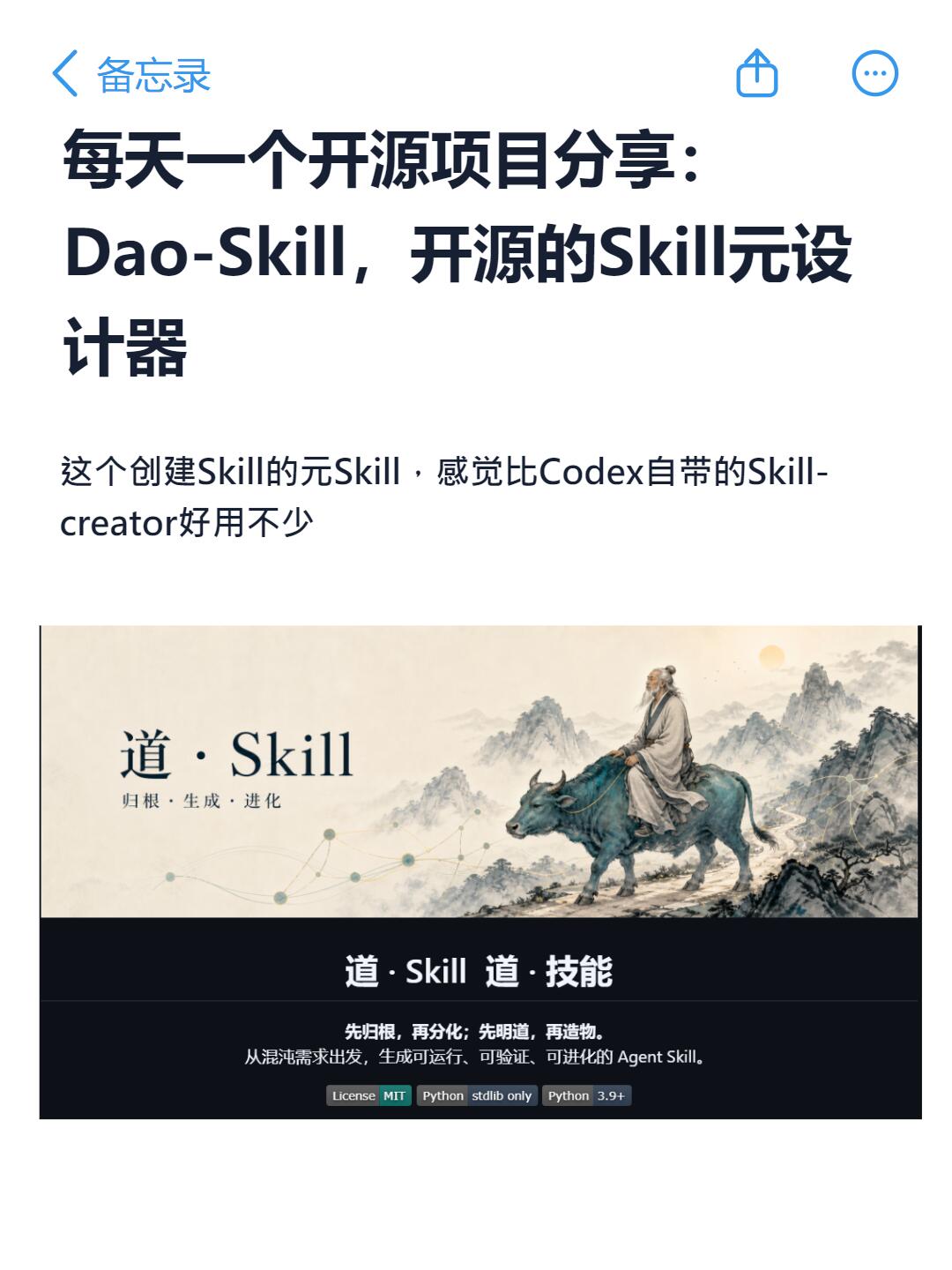
Dao-Skill — an open-source Skill meta-designer
Follow a six-step design workflow to convert a fuzzy request into a runnable, verifiable Agent Skill: identify root problem, surface conflicting goals, define Heaven/Earth/Person, choose a production mode, generate SKILL.md/references/examples/scripts and run behavior and regression checks, then convert failures into rules and tests. Screenshot notes MIT license and Python 3.9+ labels—source code link must be obtained to reproduce.
Image Analysis
Image evidence (translated):
1. Readable text (top-to-bottom, left-to-right):
- Top-left navigation: ← 备忘录 (back to Memo)
- Large multi-line main title:
- 每天一个开源项目分享:
- Dao-Skill,开源的Skill元设计器
- First paragraph of the body (smaller font):
- 这个创建Skill的元Skill,感觉比Codex自带的Skill-creator好用不少
- Banner text (left side):
- 道 · Skill
- 归根 · 生成 · 进化
- Large title in dark banner area:
- 道 · Skill 道 · 技能
- Smaller explanatory text under the dark banner:
- 先归根,再分化;先明道,再造物。
- 从混沌需求出发,生成可运行、可验证、可进化的 Agent Skill.
- Bottom labels/badges (each in small rectangles):
- License MIT
- Python stdlib only
- Python 3.9+
2. Interface elements and visible graphics:
- Top-right icons: a share icon (square with up arrow) and a three-dot more options icon.
- Banner artwork: traditional Chinese ink painting of an elder riding a water buffalo, mountains and mist in the background.
- Left side of the banner: several small dots connected by lines forming a node/network visualization (no labels).
- Page layout: vertical single-page scroll; screenshot shows upper and middle sections.
3. Unclear items:
- The specific meaning or numeric values of nodes/lines in the banner are unlabeled and cannot be determined.
- Lower portion of the page may contain additional icons or text not visible in the screenshot.
4. Facts vs. inferences:
- Facts (directly visible):
- The screenshot contains the texts and UI elements listed above.
- Three bottom badges read “License MIT”, “Python stdlib only”, and “Python 3.9+”.
- Header shows “备忘录” and a back arrow; share and more icons are present.
- Inferences (not directly shown):
- The page may be a note or article, but “备忘录” alone does not prove the exact application used.
- “Dao-Skill” appears to be an open-source project (inferred from license and Python tags), but no repository link is visible in the screenshot.
SkillPI Creation Analysis
Purpose and verifiable deliverables:
- The provided summary and screenshot document a design concept named “Dao-Skill”, a meta-designer for producing Agent Skills. Verifiable claims in the source include a six-step workflow (rooting, identifying tensions, establishing Heaven/Earth/Person, choosing production mode, generating deliverables and running validation, evolving from failures) and a recommended set of deliverables (SKILL.md, references, examples, scripts) plus governance/verification mechanisms (behavior checks, regression validation, evidence levels, Trust Gate, priority fixes).
Image evidence (verifiable items):
- Bottom badges show “License MIT”, “Python stdlib only”, and “Python 3.9+”, indicating the author labels the project as MIT-licensed and targeting Python 3.9+ with only standard library dependencies. The screenshot does not show a code repository URL or install/run instructions; obtaining the source is required to reproduce behavior.
- Title and banner copy align with the textual summary, confirming source consistency.
Actionable steps (mapped from the described workflow):
1) Define the root problem: break a vague need into concrete goals (e.g., style extraction, topic selection, content generation, or a content system).
2) Identify core tensions: list conflicting objectives (example: creative freedom vs stable output) and set balance rules or priorities.
3) Define Heaven/Earth/Person:
- Heaven: top-level principles and hard boundaries (rules/ethics);
- Earth: scenario, environment, routing/trigger conditions;
- Person: how the Agent asks, judges, executes, and formats outputs.
4) Choose production mode: decide whether to implement a single-process Skill, an engineering workflow package, a methodology toolbox, or a cognition-refinement Skill; this choice drives file structure.
5) Produce deliverables and validate: create SKILL.md, references, examples, scripts, then run behavior checks and automated tests to validate expected behaviors (critical checks include boundary cases, conflict resolution, and evidence-level outputs).
6) Evolve from failures: convert failure cases into rules, tests, examples, and scoring criteria; keep previous behaviors and rollback conditions for traceability.
Reproduction prerequisites and items to verify:
- Prerequisites: obtain Dao-Skill source code or implementation (repository URL or executable package), a runtime environment (if the badges are accurate: Python 3.9+ and stdlib-only), and example input/output vectors and test cases. Without these, automated validation and regression tests cannot be reproduced.
- Items to verify:
- Location and current availability of Dao-Skill codebase (not shown in screenshot).
- Concrete implementations of Trust Gate, evidence levels, and priority-fix mechanisms if they exist.
- Formats and validators for generated SKILL.md, references, examples, and scripts.
Caveats (no fabrication):
- This content summarizes the source material and image evidence; it does not claim independent verification of software, APIs, or runtime behavior. For deployment or execution, obtain and audit the codebase and run the described validations in a controlled environment.
Source and verifiable elements:
- Original source page: https://www.xiaohongshu.com/explore/6a8fa6780000000025011093?xsec_token=ABizMsQIR5JiBbpWtnffdb_bfH3skUO6SuDW5rXhf_Sho=&xsec_source=pc_feed&source=web_explore_feed
- Image text evidence: page title, banner copy, and bottom badges “License MIT”, “Python stdlib only”, “Python 3.9+”.