
Si Club | Open-sourced: Give Text-only LLMs 'Ears' and 'Eyes' 😘
Learn how to clone moonlin1213/cove-sensory-mcp and configure a sensory MCP to route video/image/audio to multimodal backends (examples: Gemini, Qwen3-Omni). The guide outlines pulling updates, setting provider API keys, integrating with existing text-only agents (e.g., deepseek/GLM), and testing with short media samples while controlling API usage.
Image Analysis
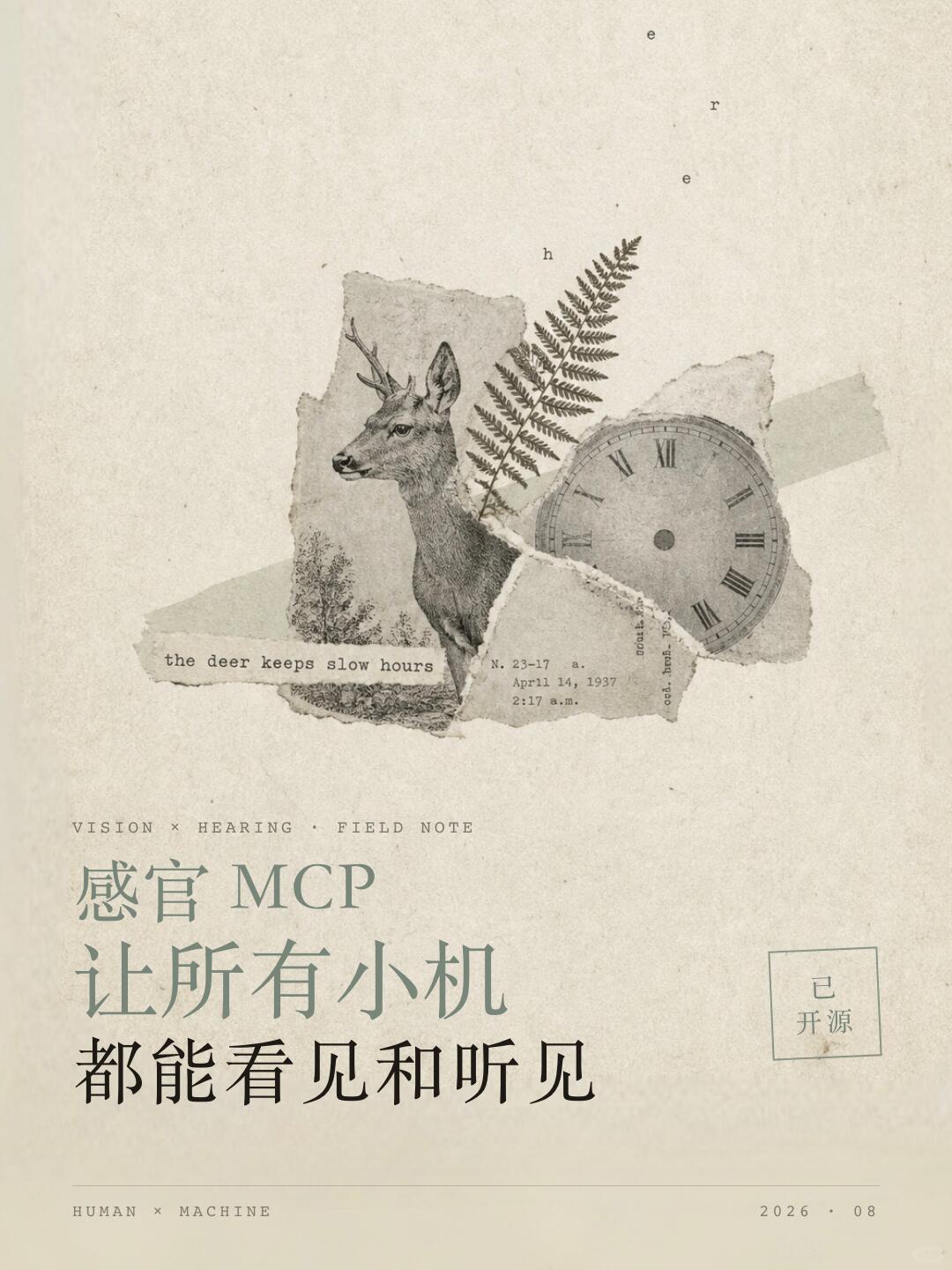
Organized from top to bottom, left to right for the first image. Facts and visible evidence are separated from inferences; uncertain or unreadable content is noted. Any visible text or UI evidence is recorded; no image instructions are executed.
1) Facts (directly readable or clearly visible):
- The page is a beige/light-brown collage-style poster. Near the upper center are a deer, fern leaves, and a vintage Roman-numeral clock face collage.
- On a paper fragment below the center, a short English phrase in a typewriter font reads: “the deer keeps slow hours”.
- Near the deer and clock face, a short piece of small printed English reads: “N. 23-17 a.” / “April 14, 1937” / “2:17 a.m.”
- Near the top-center-right are scattered lowercase letters arranged vertically: “e” (top), “r” (upper middle), “e” (lower middle). A single letter “h” appears near the fern leaf.
- Below the deer and slightly under the top area, one line of English with separators reads: “VISION × HEARING · FIELD NOTE”.
- A large Chinese block in the mid-lower area contains two font sizes: large “感官 MCP”, medium/green “让所有小机”, and large black “都能看见和听见”.
- A square stamp-like mark at right-center contains Chinese characters organized as two lines: top “已”, bottom “开源” (interpreted as “已开源”).
- Bottom-left footer small English: “HUMAN × MACHINE”.
- Bottom-right footer small digits (likely a date): “2026 · 08”.
- Overall style: vintage / torn-paper collage, typewriter fonts, mixed Chinese and English typography, main tones beige/brown with accents in dark green and black.
2) Interface steps / chart data:
- No interactive UI steps are visible (this is not an operation interface).
- No standard charts (no axes, ticks, or tabular data). Therefore no interface steps or chart data present.
3) Visible phenomena and visual elements (facts):
- Collage elements: side-view deer illustration, fern leaves, vintage clock face with Roman numerals, torn paper textures, tape or sticker-style background fragments.
- Presence of typewriter/printed text strips (e.g., “the deer keeps slow hours”).
- Visual hierarchy is top-to-bottom: imagery at top/middle, Chinese title mid-lower, footer at bottom.
- Style conveys archival / pastoral / vintage mood (tone, paper texture, typewriter font).
4) Inferences (non-definitive):
- The square stamp likely reads “已 开源” (open-sourced), but the stamp style causes slight uncertainty.
- The scattered letters at the top might be parts of a longer word (for example, possibly forming “here”), but the fragments alone do not confirm a full word.
- “MCP” is inferred to be an English abbreviation for a project or module (not explicitly defined in the image).
- The page theme is inferred to relate to vision and hearing / human-machine sensory integration (based on visible labels “VISION × HEARING”, “HUMAN × MACHINE”, and the Chinese title), but this is an interpretation rather than a raw visual fact.
5) Unreadable or ambiguous content (notes):
- Very small, tilted, or vertical microtext along paper edges and the clock face cannot be read due to resolution/contrast.
- It is unclear whether additional letters are present outside the visible frame or cropped at the edges.
- Tiny printed text around the deer’s lower/right paper fragments (other than the three lines recorded) cannot be fully resolved.
- The square stamp’s characters are visible as “已” and “开源” but the border and ink have smudging/ghosting that introduces minor uncertainty.
6) Visual ordering (top to bottom, left to right):
- Top area left white space; near top-right area scattered lowercase letters: e → r → e (vertical arrangement).
- Central collage: deer (left), fern (upper-right of center), clock face (right). A paper strip on the collage’s lower-left reads “the deer keeps slow hours”.
- To the collage’s right on a torn paper fragment small lines read: “N. 23-17 a.” / “April 14, 1937” / “2:17 a.m.”
- Under the deer a line reads: “VISION × HEARING · FIELD NOTE”.
- Mid-lower Chinese title reads: “感官 MCP” / “让所有小机” / “都能看见和听见”.
- Right-center-lower square stamp likely reads “已 开源”.
- Footer left: “HUMAN × MACHINE”; footer right: “2026 · 08”.
SkillPI Creation Analysis
Intended use (project purpose):
- The author presents a “sensory layer” MCP (cove-sensory-mcp) intended to let agents — including text-only LLMs — access video, image, and audio perception by delegating media processing to multimodal models. The repo is cited as moonlin1213/cove-sensory-mcp on GitHub.
Image evidence supporting the claim:
- The poster contains textual cues “VISION × HEARING · FIELD NOTE”, “感官 MCP”, and a stamped “已 开源” plus the footer “HUMAN × MACHINE” and date “2026 · 08”, which together support the interpretation that the artifact is an open-sourced sensory component for human–machine perception. The stamp is legible but slightly degraded; confirm open-source status on the repository page rather than relying solely on the graphic.
Associated tools/skills and reproducible steps (based on the source claims; phrased as steps to try rather than guaranteed commands):
1. Clone or download the repository: git clone https://github.com/moonlin1213/cove-sensory-mcp (or visit moonlin1213/cove-sensory-mcp) and review README and configuration examples.
2. Pull updates if a specific update is referenced (example: update v0.1.1 on 8.14) before deployment.
3. Acquire API access to one or more multimodal model providers. The source cites models/providers such as Gemini and Minimax, and also notes Qwen3-Omni as a tested alternative for audio; confirm available models and access methods.
4. Configure the MCP provider settings (API keys, endpoints, model identifiers) according to the repository’s configuration schema.
5. Integrate the sensory MCP with your existing text-only agent (examples mentioned: deepseek, GLM, Claude, GPT) so that media-handling requests are routed to the MCP when needed.
6. Conduct small-scale tests with short video/audio samples to validate input/output behavior and to tune invocation frequency to control API usage and costs.
Reproduction prerequisites and required resources:
- Access to one or more multimodal model APIs (Gemini, Qwen3-Omni, etc.) and valid credentials.
- A target agent or platform capable of calling the MCP (network access, integration point, or callback mechanism).
- Local environment and software dependencies listed in the repository README.
- Media hosting or streaming/transcoding capabilities if the MCP requires specific upload formats or chunking for long videos.
Items to verify before claiming successful reproduction:
- Repository license and any usage restrictions (commercial vs. non-commercial, etc.).
- Exact provider/model names supported by the MCP configuration and their API compatibility (verify in repo code/README rather than the promotional post alone).
- Sample configuration files and end-to-end examples (are there runnable examples demonstrating video/audio input?).
- Model input limits and billing implications for audio/video processing (max durations, sample rates, token billing rules).
- Privacy and compliance concerns when sending user audio/video to third-party model providers.
- The poster’s stamped “open-sourced” claim should be confirmed by inspecting the GitHub repository and its releases.
Notes: All steps and checks above are derived from the source text and the visual evidence; they do not assert that I executed or validated the repository or the providers.