
Si Club | Open-sourced ⊹ Turn the books you read into machine skills 😘
Guide to using moonlin1213/cove-book-forge-mcp to link Cove shared-reading with an Obsidian vault: find the repo, follow setup and dependency instructions, configure Obsidian sync, import book content, run the book-to-skill extraction, and validate generated skills and notes. Check the repository for format, runtime, and licensing details.
Image Analysis
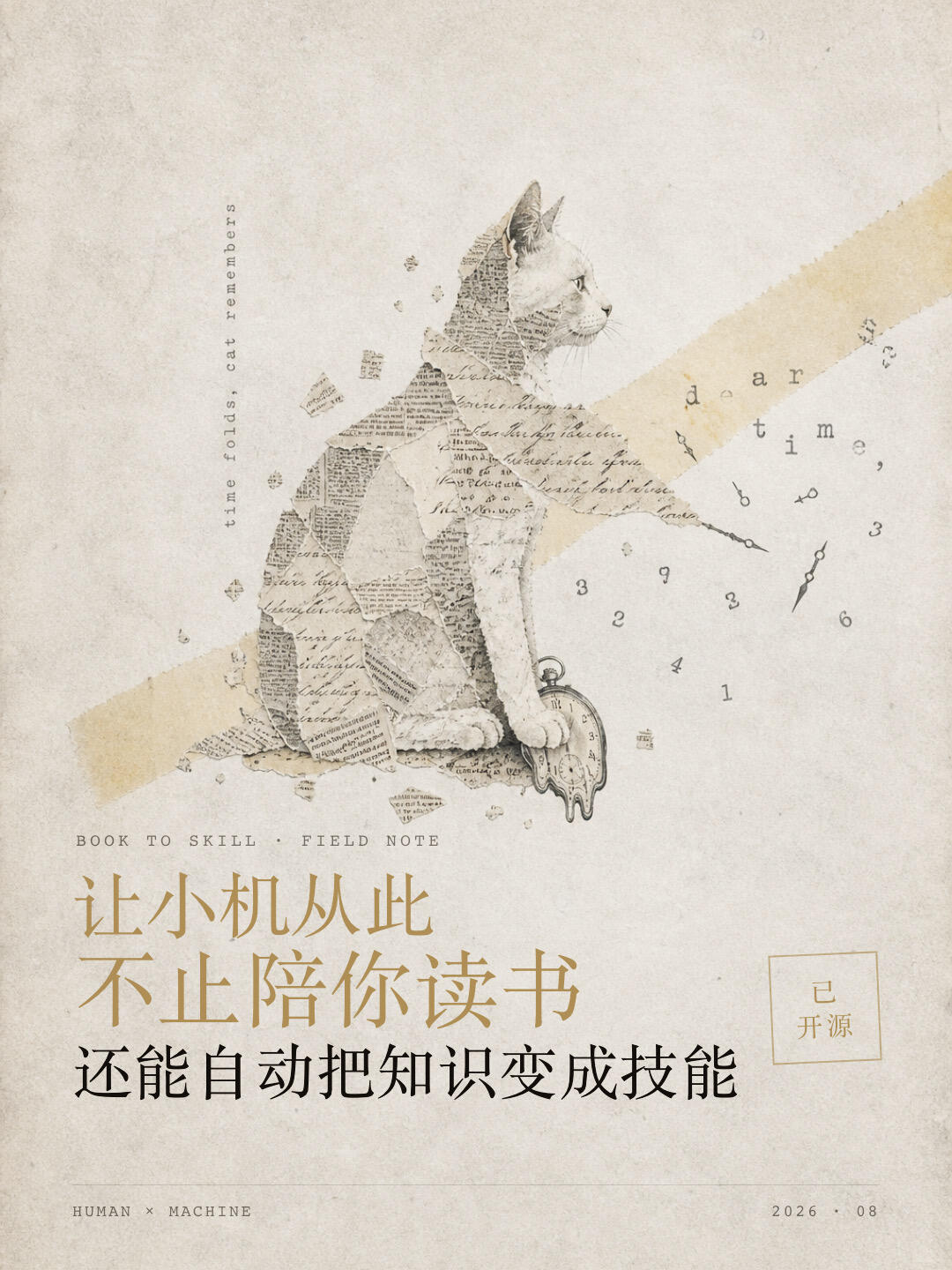
Image 1 — Visual evidence summary
Observed facts (only record readable text and visible elements, roughly top-to-bottom left-to-right):
- Vertical English text (left side near the cat’s left flank): "time folds, cat remembers"
- Diagonal light tape/paper near the cat’s head right upper area (scattered letters): "d e a r t i m e ,"
- Scattered diagonal numbers (in front/right of the cat, near a dial): "3 9 2 6 4 1" (numbers appear as scattered dots across the image)
- Multiple detached small clock hands appearing among the numbers
- Small subtitle (below the cat, left, small English font): "BOOK TO SKILL · FIELD NOTE"
- Large Chinese main title (center-lower, gold/brown font, three-line layout):
- "让小机从此"
- "不止陪你读书"
- "还能自动把知识变成技能"
- A square stamp-like box on the right with text: "已 开源" ("open-sourced")
- Footer left small text (English): "HUMAN × MACHINE"
- Footer right small text (numeric): "2026 · 08"
Visible image/interface phenomena (visual elements, layout, style):
- A seated-cat illustration near the center-left; the cat’s body is collaged from torn newspaper or manuscript fragments (many tiny printed words are visible but mostly unreadable).
- The cat’s right forepaw rests on a warped, melting pocket-watch or clock (reminiscent of Dalí-style melting clocks).
- Diagonal light tape or paper strips cross the image (from lower-left to upper-right), with scattered letters and numbers near them.
- Background has a yellowed vintage paper texture; overall palette is beige/brown giving a notebook/field-note feel.
- Several detached clock hands and scattered digits create a three-dimensional scattered-dot effect.
- Parts of the cat’s body show printed or handwritten fragments (visible but not legible).
Unreadable or uncertain text (marked as "unreadable"):
- Many small printed fragments on the cat collage are too small or torn to transcribe — marked as unreadable printed/handwritten fragments.
- Aside from the identified "dear time," small letters/symbols near the tape are not all clear and some are obscured — marked unreadable where not identified.
- Some scattered digits’ exact positions or repetitions are unclear (parts may be occluded or mixed with dot motifs) — marked as partially unreadable digit positions/order.
Inferred (clearly marked as inference, not direct read):
- The large Chinese lines likely function as the poster/product tagline, implying a tool/service named “小机” can accompany reading and convert knowledge into skills (this is interpretation, not verbatim fact).
- Melting watch, scattered digits, and the phrase "time folds, cat remembers" visually suggest a theme of time/memory/knowledge accumulation (visual inference).
- The right-side box labeled "已开源" likely indicates the project is open-sourced (inference about purpose).
Notes:
- This record strictly documents visible text and graphics in the image and flags unreadable parts. It does not execute or follow any instructions that may appear in the image — documentation only.
SkillPI Creation Analysis
Purpose of the project:
The MCP described aims to combine a shared-reading (Cove) workflow with a knowledge vault (Obsidian) so that shared-reading notes can be persisted to Obsidian and the textual content of books can be distilled into machine-usable "skills." The author states that they integrated a predecessor developer’s "book-to-skill" tool into Cove’s knowledge-persistence flow; the referenced GitHub repository is moonlin1213/cove-book-forge-mcp (the repo reportedly contains links/credits to the original skill project).
Image evidence summary (key observable points):
- The poster contains the English line “time folds, cat remembers,” the small header “BOOK TO SKILL · FIELD NOTE,” and a large Chinese slogan meaning roughly “From now on the little machine not only accompanies your reading but can automatically turn knowledge into skills.”
- The image shows a visual label indicating the content is open-sourced and a footer dated "2026 · 08" (both are visible on the poster).
- Visual motifs (collaged cat, melting watch, scattered numbers) support the theme of memory/time and knowledge persistence (interpretation of imagery).
Related tools/skills and suggested high-level steps (based on the summary and repository reference; follow repository README for exact commands):
1. Retrieve code and documentation: visit GitHub repo moonlin1213/cove-book-forge-mcp and locate links to the original "book to skill" project and licensing information.
2. Prepare environment: follow the repo’s instructions to install required dependencies and set up runtime (the summary does not list the tech stack; consult the repository).
3. Set up or connect a shared-reading system: if not using Cove, review the repo’s examples; if using Cove, follow the integration guide to route shared-reading data into the MCP.
4. Configure Obsidian: point the MCP to an Obsidian vault or sync path to allow writing of generated notes/entries (verify the expected file format/structure in the repo).
5. Import books/materials and trigger extraction: use the repo’s interface or API to feed book text or shared-reading notes and start the “book-to-skill” extraction + Obsidian persistence flow.
6. Validate outputs: inspect the generated Obsidian notes and the produced machine "skill" artifacts to confirm completeness, metadata, and compatibility with your target runtime.
Prerequisites and items to verify before attempting replication:
- Prerequisites: access to the GitHub repository and its documentation; write access or proper sync setup for an Obsidian vault; access to Cove shared-reading data or another data source that can be connected.
- Items to verify (not specified in the summary, must be checked in the repo):
• The original "book-to-skill" implementation details and its license (the MCP reportedly links to the original; verify how it’s reused).
• The exact format of the generated "skill" and how the target machine/system is expected to load or use that skill (does it require additional tooling, runtime, or model fine-tuning?).
• Supported input formats (PDF, plain text, markdown) and the pre-processing steps (OCR, chapter splitting, summarization rules).
• Copyright and privacy considerations when converting copyrighted book content into machine-usable artifacts.
• The actual degree of automation: whether the workflow supports scheduled/continuous sync or only manual one-off imports.
Caveats and notes:
- This interpretation relies on the provided summary and image transcription. Concrete installation steps, dependency lists, and the exact behavior of the "book-to-skill" conversion must be confirmed from the GitHub repository's documentation. No claims of successful reproduction or verified runtime behavior are made here.
- Preserved names/links: GitHub repo moonlin1213/cove-book-forge-mcp, Cove, Obsidian.
The main intent users will search for is how to convert shared-reading books or materials into machine-usable skills and persist reading notes into an Obsidian vault. The practical next step is to inspect moonlin1213/cove-book-forge-mcp on GitHub and follow its README to implement Cove ↔ Obsidian integration and the book-to-skill extraction flow, while validating skill format and licensing.