
Open-source: Let AI Agent Skills Automatically Evolve!
Learn the practical pipeline SkillClaw uses to evolve agent skills: collect in-the-wild interaction trajectories and human/environment feedback, analyze evidence and attribute root causes with Agentic Evolver, generate skill-update proposals (e.g., Evolve-Skill.md), merge and distribute updates to a SkillHub, and validate changes with WildClawBench and models like Qwen3-Max. Code and implementation details are available in the AMAP-ML/SkillClaw repo on GitHub.
Image Analysis
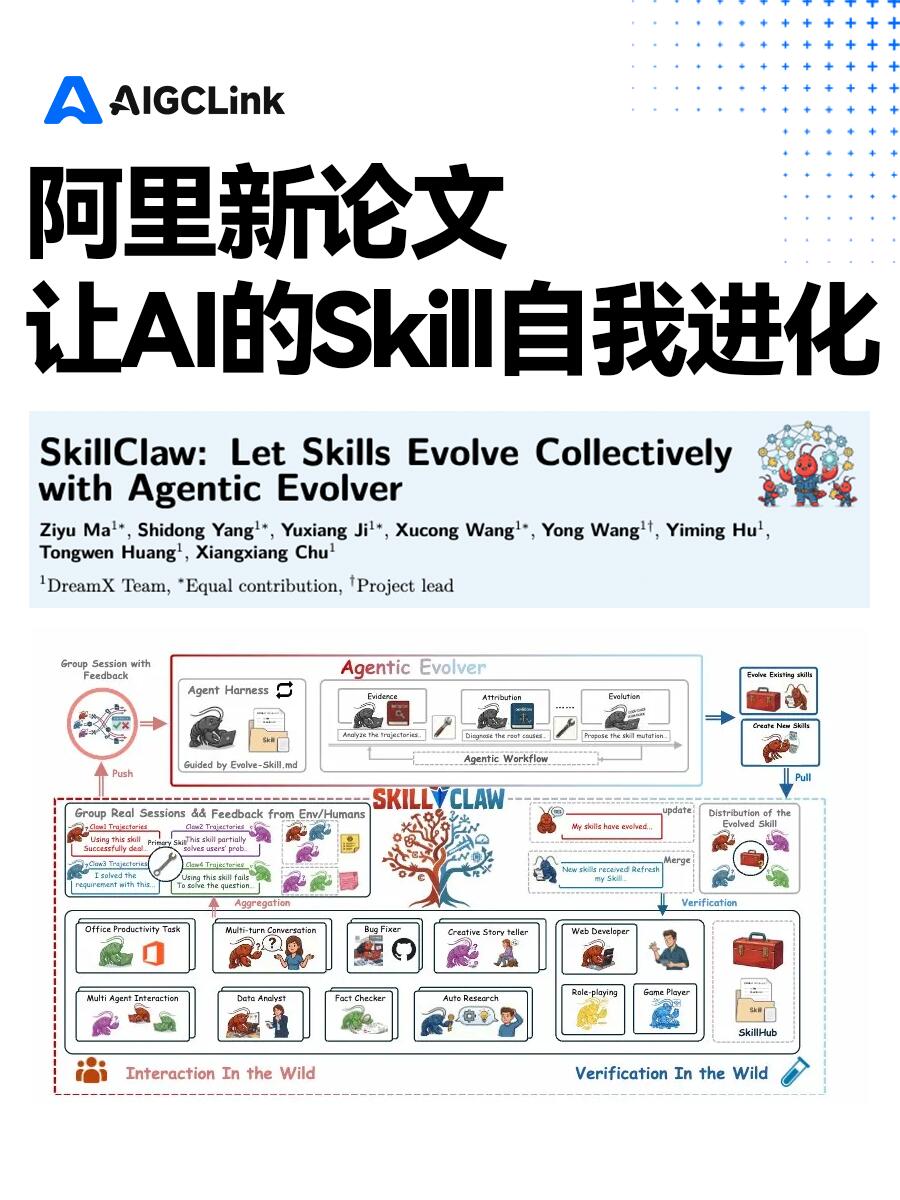
The following is a整理 of visible content from image 1. Contents are divided into “Facts” (directly readable or clearly visible) and “Inferences” (reasonable deductions based on layout/graphics). Hard-to-read text is marked as “unreadable”.
1) Facts (directly readable or obvious):
- Top-left label: AIGCLink (with icon).
- Prominent Chinese headline: 阿里新论文 让AI的Skill自我进化
- English paper title: SkillClaw: Let Skills Evolve Collectively with Agentic Evolver
- Author line (readable): Ziyu Ma1*, Shidong Yang1*, Yuxiang Ji1*, Xucong Wang1†, Yong Wang1†, Yiming Hu1, Tongwen Huang1, Xiangxiang Chu1
- Author footnote (readable): 1DreamX Team, *Equal contribution, †Project lead
- Center-top box title: Agentic Evolver
- Inside Agentic Evolver box readable flow words: Evidence, Attribution, Evolution
- Inside the Agentic Evolver box associated readable phrases (partial): Analyze the trajectories, Diagnose the root causes, Propose the skill solutions
- Left of the Agentic Evolver box: Agent Harness
- Below Agentic Evolver box: Agentic Workflow
- Left-side circular arrow and text: Group Session with Feedback
- Lower-left of Agentic Evolver: Guided by Evolve-Skill.md (or similar; see unreadable note)
- Central area big label: SKILLCLAW (tree-like logo)
- To the right of the tree a small panel shows text (partial): update, Merge, Distribution of the Evolved Skill, Verification
- Top-right near tree: buttons/boxes readable as Evolve Existing skills, Create New Skills
- Lower-left large area heading: Group Real Sessions && Feedback from Env/Humans (with colored bubbles)
- Bottom row contains skill example boxes, readable items include: Office Productivity Task, Multi-turn Conversation, Bug Fixer, Creative Story teller, Web Developer, Multi Agent Interaction, Data Analyst, Fact Checker, Auto Research, Role-playing, Game Player
- Bottom-left phrase: Interaction In the Wild
- Bottom-right phrase: Verification In the Wild
- Near the Verification area bottom-right an icon and text: SkillHub (with suitcase/box icon)
- Multiple arrows on the right indicate flow relationships
- Image uses many small icons/cartoon animals (snail/crab/etc.) to denote different skills or instances
2) Unreadable or partially readable items:
- Some small text inside Agentic Evolver box is tiny and blurred; exact wording near “Guided by Evolve-Skill.md” cannot be fully confirmed.
- Many small bubbles/annotations in Group Real Sessions & Feedback area are small; only fragments readable (e.g., “Using this skill partially ...”, “Successfully …”); full sentences not legible.
- Many tiny labels beneath skill icons are not clearly readable.
- Some small labels on connecting lines are blurred.
3) Interface steps / flow (visually evident main steps, facts vs. inferences separated):
- Facts (visible nodes/step names): Group Session with Feedback → Agentic Evolver (Agent Harness) → Evidence → Attribution → Evolution → Evolve Existing skills / Create New Skills → Distribution of the Evolved Skill → Verification → SkillHub
- “SKILLCLAW” is shown centrally as an aggregation tree; “Aggregation” is visible near it.
- Bottom lists multiple “in-the-wild interaction” task/skill categories (as above).
- Unreadable minor annotations correspond to previously listed unreadable items.
4) Observable visual cues:
- A tree metaphor represents skill evolution/aggregation (central tree logo).
- Left shows push-like direction; right shows pull/distribution toward SkillHub (arrows indicate directionality).
- Skills under the tree use different colors/animal icons indicating diverse skill sources or instances.
- Diagram style infographic with modules (Agentic Evolver, Group Sessions, Aggregation, Verification, SkillHub) connected by arrows to indicate data/feedback flow.
- Small person/environment icons near Group Real Sessions & Feedback indicate human/environment feedback sources.
5) Inferences (reasonable interpretations, not direct reads):
- The diagram intends to describe a closed-loop: collect group sessions/real interactions and feedback → Agentic Evolver analyzes trajectories (Evidence), attributes root causes (Attribution), proposes evolution plans (Evolution) → evolved skills are merged/updated and distributed to SkillHub → verification in the wild.
- Aggregation likely means combining sessions/feedback into the central SkillClaw tree to produce global updates.
- “update” and “Merge” suggest evolved skills are merged back into existing libraries or trigger new skill creation.
- Bottom-listed task examples are likely application scenarios or benchmark test suites.
- “Guided by Evolve-Skill.md” suggests an instruction/config file guiding the evolution process (file name visible; actual function inferred).
- Color coding may indicate skill states (success/partial/failure) or different evolution branches; this is a common visual convention and thus inferred.
6) Other notes:
- Many small annotations exist; a higher-resolution crop would be needed for verbatim transcription of blurred parts.
- Operational instructions (e.g., “click/run”) were ignored; only UI/diagram content and text evidence were recorded.
SkillPI Creation Analysis
Purpose:
The material (SkillClaw and its diagram) describes a system for continuous, collective evolution of deployed agent skills. The goal is to collect in-the-wild interaction trajectories and environment/human feedback, automatically diagnose recurring failures or inefficiencies, generate actionable skill updates via an Agentic Evolver component, merge and distribute evolved skills to a shared SkillHub, and verify updates in real scenarios.
Image evidence (what the image supports):
- A central Agentic Evolver module with an internal pipeline Evidence → Attribution → Evolution and phrases such as “Analyze the trajectories”, “Diagnose the root causes”, “Propose the skill solutions”.
- Data sources labeled Group Session with Feedback and Agent Harness implying collection of group sessions and environment/human feedback.
- A central SKILLCLAW aggregation/tree visual, plus right-side steps: update, Merge, Distribution of the Evolved Skill, Verification, and UI elements for Evolve Existing skills / Create New Skills.
- Bottom enumerated skill/task examples (Office Productivity, Bug Fixer, Data Analyst, etc.) showing intended application domains.
- A visible reference to a guiding file named Evolve-Skill.md.
Practical steps to use related components (based on visible workflow):
1) Instrument agents to log trajectories and collect environment/human feedback (session logs, success/failure labels, annotations).
2) Aggregate and preprocess trajectories by task/category for downstream analysis.
3) Run the Agentic Evolver’s Evidence and Attribution stages to find recurring behavior patterns and diagnose root causes tied to specific skills or sub-policies.
4) Use the Evolver to propose skill updates (likely output as update proposals or a file like Evolve-Skill.md).
5) Apply merge/update to the skill repository or create new skills; publish evolved skills to a SkillHub for other agents to pull.
6) Verify evolved skills in-the-wild or on a benchmark (diagram and summary reference verification and WildClawBench testing).
Reproduction prerequisites:
- Access to the SkillClaw source (github/AMAP-ML/SkillClaw) to view implementations and run components.
- Ability to collect and store agent interaction logs with appropriate privacy/consent handling.
- Baseline models and evaluation platform (paper mentions using WildClawBench and Qwen3-Max as a tested model), and compute to run analysis/evolution steps.
- Mechanisms for skill versioning, merge policies, human review gates, and rollback.
Items to verify (not fully specified in the image/summary and requiring the paper/repo):
- The exact Evolver implementation: algorithms used for attribution and generating skill updates (e.g., rule extraction, ML models, RL, or LLM-based synthesis).
- The schema and automation role of Evolve-Skill.md (fields, actionable patches, testing hooks).
- Merge policy and verification thresholds: what metrics or human checks gate a merged update.
- Privacy and data handling practices for collected trajectories (de-identification, retention, consent).
- Generalization limits across task types and reported failure modes—image lists many task types but does not quantify per-task effects.
Note: This interpretation is drawn from the provided summary and readable image text. For implementation-level reproduction or evaluation, consult the paper and the open-source repository; do not assume details beyond what is documented there.