
I built a Multi‑Agent travel planning app
Learn how to coordinate Planner, Reviewer and Time Check agents to combine user preferences, live Amap (Gaode) POI data, weather and opening hours into an editable day-by-day map itinerary. Deliverables include POI replacement, time adjustments, route optimization and live agent progress in an app. See the reference repo: https://github.com/shouzhuoshouzhuo/FloatTrip
Image Analysis
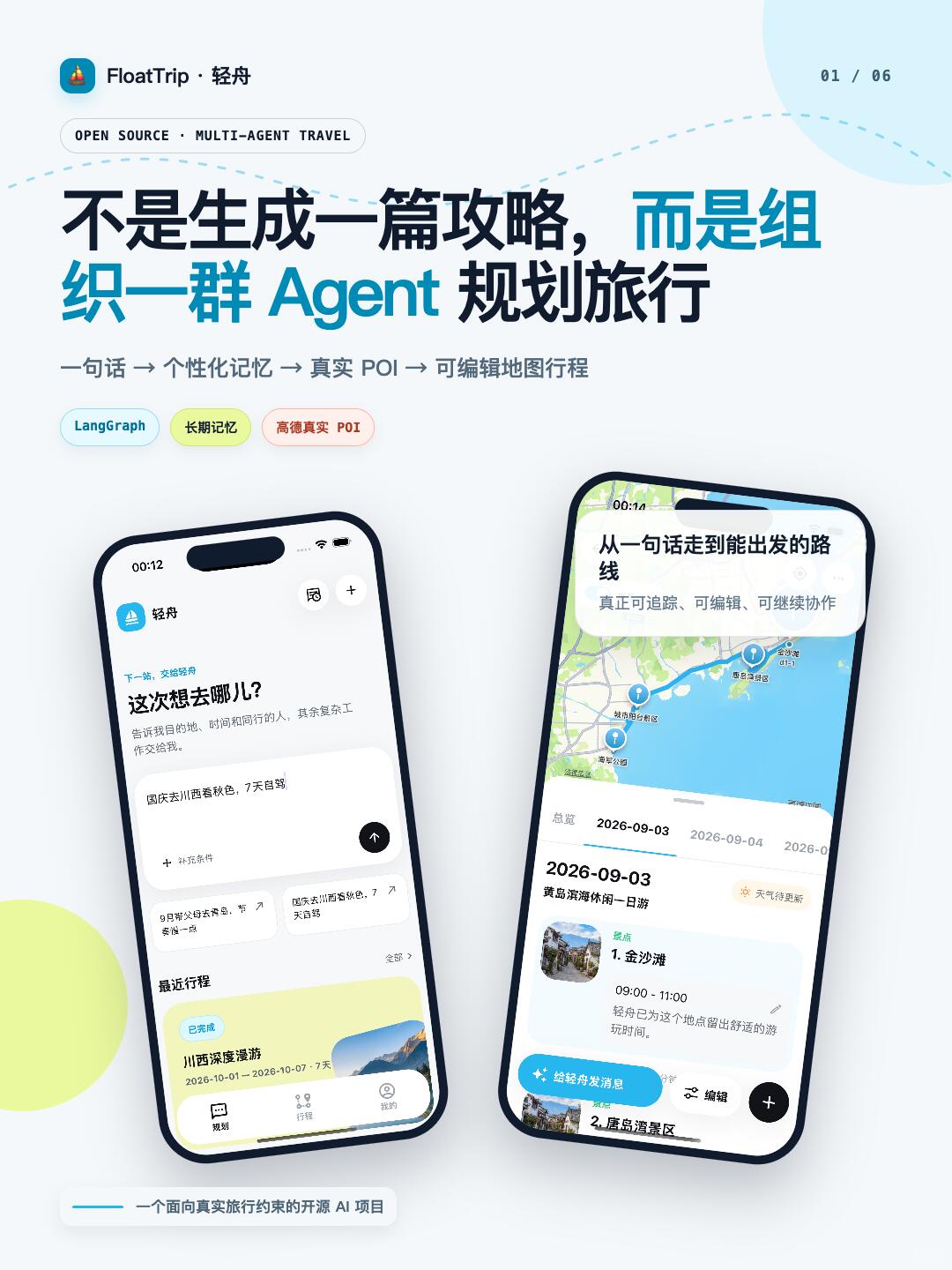
Image facts (text and visible UI elements readable from the image):
- Top left: an app icon resembling a small boat; text: "FloatTrip · 轻舟"; subtext: "OPEN SOURCE · MULTI-AGENT TRAVEL".
- Top right: page indicator "01 / 06".
- Main headline (large font): "不是生成一篇攻略, 而是组织一群 Agent 规划旅行" (Chinese; the word "Agent" is in Latin letters).
- Subtitle/flow phrase under headline: "一句话 → 个性化记忆 → 真实 POI → 可编辑地图行程".
- Three colored rounded buttons/labels (left to right): LangGraph (blue), 长期记忆 (long-term memory, yellow/green), 高德真实 POI (Amap real POI, red-orange).
- Main area shows two vertical phone mockups:
- Left phone: status bar time 00:12; app name/icon "轻舟"; large prompt "这次想去哪儿?" with helper text asking for preferences, time and companions to generate a draft; an example input card partially readable (inferred text: "国内两川西自驾游,7天自驾"); a "Recent trips" section with a card titled "川西深度漫游" dated 2026-10-01 — 2026-10-07; bottom tab bar with three icons (likely Home, Trips, Profile).
- Right phone: status bar time 00:14; top map view with markers and route lines (coastal route visible); floating banner above map: "从一句话走到能出发的路线" and subtext "真正可追踪、可编辑、可继续协作"; date timeline below map showing dates like 2026-09-03; daily itinerary card example for 2026-09-03 titled "黄岛海滨休闲一日游"; POI list item 1 shows "1. 金沙滩 09:00 - 11:00" with two action controls (a blue button readable as "给轻舟发送消息" and an "编辑" edit control); right-bottom has a circular "+" add button.
- Bottom-centered tagline: "一个面向真实旅行约束的开源 AI 项目".
Visual/UI notes: light blue and white color scheme, card-style POI lists with timeline/date slider, map-day-route linkage, mobile travel-planning app style.
Unreadable or unclear parts: full text of the left example input card, names/descriptions of POI items beyond the first, labels under bottom tab icons, small icon text and some UI details.
Reasonable inferences (not direct text): the three colored labels likely highlight core product features; user can generate a personalized draft from a single sentence and then edit the map-linked itinerary; the app emphasizes real constraints and collaborative agent workflows.
SkillPI Creation Analysis
Intended use:
- FloatTrip is presented as an open-source project that turns a user’s brief travel input into a practical, editable itinerary by splitting planning tasks across multiple agents. The goal is to produce an itinerary that respects real constraints (POIs, weather, opening hours) and supports iterative edits instead of a one-shot static guide. Repository: https://github.com/shouzhuoshouzhuo/FloatTrip.
Image-based evidence summary:
- The UI shows three feature labels (LangGraph, long-term memory, Amap real POI) and two phone mockups illustrating: (1) a short-text input flow to generate a draft trip and (2) a map-linked day-by-day editable itinerary with POI items (example: "Jinsha Beach 09:00–11:00") and actions like message-to-Agent and edit.
Associated skills and high-level implementation steps (based on the source description, not the repo code):
1) Define agent responsibilities: Planner (generate daily routes from dates/preferences/weather/POI), Reviewer (audit flow, pacing, requirement coverage), Time Check (validate opening hours/closures and detect time-slot conflicts).
2) Integrate real POI data: connect to Amap/Gaode POI APIs and ensure reliable POI metadata.
3) Add weather integration: use a weather API to influence scheduling and risk-aware time slots.
4) Implement a controllable memory store: persist user travel preferences and constraints with ability to view/edit/forget and a rule that current-trip settings override long-term memory.
5) Build agent coordination: implement a feedback loop where Reviewer/Time Check return explicit modification instructions to Planner rather than finalizing a one-shot output.
6) Front-end map and UX: present an editable map-linked daily itinerary UI with POI replacement, time adjustments, route optimization and live agent progress indicators.
Prerequisites for reproduction:
- Access to Amap/Gaode POI API keys and documentation;
- A weather data API for weather-aware scheduling;
- Back-end infrastructure for agent orchestration, messaging, and persistent memory storage;
- Map SDK for mobile/web to render POIs and routes;
- Engineering skills in multi-agent orchestration, API integration, and front-end map interactions.
Items to verify (not fully specified in the source):
- The exact role and integration details of "LangGraph" shown in the UI need confirmation from the repository (the label appears in the image but implementation details are not given).
- Which language models or LLMs (if any) are used, and how they are invoked or hosted are not specified.
- Memory storage format, synchronization strategy, privacy and retention policies are not described and should be checked in the code/docs.
- The source(s) for opening hours/closure data and their update frequency need verification to ensure Time Check accuracy.
- Full stack, dependencies and deployment steps should be reviewed in the GitHub repo before attempting reproduction.
Note: This interpretation is based on the provided summary and the UI evidence in the image; it does not claim code-level reproduction. For implementation details and to validate the above points, refer to the project repository: https://github.com/shouzhuoshouzhuo/FloatTrip.