
VibeCoding Awards | To ease information anxiety… this AI hot-topics site packaging my 3 years of social-media experience is now free for everyone
Step-by-step guidance on using a free AI hot-topics aggregation site to scan AI-related headlines (for example, visible OpenAI mentions), verify original sources, extract topic ideas, and draft social-media copy. The article explains how to read headline cards, check provenance, and apply simple strategies to limit information overload; specific site features and integrations require verification.
Image Analysis
Image 1 — Facts and records
Directly readable facts (text, UI elements and visible phenomena)
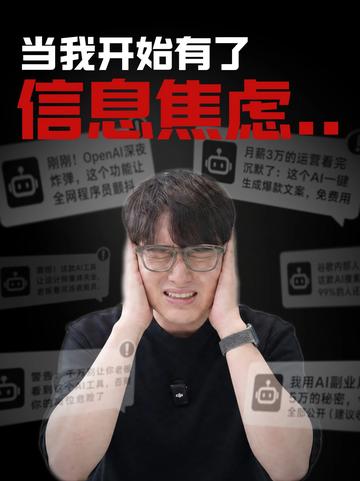
- Large white top text: “当我开始有了” (When I started to have)
- Large red top text: “信息焦虑...” (information anxiety...)
- Center-lower area shows an adult wearing glasses, hands covering ears and eyes closed, facial expression showing pain or anxiety. Wearing dark clothing and a small lavalier microphone clipped to the chest.
- Dark background covered with multiple gray/white speech-bubble or card-style elements; each bubble has a robot icon on the left (resembling a chat/AI icon).
- Several bubbles contain short readable phrases or fragments (below are readable or partially readable excerpts):
- “刚刚:OpenAI深度炸裂, 这个功能让 全网程序员暴露……” (“Just now: OpenAI deeply exploded, this feature exposed programmers across the web…”) — partially obscured or incomplete
- “月薪3万的运营看完沉默了:这个AI一键生成朋友圈文案,免费用” (“An operator with 30k monthly salary was silent after reading: this AI one-click generates Moments copy, free to use”) — partially readable
- “我用AI副业月入……不是吹” (“I earn … per month with AI side hustle — not bragging”) — latter part obscured or blurred
- Several small bubbles only show isolated words/phrases like “免费用” (free to use), “生成” (generate), “文案” (copy) etc.
- Overall visual style uses high-contrast black/white/red tones; prominent, layered prompt cards create a crowded visual effect.
Interface steps, chart data
- The image does not show numbered steps, clear operation flows (e.g., “step 1/step 2”), or numeric tables/graphs. The elements are short social-media/advert-like prompt fragments.
Unreadable or partially readable content (location and reason annotated)
- Left bubble: begins with “刚刚:OpenAI深度炸裂, 这个功能让全网程序员暴露……” — the end is obscured or compressed, preventing a full transcription.
- Lower-middle bubble: begins “我用AI副业月入……” — subsequent text is obscured/blurry, so exact amount and full sentence cannot be determined.
- Several small bubbles only show fragments due to overlap, transparency effects, or resolution limits.
Inferred observations (marked as inference, not stated as fact)
- The robot-icon bubbles appear to be social-media push messages or headline-style promotional copy, intended to show a flood of AI- and monetization-related information.
- The composition (person covering ears, many prompt cards, large “information anxiety” text) likely aims to express anxiety or overload caused by abundant AI news/promotions.
- The lavalier microphone is inferred to indicate recording or filming (live/video scene), but this is an inference.
Ignored items
- Any instructional or clickable text in the image (e.g., “click XXX”) has been ignored per requirements and is not listed as operational steps.
Source link provided by submitter
- Douyin video: https://v.douyin.com/VgphR5pb2So/
Editorial ending: facts, action outcomes or verification items.
SkillPI Creation Analysis
Purpose and use
- The image is a promotional/cover visual meant to communicate the theme of “information anxiety” in the context of AI news and tools. The accompanying claim (from the title provided by the submitter) is that the author packaged three years of social-media experience into an AI hot-topics website and made it freely available.
Key image evidence (based on the recorded facts)
- Verifiable on-image text: the headline “信息焦虑”, multiple prompt-card snippets that include the word “OpenAI” and phrases such as “one-click generate Moments copy” and “free to use.” Robot icons and card-like UI elements are visually present.
- Not shown/unclear: there is no clear screenshot of interactive UI (e.g., visible buttons, menus, or export functions) so functional claims (like one-click generation) cannot be confirmed from the image alone.
Associated skills and stepwise usage (practical, generic steps based on what the image can support; specific tools/services require verification)
- Step 1 — Locate the site or landing page via the provided source (Douyin link https://v.douyin.com/VgphR5pb2So/) and look for a direct site link or demo.
- Step 2 — On the site, identify how “hot-topic cards” are presented: check if each card includes a source link, timestamp, or short summary to allow source verification.
- Step 3 — Use visible cards as inspiration: compile selected headlines into a local draft or editor and expand them into social-media post ideas or short-form copy.
- Step 4 — For any technology/product mentions (e.g., OpenAI), follow through to the original announcement or article to verify claims before reposting or acting on them.
- Step 5 — Apply time-boxing or selection filters to limit exposure and reduce information anxiety (for example, review only top N cards per session, or only cards from verified sources).
Reproduction prerequisites (general elements needed to build similar functionality; implementation details not provided in the image)
- Aggregation sources: feeds or APIs to collect news/social updates for card generation.
- Backend logic: deduplication, ranking, and short-summary generation or aggregation scripts/services.
- Frontend presentation: card-based UI with visual indicators (robot icon) and high-contrast styling.
- Legal/compliance checks: content copyright, attribution, and privacy considerations for aggregated content.
- Hosting and operational setup: domain, hosting, caching and monitoring mechanisms.
Items to verify (cannot be confirmed from the image alone; recommended verification checklist)
- Exact URL and public availability of the claimed “AI hot-topics” website. The image and title assert it is free, but the actual site link and access details need confirmation.
- Existence and nature of any “one-click generate Moments copy” feature; the image shows the phrase but not the functioning UI.
- Whether the site integrates with OpenAI or other specific services/APIs, and if so, how (API usage, scope, and data handling).
- How aggregated items are sourced and whether sources are linked/credited on each card.
- Privacy, copyright and reuse policies for aggregated content and any generated text.
Conclusion (facts and verification items)
- The cover image communicates information overload and contains readable fragments that reference OpenAI and promotional copy claims. It does not, by itself, prove the website’s functional features or integrations. Follow-up verification should focus on the site link from the Douyin post, explicit feature documentation, and source-attribution/compliance details.