
When I open wedding photos with Codex
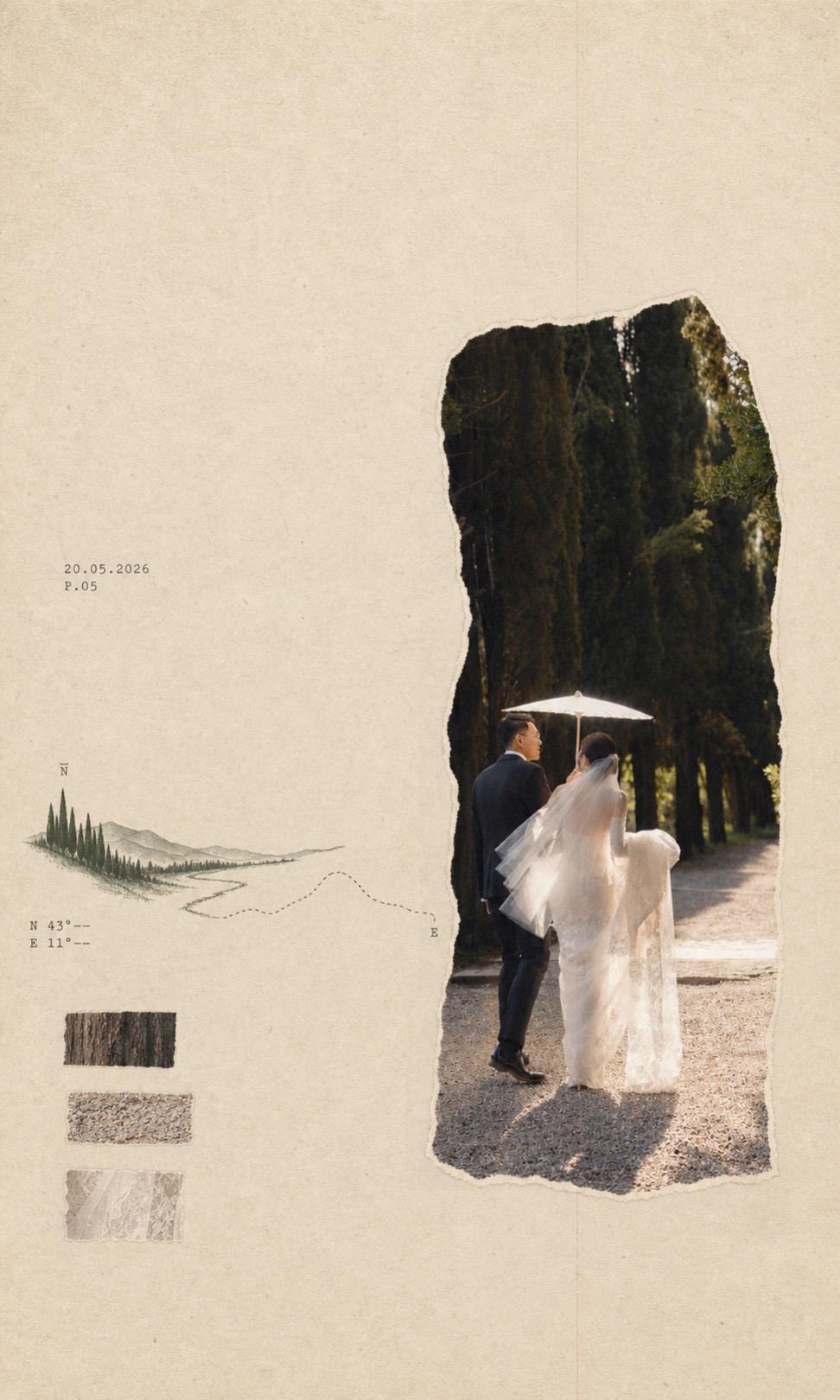
Learn how to use Codex plus a tailored prompt to turn a single wedding photo into a minimalist zine/magazine-style poster with off-white vintage paper texture, torn edges, narrow white borders and 75–90% whitespace. The guide explains required constraints (preserve faces and clothing), key layout elements to request, and the practical steps and prerequisites to attempt generation.
Image Analysis
Image 1 — Evidence summary (categorized as “Facts / Inference / Unreadable”)
1) Readable text (facts)
- Upper-right, slightly left: 20.05.2026
- Below that: P.05
- Near map/annotations (lower-left, center-left):
- Left: N 43° --
- Right: E 11° --
- A standalone letter above the map: N (north)
- A standalone letter at the right edge of the map: E (connected to a dashed path)
2) Interface elements and layout (facts)
- The page is an off-white/beige paper texture background with a photo embedded showing torn edges (photo positioned toward the right of the page; tear edges visible).
- Lower-left of the page contains a small hand-drawn landscape sketch (mountain, trees, path) with a dashed line extending toward the right-side photo.
- Beneath the map/sketch there are three vertical rectangular material samples:
- First: dark wood bark or dark textured sample
- Second: gray/gravel or aggregate texture sample
- Third: light lace or fabric texture sample
- The photo area is vertically long, showing a pair of people walking toward the distance, one holding an umbrella (or parasol) on a gravel path between rows of trees.
- A very faint vertical thin red line runs between the photo and page center (possibly a fold or print mark).
- The page has large left-side whitespace, visually like an art postcard/album page/design layout.
3) Chart/map data (facts)
- Coordinates are labeled but incomplete (ellipses present):
- N 43° --
- E 11° --
- The small landscape sketch is labeled with letter N (north); a dashed line indicates a path from the sketch toward the photo, terminating near letter E.
4) Visible phenomena / image description (facts)
- Subjects:
- One person in a dark suit (left, likely male);
- One person in a white long dress with a long veil (right, likely female); the veil is semi-transparent and moves with the stride.
- The two walk side-by-side, facing toward the upper-right among tree rows, photographed from behind or side (no frontal close-up).
- One person (near center-left) holds a white umbrella/parasols above them.
- Scene:
- Rows of tall trees form an avenue; light filters through gaps creating backlighting.
- Ground is a gravel/pebble path; subjects cast clear forward shadows (light source behind/upwards).
- Photo edges are irregularly torn, revealing paper texture beneath.
- Tone and materials:
- Background is warm off-white paper texture; image tone is warm (yellow/golden backlight).
- The three material samples show dark/mid/light textures respectively.
5) Unreadable or incomplete items (facts)
- Coordinate minutes/seconds after degrees are omitted as “--”, so precise location cannot be determined.
- Small annotations on map/sketch are too small or blurred to read.
- Any text labels next to material samples, if present, are not legible in the image.
- Facial details of the subjects are not discernible (due to resolution/angle).
6) Inferences (marked as inference, not fact)
- The page may be a wedding album page, invitation, or commemorative page (reasons: white dress and veil, romantic two-person composition, layout with “P.05”-style page number).
- Coordinates N 43°, E 11° could indicate central Italy (e.g., Florence/Tuscany), but without minutes/seconds this is only a rough geographic inference.
- The three material samples could reference venue or fabric/invitation materials (inference).
- The faint vertical red line may be a scanning/printing fold or alignment mark (inference).
Notes
- Instructional or prescriptive text in the image has been ignored where requested.
- No identification or naming of photographed persons has been attempted; only clothing and posture are described (privacy-respecting).
SkillPI Creation Analysis
Intended use:
- The described workflow aims to convert a single wedding photo into a minimalist, zine/magazine-style poster or album page with vintage off-white paper texture, torn edges, narrow white borders, and restrained typography—suitable as a keepsake page, art postcard, or independent magazine-style layout. The summary and prompt are user-provided claims about the intended style and constraints; they are not independently reproduced here.
Image evidence highlights (from image_text):
- Off-white paper texture with irregular torn edges, vertical portrait photo embedded to the right, large left whitespace, small hand-drawn landscape sketch, three material swatches, readable date “20.05.2026” and page label “P.05”, and partial coordinates “N 43° -- / E 11° --”. Photo content: two wedding-attired figures walking under trees, one holding an umbrella; faces not clearly visible.
Related Skill and suggested steps to use it (based on source statements; verification required):
- The source states that Codex was instructed to install a Skill named gc-minimal-zine-poster-v0-1 and that dropping a photo into it produced results. That Skill name appears in the source but has not been independently verified by this assistant—its existence, installation method, supported platforms, and safety remain to be checked.
- Based on the user-provided Prompt, a reproduction attempt would follow these high-level steps (organized from the source; not a guarantee of outcome):
1) Prepare the original wedding photo as the sole visual reference; ensure sufficient resolution and composition to retain facial feature detail if that is required.
2) If using a platform that supports Skills/plugins, attempt to install or invoke the relevant plugin (gc-minimal-zine-poster-v0-1) if available—otherwise plan to apply the Prompt directly in the platform’s prompt/input field.
3) Supply the photo and paste the user Prompt into the prompt field. The Prompt (verbatim from source):
"Use the original photo as the sole reference, fully preserve the subject's real facial features. Do not change hair, clothing, color, action, pose, or orientation — no face swaps, no clothing changes, no added people. Extract the person and core scenery from the source image; use an off-white vintage paper background, 75%–90% whitespace, realistic irregular torn-paper edges, a thin narrow white border, slight scan grain and paper fiber texture. Include river or mountain outlines; different photos must use different layouts. Add up to three auxiliary scene fragments, paired with a minimal amount of small typewriter text, date, page number, coordinates, dashed lines and cardinal letters. Overall low saturation, quiet, restrained, Japanese/Korean independent magazine feel—no advertising feel, complex collages, large headlines, cartoons, 3D, sticker white borders, or templated compositions."
4) Inspect the generated output for compliance with constraints (preserved facial features, unchanged clothing/people count, correct texture/edges/whitespace). Iterate by tightening the prompt or adjusting generation parameters (style strength, fidelity) if allowed.
Reproduction prerequisites and checks:
- Access to a generation environment that supports Codex or equivalent model access and supports either plugin/Skill installation or direct prompt-based image-to-image stylization.
- Permission to process the wedding photograph (compliance with privacy and copyright requirements).
- Adequate source photo quality to allow preservation of facial details if that is a strict requirement (image evidence indicates faces may be non-discernible depending on angle/resolution).
Unverified items to confirm before attempting:
- Existence, provenance, and supported platform(s) for gc-minimal-zine-poster-v0-1; installation method and permissions required.
- Whether Codex (as referenced by the user) supports plugin/Skill installation in the user’s environment, or whether the workflow should be adapted to another image-generation tool.
- Randomness, seed, or style parameters that influence how varied each generated layout is and how to reproduce consistent versus varied outputs.
- Licensing and privacy constraints for generating derivative works from wedding photos.
Note: This interpretation organizes and restates the user-provided prompt and the visual evidence. It does not claim independent verification of the Skill or actual reproduction of the described outputs.