
Amazing — let Codex write a patent skill, learn to save thousands
Step-by-step guidance to prepare patent inputs, check README.md and SKILL.md, install requirements.txt, craft prompts for OpenAI Codex to generate draft patent text, and the key technical and legal checks required before using model outputs.
Image Analysis
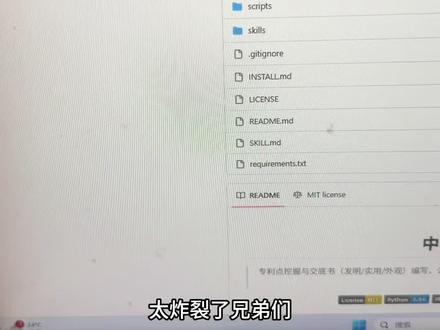
Image 1 — Extracted visual evidence
1. Readable text (roughly top-to-bottom, left-to-right):
- scripts
- skills
- .gitignore
- INSTALL.md
- LICENSE
- README.md
- SKILL.md
- requirements.txt
- README MIT license (two words side by side; README icon and “MIT license” visible)
- Bottom-center overlay text on screen: 太炸裂了兄弟们 ("So explosive, brothers")
2. Interface elements / visible UI steps (facts):
- Right column shows a list of files or entries, each with an icon (file/folder icons visible).
- The list has a vertical scrollbar (indicating it is scrollable and may not show all items).
- Left side shows a large blank area or preview pane (blank area has fingerprint/smudge/reflective marks), displayed in a two-column layout with the file list.
- The image is a photo of a physical screen (reflections, smudges, and screen edges visible).
- Bottom of the screen shows a taskbar/bottom area icons (some icons and text partially visible but mostly unreadable).
3. Charts/data:
- No explicit charts or numeric tables are visible in the image.
4. Observable facts:
- Screen surface shows fingerprints/smudges and reflections.
- Image is cropped; right-side file list is complete but other edges may be trimmed.
- Bottom overlay text in Chinese (“太炸裂了兄弟们”) appears to be a subtitle or comment overlay from the video, not part of the UI.
- Several small badges or labels are visible at the lower right of the screen (text blurred/unreadable).
5. Unreadable or uncertain items (marked “unreadable”):
- Small rectangular badges near the README are unreadable (colors/shapes visible, text not legible).
- Some interface text outside the right list is partially visible (a single Chinese character “中” is visible), rest is unreadable.
- Specific icons/text on the taskbar are mostly unreadable.
6. Inferred (explicitly labeled inference):
- (Inference) The interface might be a code repository or file browser (e.g., GitHub, file manager, or repo viewer) since common filenames such as .gitignore, README.md, LICENSE appear.
- (Inference) The left blank area may be a file preview pane or empty content area, not document text.
- (Inference) The bottom text “太炸裂了兄弟们” is likely a video subtitle or overlay, not part of the underlying application UI.
Note: No on-image instructions were executed.
SkillPI Creation Analysis
Intended use of the content:
The video/screenshot appears to showcase a repository-like interface containing files such as README.md, SKILL.md, requirements.txt and scripts, with an accompanying claim that Codex can be used to write patent text. The title asserts potential cost savings, but that claim is made by the publisher and must be independently verified for legal and practical validity.
Image evidence summary (verifiable facts):
- Visible filenames: scripts, skills, .gitignore, INSTALL.md, LICENSE, README.md, SKILL.md, requirements.txt.
- UI layout: right-side scrollable file list, left preview/blank area; the image is a photographed screen with reflections and smudges.
- Bottom overlay: Chinese subtitle “太炸裂了兄弟们,” likely a video overlay rather than UI text.
Suggested steps to use Codex to draft patent text (general, actionable workflow based on typical repository structure—this does not assert that the shown repo implements all steps):
1) Inspect repository documentation: open README.md and SKILL.md to learn what the skill does and how to call it.
2) Install dependencies: if it is a Python project, run pip install -r requirements.txt in a controlled environment.
3) Review scripts and code in the scripts/ directory to find entry points and input/output formats.
4) Prepare invention materials: collect a detailed technical description, embodiments, advantages, and distinctions from prior art; this material will be used to craft model prompts.
5) Design prompts for Codex: create clear, structured prompts to request sections such as specification paragraphs, example embodiments, and draft claims; iterate on model outputs.
6) Human review and legal validation: have a qualified patent agent or attorney review and adapt any model-generated drafts before official filing.
Prerequisites to reproduce or apply this approach:
- Access to a suitable model (e.g., OpenAI Codex or an equivalent code/NLP model) and valid API credentials or a compatible local runtime.
- Ability to clone or obtain the repository files visible in the image (README.md, SKILL.md, scripts, etc.).
- Appropriate runtime environment (Python version, dependencies) and knowledge of how to run the repository scripts.
- Domain knowledge in the invention area or access to a patent professional for legal checks.
Items to verify and risks:
- Implementation presence: the image only shows filenames; you must inspect the actual repository code to confirm whether it implements a patent-writing skill and how it works.
- Legal sufficiency: model-generated drafts may not meet patent office requirements for disclosure, novelty description, enablement, or correct claim language—legal professionals must assess.
- Licensing and reuse: review the repository LICENSE to confirm permitted uses and distribution.
- Data confidentiality: submitting unpublished invention details to an external API may risk disclosure; check service terms and consider confidentiality agreements.
- Claimed savings: the title’s claim of saving “thousands” is a publisher assertion; cost savings depend on many factors and should be independently evaluated.
Summary recommendation:
The screenshot supports that a code repository with files relevant to a “skill” exists and that the publisher suggests using Codex to draft patent text. To proceed, obtain the repo, read SKILL.md and README.md, run scripts in a controlled environment, craft and log prompts, and always perform human/legal review of model outputs before relying on them for filings.