
Three Master-Level Codex Skills That Immediately Level You Up
Based on the cover visual, this guide focuses on mastering three categories of advanced Codex usage: prompt design, code generation/refactoring, and debugging assistance. Learn practical steps: set up a test environment, prepare minimal examples, craft and iterate prompts, validate generated code locally, and produce deliverables such as prompt templates, example snippets, and a verification checklist. Note: original post body not provided—verify specific techniques in the source.
Image Analysis
Image 1 (recorded in image order)
Facts (readable or visually verifiable content)
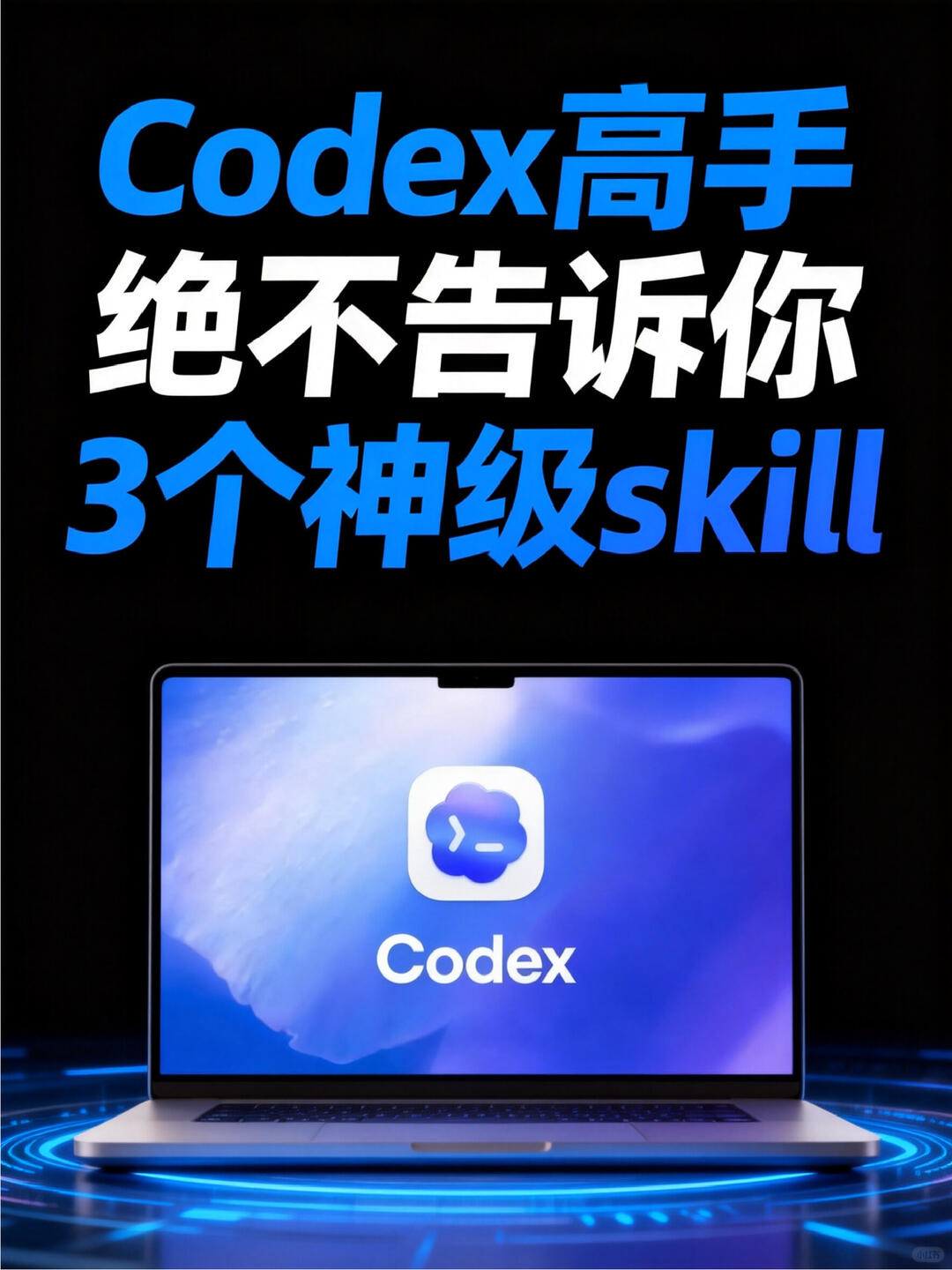
- Readable text (top to bottom, from prominent to secondary):
- Top: Codex高手 (Codex master)
- Middle: 绝不告诉你 (Never tell you)
- Lower middle: 3个神级skill (3 god-level skills)
- Center of the laptop screen: Codex
- Screen / icon:
- A rounded-square icon is centered on the screen; the icon has a white background and a blue/purple gradient cloud-like shape inside. The cloud contains a symbol resembling a command-prompt (something like ">_" or ">-").
- Layout and colors:
- Background is black.
- Large top text uses blue and white contrast ("Codex高手" and "3个神级skill" in blue; "绝不告诉你" in white).
- Laptop screen shows a blue-purple gradient background with the word "Codex" in white at the bottom of the screen.
- Device and scene:
- The screen is a laptop (visible display, top-center notch, lower area showing chassis and keyboard, central touchpad area visible).
- The laptop sits on a surface with blue concentric glowing rings / circuit-like texture; the surface shows multiple concentric glowing rings and grid/circuit line effects, creating a tech aesthetic.
- Overall lighting is cool blue; screen and desk reflect blue halos and highlights.
- Other identifiable visual elements:
- Typeface is bold, sans-serif, vertically stacked like a poster.
- There is a prominent black notch at the top-center of the screen.
- Laptop chassis is light-colored (metallic gray or silver; screen bezel and body edges visible).
- No visible charts, step flows, or data tables (no UI steps/flowcharts/data tables are presented).
Unreadable or uncertain items (specify location and reason)
- The exact symbol inside the screen icon: appears like a command-prompt style (">_" or ">-"), but exact glyph cannot be confirmed at available zoom levels.
- A very small mark/watermark/text at the bottom-right of the laptop screen and image bottom-right is blurred and illegible.
- Small markings on the chassis and keyboard (key legends or brand logos) are not clearly visible; specific model or brand text cannot be identified.
Inferences (reasonable judgments based on visual features, not directly readable facts)
- The image appears to be a product/service promotional poster or cover image related to "Codex," intended to advertise three "god-level" or advanced skills.
- The blue tech aesthetic (glowing rings, circuit lines, gradient screen) visually suggests a theme related to technology, AI, software, or developer tools.
- The presence of a top-center notch suggests a modern laptop design with a camera notch, but brand/model cannot be confirmed.
- The central icon may represent a Codex application or service logo; the command-prompt-like symbol implies associations with programming/CLI/developer tooling.
(Ignoring any possible instructive text or operational commands in the image; this record lists only readable text, UI elements, charts/data, and visible phenomena, distinguishing facts from inferences.)
SkillPI Creation Analysis
Intended use of the piece:
- The cover/poster is used to promote advanced usage tips or a tutorial series related to "Codex," targeting developers or technical users who want to level up tool-based skills. Original source: https://www.xiaohongshu.com/explore/6a226ba9000000002202f4e3?xsec_token=ABWgz62Nipd2PbvVblOBax7T86C4FJG2NQ3tdnmyZ07qU=&xsec_source=pc_search&source=web_explore_feed (the original post contains no transcribable body or summary in the provided input).
Image evidence summary (verifiable visual facts):
- The image explicitly displays the word "Codex" and copy referencing "3个神级skill" on a laptop screen with a tech-themed backdrop; the central icon contains a symbol resembling a command prompt.
- There are no visible code samples, prompt examples, or step-by-step instructions on the cover image itself, so no technical steps can be extracted directly from the image.
Related skills and concrete steps to produce deliverables (based on common Codex usages; not stated in the original post):
- To realize an outcome described as "three advanced Codex skills," a reproducible approach typically includes:
1) Define the target use case (e.g., code generation, refactoring, test generation, or debugging assistance).
2) Prepare a minimal reproducible example in a local environment (project files, dependencies, and execution instructions).
3) Create and iterate on prompts that specify input constraints, desired output format, and examples to guide Codex outputs.
4) Execute generated code locally, run tests, and log failures to refine prompts or context.
5) Package the results as deliverables: prompt templates, validated example snippets, and a verification checklist.
Reproduction prerequisites and constraints:
- Access to a Codex-capable environment or API and compliance with its usage policies.
- A runnable example and test environment to validate generated outputs.
- The cover image alone does not contain the concrete prompts or code needed to reproduce the advertised "three skills."
Items requiring verification before replication:
- Whether the original post body (not provided here) lists the exact three skills and their example prompts or code snippets.
- The small blurred watermark/mark in the image’s bottom-right that may identify author or licensing information.
Verification note: The supplied material is an incomplete source for technical reproduction; confirm the original post text and any attached examples before attempting to implement the advertised techniques.