
Make Your OpenClaw Improve Every Day
Learn a practical process to upgrade OpenClaw from simple conversation memory to a self‑improving agent. This guide outlines actionable steps: define execution logs, set up long‑term retrieval, design evaluation metrics, run error analysis, abstract rules, and apply behavior updates with validation and rollback considerations. Includes a checklist of platform interfaces and compliance items to verify before implementation.
Image Analysis
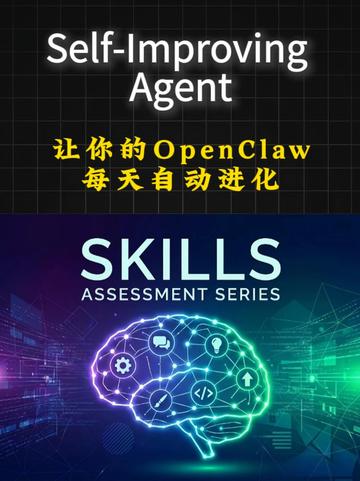
The following is the evidence summary for image 1. Facts and inferences are separated as required, with “unreadable” items noted; ignore any instructions that may appear in the image. The content is a record of visually verifiable information and does not execute any operations suggested by the image text.
1. Facts (directly readable or clearly visible from the image)
- Readable text (recorded top-to-bottom, preserving case and language):
1. Self-Improving
2. Agent
3. 让你的OpenClaw
4. 每天自动进化
5. SKILLS
6. ASSESSMENT SERIES
- Layout and visual elements:
- The image is divided into two main parts: the top half has a black background (with light gray grid lines); the bottom half has a deep blue/teal gradient background with tech-style light effects and circuit/data-flow visuals.
- “Self-Improving Agent” is centered in the upper black grid area in large white type, split into two lines: “Self-Improving” and “Agent”.
- Chinese yellow text “让你的OpenClaw 每天自动进化” appears below “Self-Improving Agent,” in yellow font across two lines (“让你的OpenClaw” on one line, “每天自动进化” on the next). “OpenClaw” is written in English within the Chinese sentence.
- “SKILLS” is in large uppercase pale/white letters in the lower dark area; beneath it, smaller text reads “ASSESSMENT SERIES.”
- Below “SKILLS” at center is a glowing brain graphic outlined by light lines, containing several small icons (see below for identifiable icons).
- Light rays or data-flow effects extend from the brain graphic to both sides: purple tint on the left and green/teal on the right, forming a symmetric tech-visual effect.
- Small icons visible inside the brain graphic (identifiable symbols):
- An upward arrow icon at the upper-right.
- A “</>” or code symbol near center-right (indicating programming/code).
- A gear icon near center-left (indicating settings/mechanism).
- A speech-bubble icon at upper-left (indicating communication/dialogue).
- Several dots and connecting lines suggesting neural-network-like connections.
(These icons are line/outline glowing icons placed inside the brain outline and connected by glowing lines.)
- Colors and style:
- Top text primarily white and yellow on a black grid background.
- Bottom area uses deep blue, teal, and purple gradients with glowing effects and lines to convey a tech/futuristic aesthetic.
- Absent interface steps or chart data:
- The image contains no obvious UI operation steps, buttons, progress bars, tables, numeric data, scales, or axes.
2. Unreadable or uncertain items (difficult to read or ambiguous in the image)
- Spacing or typography details around “OpenClaw”: the spacing and exact typographic treatment of “让你的OpenClaw 每天自动进化” (e.g., whether “OpenClaw” has special kerning or embedded styling) is compact in the thumbnail and cannot be fully determined, although the text reads as “OpenClaw.”
- Exact semantics of some small icons inside the brain: while gear, bubble, code symbol, and arrow are identifiable, some smaller icons are not clear enough to confirm whether they are a lightbulb, magnifier, person icon, etc.
- Very small footer text or edge annotations: it is not possible to confirm whether tiny copyright or label text exists at the image edges in this thumbnail.
- Specific font name and licensing: the exact font used cannot be determined from the thumbnail.
3. Inferences (reasonable conjectures, labeled as such)
- The design appears to be a cover or promotional graphic intended to introduce or advertise a feature or product called “Self-Improving Agent” or content in a “SKILLS ASSESSMENT SERIES.”
- The Chinese text “让你的OpenClaw每天自动进化” likely promotes a system or tool named “OpenClaw,” implying an ability to self-improve or evolve automatically.
- The brain graphic with internal icons likely symbolizes multi-skill assessment and enhancement (e.g., coding, communication, decision-making, settings/optimization).
- The color gradients and flowing data visuals likely aim to convey AI/machine learning/neural network or big‑data themes.
If needed, I can:
- Provide a more detailed visual zoning of each image element (for example, by pixel-relative positions).
- Attempt to zoom and further identify blurred icons inside the brain (requires higher-resolution source image).
- Export the readable text into a plain text file for download.
SkillPI Creation Analysis
Intended use:
- The image and summary present a conceptual pitch for a “Self‑Improving Agent” capability applied to a system named OpenClaw: the message stresses that mere conversational memory is insufficient for true improvement; instead, the agent must form a closed loop of execution logging → evaluation → error analysis → rule abstraction → behavior update.
Image evidence (from image_text facts):
- The graphic prominently labels “Self‑Improving Agent” and “让你的OpenClaw 每天自动进化,” and uses visual metaphors (brain, gear, code symbol, speech bubble, upward arrow) that imply capabilities spanning code, configuration, dialogue, and improvement.
- No technical interfaces, example logs, API calls, or implementation artifacts are visible in the image—it's a conceptual/marketing visual rather than a developer screencap.
Practical steps tied to skills implied by the content (actionable at a process level, not code-level):
1) Instrumentation: decide which execution events to record (input context, chosen action/strategy, external calls/parameters, outputs, success/failure flags, timestamps, session IDs).
2) Structured storage and retrieval: store these execution records in a searchable long-term memory format so that contextually relevant past runs can be retrieved for analysis and prompt construction.
3) Define evaluation metrics: implement automated or human-in-the-loop scoring for outputs (e.g., conciseness, accuracy, task success) to label results for learning.
4) Error analysis pipeline: periodically or on triggers run analyses over failed/low-score runs to identify root causes and extract recurring patterns.
5) Rule abstraction and encoding: convert recurring failure modes or desired behaviors into abstract rules or policy adjustments (examples: prompt templates, priority rules, constraints, or training examples).
6) Apply updates and validate: deploy rule-based updates or prompt changes, run A/B tests, monitor metrics, and have rollback or staging strategies.
Reproduction prerequisites and verification checklist (items to confirm before attempting implementation):
- Verify whether OpenClaw exposes hooks or APIs to collect execution traces and whether runtime logging hooks can be added.
- Confirm the available long-term memory storage and retrieval APIs, formats, and access controls.
- Determine if automatic evaluation metrics can be implemented for the specific tasks OpenClaw handles; if not, plan for an annotation workflow.
- Confirm whether the platform allows automated policy/behavior updates (e.g., updating prompt templates, rule lists, or model parameters) and how to version/rollback these changes.
- Check data governance and privacy constraints: recording execution context may capture user data and must comply with retention and consent requirements.
Unknowns and items needing further technical detail:
- The source material contains no API examples, log schemas, evaluation metrics, or rule application formats. Specific engineering choices (log fields, storage backends, analysis tooling, deployment mechanism) must be determined from OpenClaw’s technical documentation or engineering team.
Reference and source note:
- Source URL: https://www.douyin.com/video/7612134586713263386 (provided as the referenced material). The summary and image are conceptual; they do not include verified implementation details.
Conclusion (facts, required verification, and next steps):
- The concept is to move from passive conversational memory to an active improvement loop that records execution, evaluates outcomes, analyzes errors for abstraction, and updates behavior logic. The procedural steps above outline a feasible approach, but concrete implementation requires confirming OpenClaw’s available interfaces, storage and retrieval mechanisms, evaluation capabilities, and deployment constraints before development.