
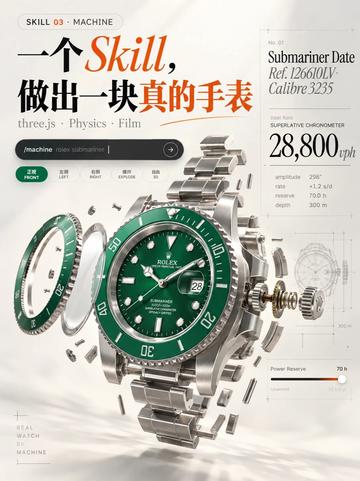
Skill 03: Real 'Machine' Skill
Learn a practical workflow to tell an AI what machine you want, have it research real structure and dimensions, generate parts and materials, integrate physics calculations, and export everything as a single HTML file that runs in the browser and can produce a demo video. The guide explains basic steps, prerequisites and what to verify before attempting reproduction.
Image Analysis
Image 1 — Extracted visual evidence
1) Readable text (verbatim / legible phrases):
- "SKILL 03 · MACHINE"
- "一个 Skill, 做出一块真的手表" (Chinese phrase present; “Skill” in English)
- "three.is · Physics · Film"
- browser/search/path bar text: "/machine rolex submariner"
- view/tab label: "正面" / "FRONT" (side-by-side, green)
- top-right title: "Submariner Date"
- second line: "Ref. 126610LV · Calibre 3235"
- large right-side text: "SUPERLATIVE CHRONOMETER"
- main numeric value: "28,800 vph"
- bottom scale/label: "Power Reserve" with annotation "70 h"
- other small/vertical English words partially legible: "REAL WATCH MACHINE" (left-bottom vertical)
- other small lines/parameters present but not fully legible (see “Unreadable content”)
2) Interface elements / controls visible:
- header/section label "SKILL 03 · MACHINE".
- mid-top search/path bar containing "/machine rolex submariner".
- green button labeled "正面 / FRONT" (likely view selection).
- right vertical column showing technical parameters (model, caliber, timing specs, frequency, charts).
- lower-right shows a "Power Reserve" axis/slider/indicator marked 70 h.
- left-bottom vertical small title/brand text "REAL WATCH MACHINE".
3) Chart data & technical graphics (legible numbers):
- frequency: "28,800 vph" (below "SUPERLATIVE CHRONOMETER").
- power reserve: "70 h" (associated with "Power Reserve").
- right-side contains small schematic images including circular cross-section and dimension annotations (details mostly blurred).
- right-side also includes small bar/gauge visuals for amplitude/power/remaining, with only "Power Reserve 70 h" clearly legible.
4) Visible objects / visual features:
- A green-bezel, green-dial dive watch (Submariner style) shown as an exploded view with parts radially separated:
- separated bezel and insert;
- crystal/bezel assembly, dial, hands and case;
- crown, crown stem, springs/gaskets and small parts arranged to the right of the case;
- metal bracelet links separated and arranged below the case;
- date window with cyclops magnifier at right side of the dial;
- dial shows ROLEX-style uppercase letters (brand-like typography), central hour markers and hands visible;
- background includes engineering-drawing style lines (circle cross-section, dimension callouts, grid lines);
- rendering style is high-fidelity 3D/photorealistic with shadows and highlights.
5) Unreadable content (explicitly noted):
- right-side parameter column lines other than "28,800 vph" and "Power Reserve 70 h" are blurred and cannot be fully transcribed.
- fine dimension callouts on the engineering diagram on the right are not legible.
- some small header/mid-area text and icons are partially obscured or blurred beyond accurate transcription.
6) Facts vs. inferences:
- Facts (based solely on visible/readable content):
- header shows "SKILL 03 · MACHINE".
- Chinese phrase visible: “一个 Skill, 做出一块真的手表”.
- path bar contains "/machine rolex submariner".
- the page displays an exploded-view green-bezel Submariner-style dive watch with a date window and metal bracelet.
- right-side lists "Submariner Date", "Ref. 126610LV · Calibre 3235", "SUPERLATIVE CHRONOMETER", "28,800 vph", and "Power Reserve 70 h".
- page includes engineering-drawing visual elements and a technical parameter panel.
- Inferences (based on visible clues but not fully legible):
- the watch appears to be a Rolex Submariner Date (based on "Submariner Date", "Ref. 126610LV", dial/bezel style and visible ROLEX-like text).
- other right-side parameters likely represent amplitude, beat error, depth rating or similar technical specs, but specific values are blurred.
- page layout suggests a magazine or technical feature presentation, though no publication name/date is visible.
End of visual evidence extraction.
SkillPI Creation Analysis
Intended use of the piece:
- The video/demo illustrates a ‘Machine Skill’ workflow that converts a short natural-language description into an interactive mechanical model with component-level visualization, parameter panels and integrated physics calculations, then packages the result as a single HTML file that runs in a browser and can produce a demo video.
Image evidence summary:
- The screenshot shows "SKILL 03 · MACHINE", a path of "/machine rolex submariner", and an exploded-view model of a green-bezel Submariner-style watch. Right-side UI lists "Submariner Date", "Ref. 126610LV · Calibre 3235", "SUPERLATIVE CHRONOMETER", "28,800 vph" and "Power Reserve 70 h". "three.is · Physics · Film" is also visible in the image.
Steps to use the described Skill (derived from source text; actionable outline without claiming full reproduction):
1) Provide a one-sentence prompt to the AI describing the machine you want (example: “a fully explodable Rolex Submariner mechanical watch model with visible movement”).
2) The system gathers/reference real-world structure and dimensional data for the requested object (source states AI “studies real structure and dimensions”).
3) The AI generates part geometry, materials, assembly relationships, and creates interactive views (outer shell, cutaway, angle changes, exploded parts). A parameter panel displays model metadata (e.g., Ref. number, caliber, frequency, power reserve).
4) If supported, the platform integrates basic physics/functional calculations (e.g., thrust, combustion parameters, movement frequency) so displayed telemetry values update according to internal model parameters.
5) The platform exports or bundles the full interactive scene and any physics behaviors into a single HTML file that can be opened in a browser and used to generate a demonstration video.
Prerequisites to attempt reproduction:
- Access to the exact platform, model, or service that performs the conversion from prompt to interactive HTML (the video does not name a verified product; this must be obtained or confirmed).
- A browser with support for the required client-side technologies (likely WebGL and possibly WebAssembly or JS physics libraries) if the physics and rendering run client-side.
- Source data for accurate models/parameters when fidelity matters (e.g., "Ref. 126610LV · Calibre 3235", "28,800 vph", "Power Reserve 70 h").
- Permissions/licenses for using brand-specific designs and technical specifications if redistributing or publishing results.
Items requiring verification (not explicit or unclear in the source):
- The specific tool/service used to produce the single-file HTML (the term “Machine Skill” is used descriptively in the video but no commercial product or repository is cited).
- Whether the physics simulation runs fully client-side in the exported HTML, or if it relies on precomputed data or a backend service.
- Technical export details of the HTML (included libraries, runtime dependencies, file size, performance on different browsers/devices).
- The provenance of the reference data (are dimensions and part parameters taken from official specifications, third-party databases, or approximated by AI?).
Source & preserved identifiers:
- Video URL: https://www.douyin.com/video/7696175669423639823
- On-screen identifiers and numbers preserved in the image: "Ref. 126610LV · Calibre 3235", "28,800 vph", "Power Reserve 70 h", and path "/machine rolex submariner".
Conclusion (evidence-based):
- The provided material demonstrates a concept: an AI-driven workflow that can generate interactive, physics-aware mechanical visualizations and export them as a runnable HTML file. The description and screenshot show interface elements and concrete numeric examples (watch reference, frequency, power reserve). However, the source does not disclose the exact implementation details or the specific tool used; those technical specifics must be obtained to replicate the output.