
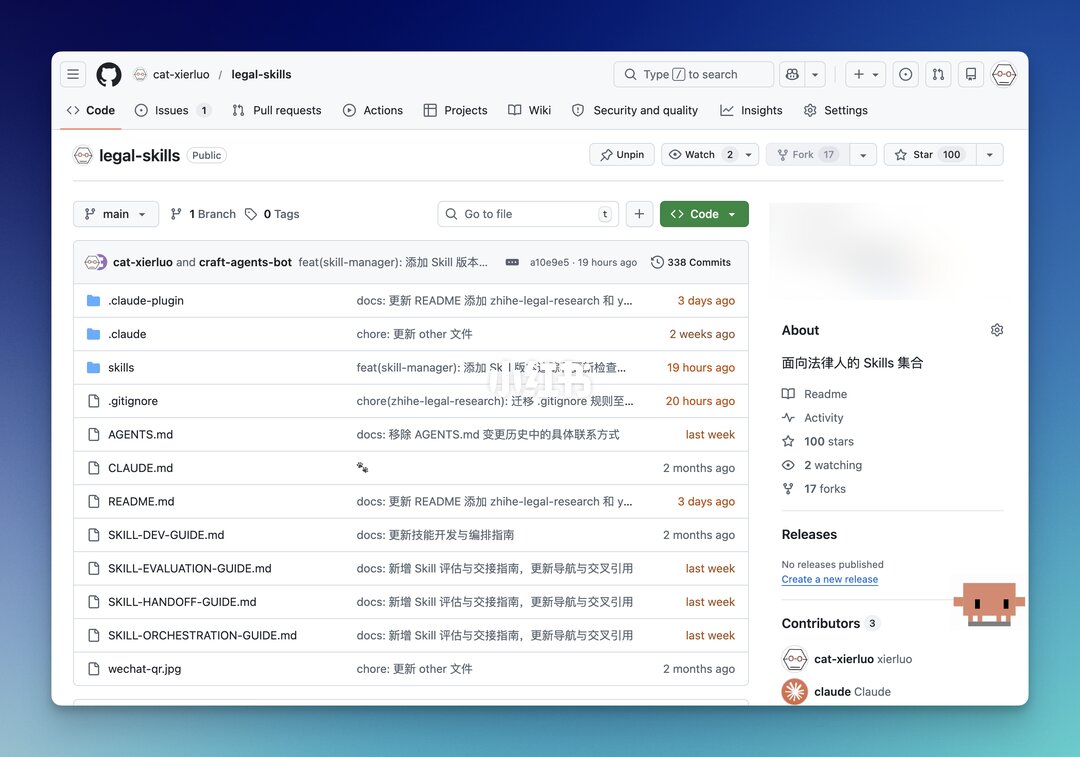
legal-skills reached 100 stars
Learn how to verify and reuse the legal-skills GitHub repository: clone the repo, read README and SKILL-DEV-GUIDE.md, inspect skills/ and .claude(.plugin) directories, review SKILL-EVALUATION-GUIDE.md and SKILL-HANDOFF-GUIDE.md, check commit history and contributors, and confirm per-skill dependencies before reuse.
Image Analysis
Image 1 — Evidence record (organized top-to-bottom, left-to-right)
Facts (only record readable text, UI elements, times and numbers visible in the image)
- Top path / title
SkillPI Creation Analysis
Intended use:
- The repository is presented as a collection of skills for legal professionals. The presence of README.md and multiple SKILL-* guide files indicates the project aims to provide development, evaluation, orchestration, and handoff documentation for skills and possibly example implementations in the skills/ directory.
Key evidence from the screenshot (based on image_text):
- Repo path cat-xierluo / legal-skills and About text "A collection of Skills for legal professionals" confirm scope and audience.
- Files like SKILL-DEV-GUIDE.md, SKILL-EVALUATION-GUIDE.md, SKILL-HANDOFF-GUIDE.md indicate explicit developer and delivery guidance is provided.
- Branch main, 338 commits, contributors listed, and UI stats (stars/watchers/forks) are visible; Releases area shows no published releases.
Steps to inspect or reuse skills (based on repository structure and standard verification workflow; do not assume runtime requirements):
1. Obtain the repository URL from GitHub and clone locally: git clone <repo URL>. The screenshot does not show the clone URL; you must fetch it from the repo page.
2. Checkout the main branch: git checkout main, and review commit history (git log) to understand recent changes and the role of commits like feat(skill-manager).
3. Read README.md for an overview, then open SKILL-DEV-GUIDE.md to learn the repo’s conventions for skill development and integration.
4. Review SKILL-EVALUATION-GUIDE.md and SKILL-HANDOFF-GUIDE.md to understand required evaluation criteria and handoff artifacts for delivering a skill.
5. Inspect the skills/ directory to see individual skill implementations, looking for README files, dependency lists, tests, or run instructions per skill.
6. Check .claude and .claude-plugin directories for platform-specific integration files (the screenshot shows these directories but does not reveal their contents).
7. Check Issues and Pull Requests (Issues 1 visible in the UI) for known problems or ongoing work before reusing code.
Prerequisites for reproduction or reuse:
- Access to the full GitHub repository (the screenshot omits the clone URL and hides truncated commit messages).
- Git tooling to clone and inspect commit history.
- For running any skill, read each skill’s README/config to determine runtime dependencies or required credentials—these are not visible in the screenshot and must be confirmed per skill.
Items that require verification after cloning:
- The exact contents, languages, dependencies, and run instructions for each item inside skills/.
- Whether .claude/.claude-plugin files require specific platform credentials or SDKs (e.g., Claude integration); the screenshot lists these directories but does not show their files.
- License and compliance information (no LICENSE file visible in the screenshot).
- CI/CD workflows or automated checks (Actions tab is visible but workflow files are not shown in the screenshot).
Notes and constraints:
- The summary references a tool named openclaw; the screenshot and repo structure do not provide enough detail to confirm how openclaw is used or whether it is required—this is a point to verify in repository files.
- The screenshot shows some commit messages truncated (e.g., feat(skill-manager): 添加 Skill 版本...), so full commit context must be obtained from the repository to validate versioning and change rationale.
Conclusion:
- The repository appears to be a documented collection of legal-oriented skills with developer and handoff guides appropriate for reviewing, integrating, or adapting skills. To actually run or deploy any included skill, clone the repo, read per-skill documentation, and verify dependencies, platform integrations (e.g., .claude plugin), and licensing.