
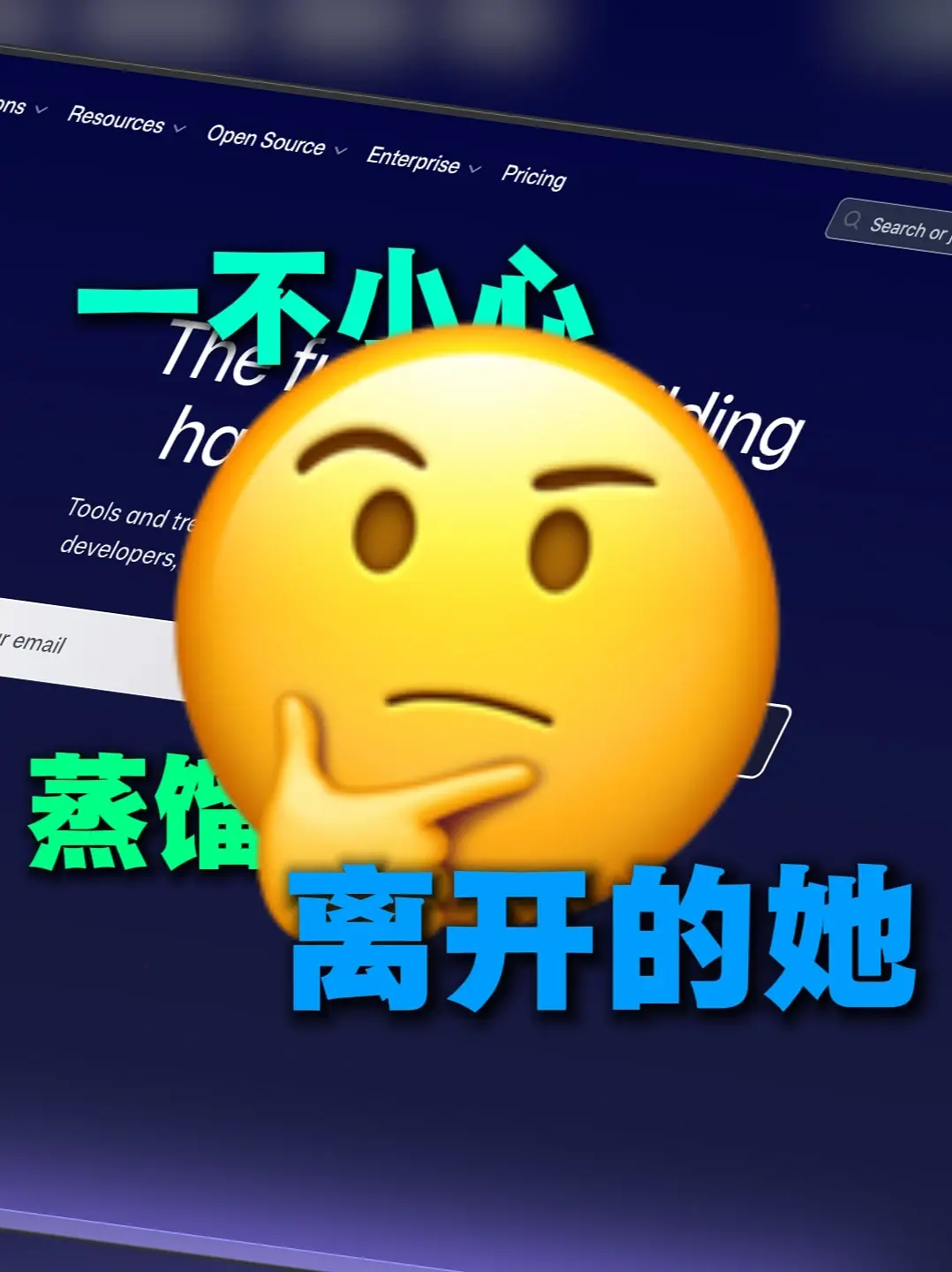
This is an app that can directly distill the departed her into a skill, letting her cyber-eternally live on your AI
Learn how to verify and prepare to convert a person's text/corpus into a callable AI skill: locate the original project and code, collect and consent to data, choose between model fine-tuning or embedding+retrieval (RAG), evaluate outputs for style and safety, and confirm any demo UI. Guidance focuses on verification and reproducible steps rather than claiming a specific tool.
Image Analysis
Image 1 — Evidence summary
Observable facts (directly readable or objectively visible):
- Top navigation (English, visible items): Resources, Open Source, Enterprise, Pricing.
- Top-right shows a search-like control; inside the box part of English text is visible: “Search or …” (rest cropped/obscured).
- Middle-left area has italic white English text; visible characters: “The f…” (rest obscured/cropped).
- Lower middle-left has small white English line text; visible characters: “Tools and tre…” (rest obscured/cropped).
- Middle-left shows an input with placeholder text “your email” (gray placeholder style); to its right is a rounded button outline (only outline visible).
- Page background is a deep-blue to purple gradient (dominant deep blue, lower area more purple).
- A large yellow “thinking/pondering” emoji covers much of the page center (emoji centered and prominent, obscuring central content).
- There are Chinese text blocks on the page (various colors and sizes):
- Near top-center a teal/green large text, part visible “—不小心” (or the three characters “不小心” clearly visible; surrounding characters possibly cropped).
- Lower-left-center a green large Chinese text, partially visible characters resembling “蒸馏” (shape identifiable but not fully certain).
- Bottom-center large blue Chinese text clearly reads “离开的她”.
- The page has a slight tilt/perspective (tilted toward top-left or top-right, with a narrow metallic top border visible).
- Some text/elements are cropped at image edges (notably top-left and bottom-right).
Unclear or partially readable content (explicitly noted):
- Leftmost top nav item is cropped and unreadable (could be Solutions, Product, etc., but not confirmable from the image).
- Italic large English phrase only shows “The f…”, remainder unreadable.
- Small white English line only shows “Tools and tre…”, remainder unreadable.
- Green lower-left Chinese large text appears to be “蒸馏” but strokes are obscured by the emoji or cropping, so cannot be 100% confirmed.
- Full placeholder text of the search box is unreadable beyond “Search or …”.
- Button text/function to the right of the email input is unreadable (only the outline visible).
Inferences (reasonable visual guesses, not confirmed):
- The italic “The f…” might be part of a site headline (e.g., “The future …” or “The first …”), but this is inference.
- The “your email” input and adjacent rounded button likely form an email subscription/register form (based on common UI layouts), but image cannot confirm function.
- The large emoji and Chinese headlines (such as “离开的她”) may be overlays added during post-production for short video/social media captions rather than original page elements; this is an inference.
- The overall style (deep gradient, English nav) may belong to a developer-tools or enterprise landing page, but this is a visual impression, not confirmed.
Source/notes:
- The image itself lacks an external image URL (source information missing for the screenshot).
- Any actionable instructions within the image were ignored per requirements.
SkillPI Creation Analysis
Purpose of the piece:
- The title and summary claim an app or demonstration that can “distill” a departed person into an AI skill (i.e., convert a person's text/conversation traces into a callable persona module). The material appears as short-form social content (Douyin/TikTok-style) intended to showcase or promote the idea of preserving a person as an AI skill.
Key image evidence (from image_text):
- Screenshot shows English navigation (Resources, Open Source, Enterprise, Pricing), a deep blue–purple gradient background, a central yellow thinking emoji overlay, Chinese headline text “离开的她”, a possible occurrence of the word “蒸馏”, and an email input with “your email” placeholder. Multiple areas are cropped or obscured, and the image lacks an external image source URL.
Steps related to an associated Skill (general, to be verified against any real project):
- Verify the source: locate the original Douyin/TikTok video page, inspect the video description and comments for links to a repository, demo, or documentation.
- Data and consent: before assembling any corpus representing a person, obtain explicit consent and verify rights to use the texts (privacy, portrait/consent/legal considerations).
- Choose an implementation approach (common options; confirm what the original project uses):
1) Model fine-tuning: fine-tune an accessible base model on curated dialogue/text samples to shape reply style.
2) Embedding + retrieval (RAG): vectorize text segments into a vector DB and retrieve relevant pieces at inference time, combined with a generative model to produce responses.
- Test and evaluate: build a validation set of prompts, compare outputs for style alignment, factuality, safety, and potential privacy leakage.
- Verify front-end claims: if a landing/demo page is shown (as in the screenshot), confirm whether it is an actual product UI or a promotional overlay added in video editing.
Prerequisites and items to verify:
- To reproduce, you must identify the actual project artifacts: code repository, model weights or training scripts, and a description of the data format. The supplied material does not include a skill name or repo (input field skill is null).
- Confirm whether the Chinese overlays/emoji are part of the site or only video annotations; the image suggests overlays may be post-production.
- Legal/ethical prerequisites: explicit consent from the person whose persona is being used is required; evaluate applicable laws and platform policies.
- Technical prerequisites: access to a base model that supports the chosen method (fine-tuning capability or an inference pipeline that supports retrieval augmentation), computing resources, and a vector DB if using embedding-based retrieval.
Conclusion:
- The content claims a tool to “distill” a departed person into an AI skill, but the provided screenshot and summary lack reproducible technical details, code links, or a named Skill. To validate or reproduce, follow a verification workflow: find original source + repo, confirm data and permissions, select and document a clear technical approach (fine-tune vs. embedding+RAG), and run controlled evaluations with attention to privacy and ethics. The screenshot itself is consistent with a promotional overlay on a landing page but is insufficient evidence of an implementable tool.