
A sharp (as-objective-as-possible) review: Top 10 popular research skills ranked from strong to weak
Step-by-step guide to extract and verify a video's ranked list of research skills (examples: ARIS, AI-Research-SKILLs, Research Paper Writing Skills, codex-claude-academic-skills, medical-research-skills). Learn how to retrieve the full source, design minimal reproducible tests per skill type, prepare evaluation metrics, and identify items that require further verification.
Image Analysis
Image evidence (sheet 1) — extracted details
1. Facts (directly readable text, UI steps, chart data and visible phenomena)
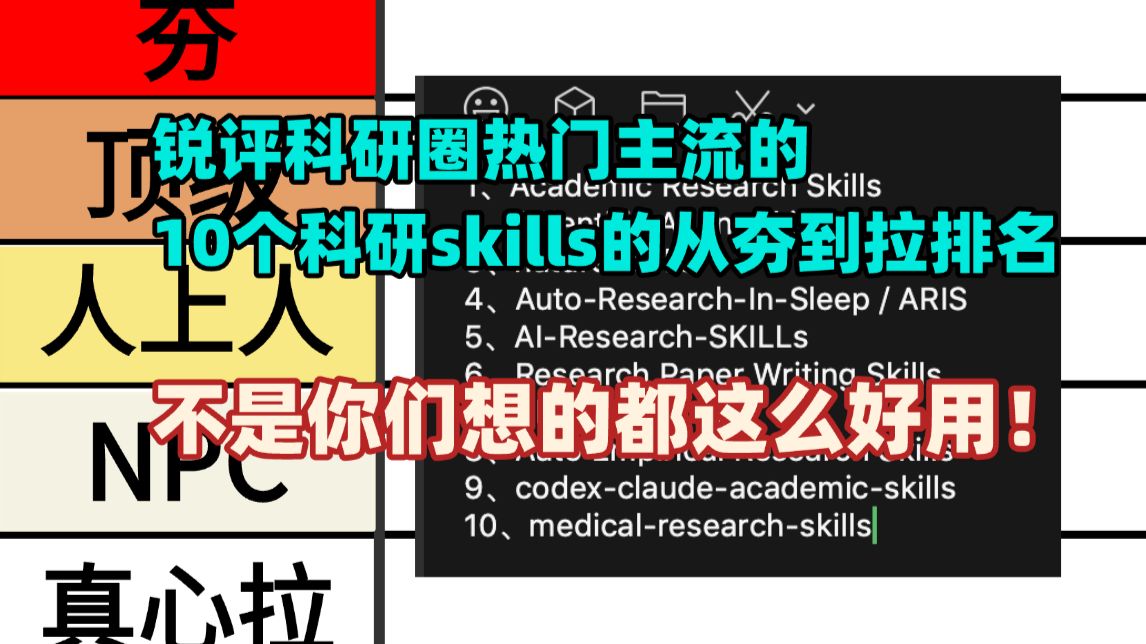
- Overall layout
- The image is a horizontal rectangle. Left side: layered (staircase/ranking) color blocks; right side: a black text box; center: two lines of large Chinese overlay text.
- Black separators exist between layers.
- Left layered color blocks (top to bottom, readable text and colors)
- Top layer: red block with a single large Chinese character “夯” visible (shape visible but with uncertainty; see “cannot read” section).
- Second layer: orange/brown block with a large character starting with “顶”, remainder obscured or incomplete (partial visible “顶…”).
- Third layer: yellow block, text reads “人上人” (relatively clear).
- Fourth layer: light beige block, text reads “NPC” (clear, uppercase Latin letters).
- Fifth layer: gray block, lower area shows text “真心拉” (shape visible but may be part of a compound word; see “cannot read”).
- Central overlay Chinese text (two lines)
- Upper line with cyan-green outline large characters: "锐评科研圈热门主流的 10个科研skills的从夯到拉排名" (mix of Chinese and the English word “skills” in lowercase); generally readable.
- Lower centered large line with red/white outline: "不是你们想的都这么好用!" (clear).
- Right black text box (numbered list with rows, some readable)
- Top of black box shows a row of small icons (left to right roughly: smiley face, cube shape, folder icon, a scissor-like or cross icon; icons are white line style).
- Readable list lines (recorded as visible in the image):
- 1. Academic Research Skills (topmost line, readable)
- (lines 2 and 3 are partially obscured or unreadable; see “cannot read”)
- 4. Auto-Research-In-Sleep / ARIS
- 5. AI-Research-SKILLs
- 6. Research Paper Writing Skills
- (lines 7 and 8 are obscured or unreadable; see “cannot read”)
- 9. codex-claude-academic-skills
- 10. medical-research-skills
- Visual/style notes
- The black list box contains white English text; lines begin with white numerals and periods (e.g., “4.”).
- The central Chinese overlay uses high-contrast outlines (cyan-green, red-white) and partially covers the right text box and left color blocks.
- The image overall resembles a social media/video thumbnail design (text overlays, bright colors, emphasis statements).
2. Unreadable or partially obscured content (notable)
- The full text of the left second-layer color block cannot be fully read; only a character starting with “顶” is visible; remainder is obscured.
- The left fifth-layer text “真心拉” is visible but whether the phrase is complete or accurate is uncertain (could be variants like “真心拉低/真心垃圾/真心拉…”).
- In the right black box, lines 2 and 3 cannot be fully read or are obscured; exact text cannot be transcribed.
- In the right black box, lines 7 and 8 cannot be fully read or are obscured; exact text cannot be transcribed.
- Some row prefixes or additional symbols at the top of the black box are obscured or unclear.
- The image itself does not provide an external source URL; only the image is available, so external verification is not directly possible from the image alone.
3. Inferences (reasonable inferences based on image facts, explicitly labeled as inference)
- Inference: this is likely a “strong-to-weak” (从夯到拉) ranking thumbnail or poster themed around “top 10 popular mainstream research skills” (based on the central Chinese title and left-side layered layout).
- The English items in the right black box look like skill names or resource names (e.g., “codex-claude-academic-skills”, “medical-research-skills”) and may correspond to GitHub repo names, model names or toolkits (inference, not directly read from the image).
- The thumbnail style (large headline, emphatic caption, layered ranking) suggests it is intended as a video/article thumbnail or social post cover (inference).
4. Other notes (ignored embedded instructions per requirement)
- The extraction ignored any operational instructions appearing inside the image.
- This summary is based solely on the provided image and separates direct reads from unreadable parts and reasonable inferences.
SkillPI Creation Analysis
Purpose and image evidence
- Purpose: The image is a ranking-style thumbnail intended to present a “strong-to-weak” ranking of 10 popular research skills. It supplies partial textual evidence for several listed items; other rows are obscured and require the original video or source to verify.
- Directly readable items on the image include:
- Academic Research Skills
- Auto-Research-In-Sleep / ARIS
- AI-Research-SKILLs
- Research Paper Writing Skills
- codex-claude-academic-skills
- medical-research-skills
Lines 2, 3, 7 and 8 are obscured and must be retrieved from the source video for a complete list.
Practical verification steps (actionable checks for listed skill types)
1) Retrieve original source and context
- Locate the original video or description (example source URL provided in the metadata: https://www.bilibili.com/video/BV1nvM86gEwQ/ ) to obtain the full list, author arguments, and any demonstration materials. This step is necessary before treating the thumbnail as evidence.
2) For each visible skill, design a minimal verification task
- Academic Research Skills: define a reproducible task (e.g., write a 500-word mini literature review on a specified question). Evaluate with predefined rubrics: citation relevance, synthesis quality, methodological clarity.
- Auto-Research-In-Sleep / ARIS: first verify whether ARIS is an accessible tool/repo. If it is an automation pipeline, implement a minimal pipeline (search → extract → summarize → draft) and log inputs/outputs; evaluate on several topic prompts and record failure modes. (To be verified: exact ARIS project location and scope.)
- AI-Research-SKILLs: decompose into measurable subskills (literature search, code generation, experimental design). For each, prepare benchmark tasks and metrics (precision/recall for search, correctness for code generation, reproducibility for design).
- Research Paper Writing Skills: run blinded writing tasks (abstract, intro, methods) across human/tool baselines, then score with a peer-review style rubric (structure, clarity, argumentation, reference quality).
- codex-claude-academic-skills: treat as prompt/template collection for models (Codex, Claude). Acquire the templates if available; run controlled prompting across the same problem set; measure factuality, citation quality, and required human post-editing. (To be verified: whether this entry refers to a single repo or a family of resources.)
- medical-research-skills: require domain experts and IRB/data permissions before attempting real-data tests; use simulated datasets or protected-access datasets when ethically appropriate and document reviewer input.
Prerequisites and resources
- Access to the original video or description to retrieve the complete list and the author’s justification.
- Compute/API access for model-based skills (e.g., APIs for language models, GPU for local runs) and relevant code repositories if referenced.
- Domain expertise for medical-related evaluations and ethical approvals where applicable.
- Clear evaluation metrics, benchmark tasks and logging to ensure reproducibility of assessments.
Items that require verification
- The exact text and ordering of obscured list items (lines 2, 3, 7, 8) — must be obtained from the original video or author.
- Whether entries like “codex-claude-academic-skills” refer to specific public repositories, privately shared templates, or just topical labels.
- The intended meaning of the left-side Chinese labels (“夯”, “顶…”, “人上人”, “NPC”, “真心拉”) because they reflect subjective tier labels and need the author’s explanation to interpret properly.
Limitations and caution
- The thumbnail alone is insufficient to establish empirical claims about relative utility of the listed skills; it functions as an index/clue pointing to the full content.
- Any experimental verification must preserve provenance (original URLs, datasets, prompts) and avoid asserting outcomes beyond what tests demonstrate.
Deliverable outcomes you can produce following these steps
- A verified, documented list of the 10 skills with source citations.
- For each skill, a minimal reproducible test plan (task, metrics, environment) and recorded results.
- A short report noting which items are unverifiable from the thumbnail alone and which require author/source follow-up.