
AI research skills GitHub heat ranking: which one do you use?
Compare five popular AI research Skill/Agent GitHub repositories (academic-research-skills, scientific-agent-skills, nature-skills, AutoResearchClaw, AI-Research-SKILLs). Learn a practical checklist to evaluate and run them: read README, check license and maintenance, inspect dependencies, run minimal examples, and verify compute/data/API requirements—so you can decide which fits literature review, paper writing, or experiment automation.
Image Analysis
Image 1 — readable text, interface elements, chart data and visible phenomena (facts / inferences / unreadable)
1) Readable text (facts)
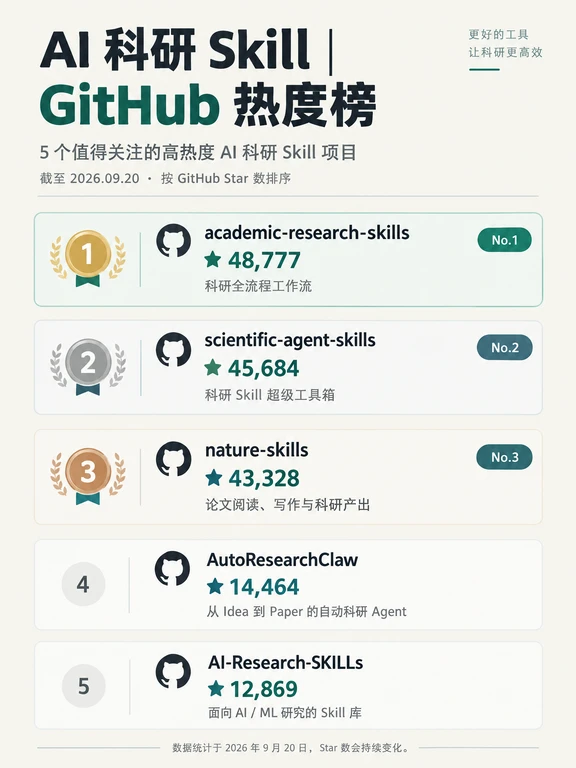
- Main title: AI Research Skill | GitHub Heat Ranking
- Subtitle: 5 noteworthy high-heat AI research Skill projects
- Small note: As of 2026.09.20 · Sorted by GitHub Star count
- Top-right small text: Better tools make research more efficient
- Ranked entries (in image order):
1. academic-research-skills
- Stars: 48,777 (star icon shown)
- Description: end-to-end research workflow
- Right tag: No.1
2. scientific-agent-skills
- Stars: 45,684
- Description: research Skill super toolkit
- Right tag: No.2
3. nature-skills
- Stars: 43,328
- Description: paper reading, writing and research output
- Right tag: No.3
4. AutoResearchClaw
- Stars: 14,464
- Description: automated research Agent from Idea to Paper
- Left circular “4” badge
5. AI-Research-SKILLs
- Stars: 12,869
- Description: Skill library for AI/ML research
- Left circular “5” badge
- Bottom small text: Data collected on 2026-09-20, Star counts will change over time.
2) Interface elements and visible phenomena (facts)
- The page uses a beige background with green/teal accents.
- Each entry has a badge or ranking icon on the left (gold/silver/bronze circular badges for top 3, gray circles with numbers for 4 and 5).
- A GitHub icon appears near each repo name; a star icon and star count are displayed next to the repo name.
- Right-side rounded rectangular labels show No.1 / No.2 / No.3 for the top three only; items 4 and 5 lack this right-side No.x label.
- The word “GitHub” in the title is colored/ highlighted differently from the rest of the title.
- Layout is a vertical list with separators or whitespace between items.
- The overall style is an infographic/poster (designed layout rather than a raw webpage screenshot).
3) Chart data (facts, as shown in image)
- 1 academic-research-skills — 48,777
- 2 scientific-agent-skills — 45,684
- 3 nature-skills — 43,328
- 4 AutoResearchClaw — 14,464
- 5 AI-Research-SKILLs — 12,869
4) Interface steps (facts / no obvious steps)
- The image is informational; it does not show clickable buttons, dropdowns, or explicit interaction steps such as “click” or “enter”.
5) Unreadable or uncertain details (notes)
- Decorative lines and small icons near the top-right are visible but any extra small text beyond “Better tools make research more efficient” cannot be fully read.
- Edge areas may contain smaller copyright or source text that is blurred and unreadable; URLs or source IDs (if present) could not be read.
- Badge textures inside the top 3 or the small icons inside circles for items 4 and 5 are too small to identify detailed imagery; only color/number shapes are discernible.
6) Inferences (marked as inferences)
- Inference: The star counts likely refer to GitHub repository stars (image notes it’s sorted by Star count).
- Inference: The right-side No.x labels are a design choice to highlight the top three.
- Inference: The image is aimed at a Chinese-speaking audience as a promotional/summary poster showing repo popularity at a given date.
(Ignored any imperative instructions found in the image; the above records only readable text, interface elements, numeric data and visible phenomena.)
SkillPI Creation Analysis
Purpose and high-level assessment:
The image is an infographic ranking several AI research Skill/Agent repositories by GitHub star count at a specific date (2026-09-20). It’s intended as a quick reference to identify popular repositories and their stated positioning (e.g., end-to-end workflow, reading/writing assistance, automated agent). This is a starting point for selection, not a substitute for repository-level validation.
Image evidence summary (verifiable facts):
- The infographic lists five repositories with the shown star counts: academic-research-skills (48,777), scientific-agent-skills (45,684), nature-skills (43,328), AutoResearchClaw (14,464), AI-Research-SKILLs (12,869).
- The graphic explicitly states the ranking is by GitHub Star count as of 2026-09-20.
Practical evaluation and usage steps (applies to each listed repo; reproducible checks):
1) Read the repository README and docs to confirm claimed scope (e.g., “end-to-end workflow” vs “paper reading/writing”).
2) Check maintenance activity: latest commits, open/closed issues, PR activity, and contributors to gauge ongoing support.
3) Verify licensing and usage constraints (LICENSE file) for research vs commercial use.
4) Inspect dependencies and environment files (requirements.txt, environment.yml, Dockerfile) to determine runtime needs.
5) Run an author-provided minimal example in an isolated environment (virtualenv or container) and record any missing dependencies or required external services.
6) For repositories that claim automated experiments or paper generation, test with small-scale or synthetic data first and do not assume production-ready automation.
Preconditions and verification checklist before attempting reproduction:
- Compute and data availability: Automated experiment agents may require significant compute or specific datasets; confirm local/cloud resources and dataset licenses.
- External services and keys: Determine whether the project requires closed-source LLMs, external APIs, or paid services and whether you have access/keys.
- Security and privacy: If the project crawls or processes external data, verify compliance with data-use policies and privacy constraints.
- Maintenance vs popularity: High star count is not equal to active maintenance; verify recency of commits and issue resolution.
- Documentation completeness: The infographic provides names and star counts only—functional details, example commands, and integration instructions must be validated in each repo.
Suggested high-level use-cases based on the image labels (do not assume unlisted features):
- academic-research-skills (end-to-end research workflow): Useful for teams aiming to pipeline literature search, notes and deliverables. Start by reviewing pipeline examples and integrating pieces into your workflow.
- scientific-agent-skills (research Skill toolkit): Useful when composing modular Skills for complex tasks. Test individual Skills’ input/output behavior before composing end-to-end flows.
- nature-skills (paper reading/writing and outputs): Targeted at literature reading and writing support—validate model or tool dependencies and how outputs handle citations/formatting.
- AutoResearchClaw (idea-to-paper Agent): Represents an automation attempt; verify compute/data requirements and validate outputs on small controlled tasks.
- AI-Research-SKILLs (AI/ML research Skill library): Likely provides modular Skills for research pipelines—test module compatibility and integration points.
Items to verify in each repository (short checklist):
- Can the README example run locally as-is? If not, what is missing?
- Which external APIs/models are required and are they publicly accessible or paid?
- What is the license and are there usage restrictions for your intended scenario?
- How recent is the last commit and are issues being addressed?
- Are there explicit warnings about data, compute or ethical limits in the docs?
Source and reference: original listing page provided by the user: https://www.xiaohongshu.com/discovery/item/6aaf9089000000002b00177c?app_platform=ios&app_version=9.34&share_from_user_hidden=true&xsec_source=app_share&type=normal&xsec_token=CBjCUaa0u86CTftUwDXjtfpjSgokOIitbk4OFa5Rca4ac=&author_share=1
Note: The infographic gives repo names, positioning descriptions and star counts only. For functional adoption, run the reproducible checks above on each GitHub repository; do not rely solely on star counts or the infographic when choosing tools for important research workflows.