
The world's top 10 most popular Skills — is your go-to one on the list?
Step-by-step guidance to evaluate and start using 10 popular open-source Skills (e.g., karpathy-guidelines, ponytail, ui-ux-pro-max). Learn how to check README and activity, run examples, and integrate a Skill into your workflow to reduce duplicated work, standardize UI, and turn book knowledge into reusable team skills.
Image Analysis
Readable image facts (observations):
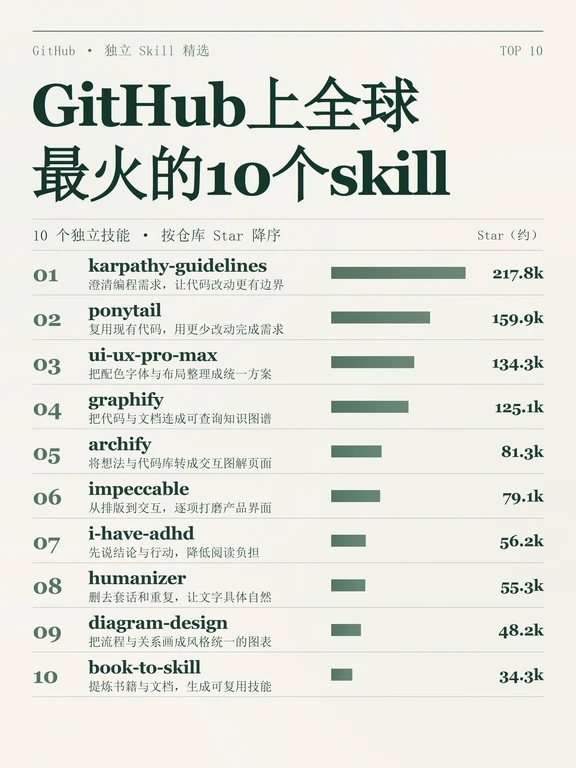
- Header/title: left “GitHub · 独立 Skill 精选”, right “TOP 10”. Main title: “GitHub上全球 最火的10个skill”; subtitle: “10 个独立技能 · 按仓库 Star 降序.”
- List entries (number, repo name, short Chinese description, horizontal bar, star count):
01 karpathy-guidelines — Clarify programming requirements and bound code changes; Star 217.8k (longest dark green bar).
02 ponytail — Reuse existing code to minimize changes; Star 159.9k.
03 ui-ux-pro-max — Consolidate color, fonts and layout into a single scheme; Star 134.3k.
04 graphify — Connect code and docs into a searchable knowledge graph; Star 125.1k.
05 archify — Convert ideas and codebase into interactive diagrams; Star 81.3k.
06 impeccable — Polish existing UI across typography, color and motion; Star 79.1k.
07 i-have-adhd — Provide conclusion and next steps first to reduce reading load; Star 56.2k.
08 humanizer — Remove bland or repetitive phrasing to make text more natural; Star 55.3k.
09 diagram-design — Turn flows and relationships into consistently styled diagrams; Star 48.2k.
10 book-to-skill — Extract books/docs into reusable skills; Star 34.3k (shortest bar).
- Visual style: dark/leaf greens for bars, light beige/gray background; two-digit numbering format (01–10); star counts shown with one decimal and ‘k’.
Not present or not readable in image:
- No data timestamp (unknown as-of date for Star counts).
- No repository URLs or external links shown in the image.
- No detailed definition or selection criteria for what constitutes a “skill.”
SkillPI Creation Analysis
Purpose and overview:
- The image presents a Star-ranked shortlist of 10 standalone open-source “Skills” intended to help with recurring work problems in coding, UI design, documentation and knowledge management.
Image evidence (items to verify):
- The image provides repo names, short descriptions in Chinese, and approximate Star counts (with ‘k’ unit). It lacks direct links and a timestamp for when the counts were recorded—both should be checked on the actual repositories.
Practical usage steps for each listed Skill (high-level; consult each repo README for precise commands and examples):
- karpathy-guidelines: read the guideline on clarifying requirements and limiting change scope → incorporate into PR/issue templates or code review checklists → apply limited incremental edits rather than broad refactors.
- ponytail: search the codebase for existing modules or utilities before implementing new features → evaluate reuse vs. new dependency trade-offs → refactor or adapt existing code to avoid duplication.
- ui-ux-pro-max: import or follow the repo’s design tokens (color, typography, spacing) → create a component/style library or tokens file → enforce in design and front-end implementations.
- graphify: extract entities (modules, classes, APIs, doc sections) from code and docs → build a graph of relations (calls, dependencies, references) → use the graph to trace impact when changing code.
- archify: map ideas, plans or repository structure into interactive diagrams → use interactive views in design reviews or technical presentations to explain relationships.
- impeccable: follow the repo’s checklist for typography, color contrast, spacing and micro-interactions → apply one change at a time to improve visual polish.
- i-have-adhd: adopt the “conclusion + next actions” output format for long answers or planning → use it as a template for task breakdown and rapid decision making.
- humanizer: feed drafts into the tool/process to remove clichés and repetitions while preserving intent → use resulting text for emails, reports or articles.
- diagram-design: produce flowcharts, architecture diagrams or user-journey visuals in a consistent style → export for presentations and product documentation.
- book-to-skill: decompose book or documentation methodologies into step-by-step templates or automation scripts → add to a team knowledge base as reusable skills.
Reproduction prerequisites and verification checklist:
- Visit the actual GitHub repositories to confirm README instructions, examples, installation steps, dependencies and active maintenance status—image lacks repo URLs.
- Confirm the Star counts on the repositories at a known timestamp if ranking matters; counts shown in the image are approximate and undated.
- Check license terms for each repo if planning commercial or company use.
- Assess integration effort and compatibility with your project (language, framework, build system) before adopting.
Source (original excerpt provided):
- https://www.xiaohongshu.com/discovery/item/6ac9f6120000000012035f2f?app_platform=ios&app_version=9.28.1&share_from_user_hidden=true&xsec_source=app_share&type=normal&xsec_token=CBAQpJAZ3fQ249oi0PUjYM_oqtyTTJqbaFiPIy5Lo8mXw=&author_share=1
(End)