
10 Creative (quirky) High-Scoring AI Skills on GitHub
A practical roundup showing how to find and run 10 creative AI Skills on GitHub—deliverables include: rigorous AI interviewer (grill-me), convert a book into a callable Skill (book-to-skill), long-term teaching tracker (teach), product launch videos (product-launch-video), music-synced videos (music-to-video), comic conversion (baoyu-comic), algorithmic visual art (algorithmic-art), interactive web widgets (web-artifacts-builder), memes and GIFs (meme-factory, slack-gif-creator). Includes general setup steps, required prerequisites and items to verify (dependencies, API keys, licenses).
Image Analysis
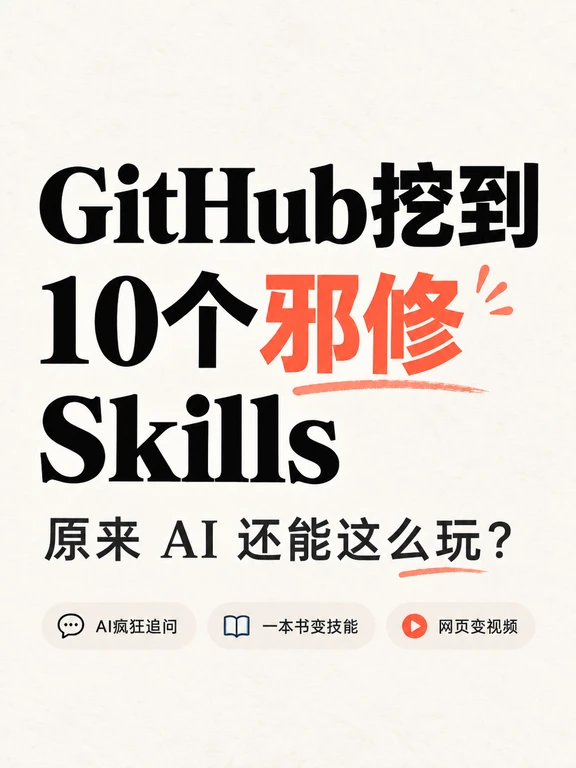
Image 1 — Evidence summary
Recognized facts (readable text, UI elements and visible phenomena):
1. Main title text (line-by-line, block-by-block):
- Line 1: GitHub 挖到
- Line 2: 10个邪修
- Line 3: Skills
2. Subtitle text (below main title): "原来 AI 还能这么玩?" (translated: "AI can do this too?")
3. Three pill-shaped icon buttons (left to right), each with short text next to or below the icon:
- Icon 1 (chat bubble) text: AI疯狂追问 (AI relentlessly questions)
- Icon 2 (book) text: 一本书变技能 (turn a book into a skill)
- Icon 3 (play/video) text: 网页变视频 (webpage becomes video)
4. Visual/style notes:
- Words like "GitHub", "Skills", subtitle are mostly black in a serif large-font layout.
- The characters for “邪修” are emphasized in red/orange with an underline and decorative strokes.
- Background is a light (paper-like) single color; overall vertical poster layout.
- No readable QR codes, footer info, or visible URL/source text on the image.
5. Punctuation/spacing: subtitle ends with a question mark "?".
Not readable / not provided (explicitly marked unreadable or missing):
1. The image does not provide readable source, author, publication info or a URL—image source missing.
2. Any very small text at edges or bottom (if present) is not legible at current resolution.
Inferences (reasonable but not direct facts):
1. The image likely serves as a promotional poster or cover (article, video, course), since it uses an attention-grabbing title and functional icons. This is an inference, not direct text evidence.
2. The three items "AI relentlessly questions / turn a book into a skill / webpage becomes video" likely represent three features or modules covered by the content. This is inferred.
3. The term “邪修” is stylized to attract attention and may be a playful informal term meaning quirky/clever hacks; exact nuance requires context and is inferred.
Source note:
- Image source: not provided (incomplete).
SkillPI Creation Analysis
Use cases and deliverables:
- The listed 10 Skills provide starting points for creative AI tasks: e.g., using grill-me to simulate a rigorous interviewer to uncover plan flaws; using book-to-skill to extract a book’s methodology into a callable Skill; using product-launch-video or music-to-video to help generate product trailers or music-synced videos; using baoyu-comic to convert text into storyboarded comics; using algorithmic-art to produce abstract visual assets; using meme-factory or slack-gif-creator to make memes or animated GIFs. Deliverables typically include cloned repositories, example scripts, generated media (images/video/GIF), and Skill configuration artifacts.
Image evidence summary:
- The image is a vertical poster-style cover titled "GitHub 挖到 10个邪修 Skills" with subtitle "原来 AI 还能这么玩?" and three representative icons/texts ("AI疯狂追问", "一本书变技能", "网页变视频"). The image does not include a readable source URL, so it cannot be used by itself to locate the original GitHub repositories.
General steps to use the GitHub Skills (practical, reproducible workflow):
1. Locate the target repository on GitHub by name or keyword (e.g., grill-me, book-to-skill, teach, product-launch-video, music-to-video, etc.).
2. Read the repository README, examples, and License to confirm intended use and legal constraints. Check for demo inputs/outputs and usage notes.
3. Clone the repository locally: git clone <repo_url>.
4. Install dependencies as described (Python requirements.txt, Node packages, or Docker images), and prepare any required API keys (e.g., for external models/services).
5. Run provided demo scripts with sample inputs (plans, book summaries, music files, webpage URLs) and inspect outputs, logging results and saving generated media.
6. Adjust prompts, parameters, or style settings to fit your use case (prompt engineering, model params, rendering options).
7. To combine Skills (e.g., book-to-skill + teach), export intermediate artifacts (JSON of extracted methods, text prompts) and feed them into the next Skill’s input pipeline.
Prerequisites and cautions for reproduction:
- Basic programming and environment setup skills (Python/Node, dependency management, CLI) are typically required.
- Many repos may depend on external AI services or paid APIs—API keys and potential costs must be handled by users.
- Verify each repo’s license and any commercial-use restrictions.
- Assess repo maintenance status (recent commits, open issues) to judge reliability and security.
- Check copyright and licensing for any media assets used in generation (music, images).
Items that must be verified in each repository (cannot be assumed from the summary or cover):
- The exact implementation details and required frameworks/models (which may require paid APIs).
- Exact input/output formats and run commands for demos.
- License terms and whether commercial use is permitted.
- Whether the repo includes training data or copyrighted assets and their licensing.
- Confirm the image’s original source (the provided image lacks a traceable URL).
Reference URL provided in the user input:
- https://www.xiaohongshu.com/discovery/item/6ad63c64000000002701ef61?app_platform=ios&app_version=9.32.3&share_from_user_hidden=true&xsec_source=app_share&type=normal&xsec_token=CBfIMf5W1v8l5nRKsQu8C76XefHilrqBhW6kXXlUGIt8g=&author_share=1
Note: repository names from the summary are preserved as proper nouns. Before attempting full reproduction, open each GitHub repo to confirm README instructions, dependencies, API requirements, and licensing. The cover image itself does not provide a direct link to the repos.