
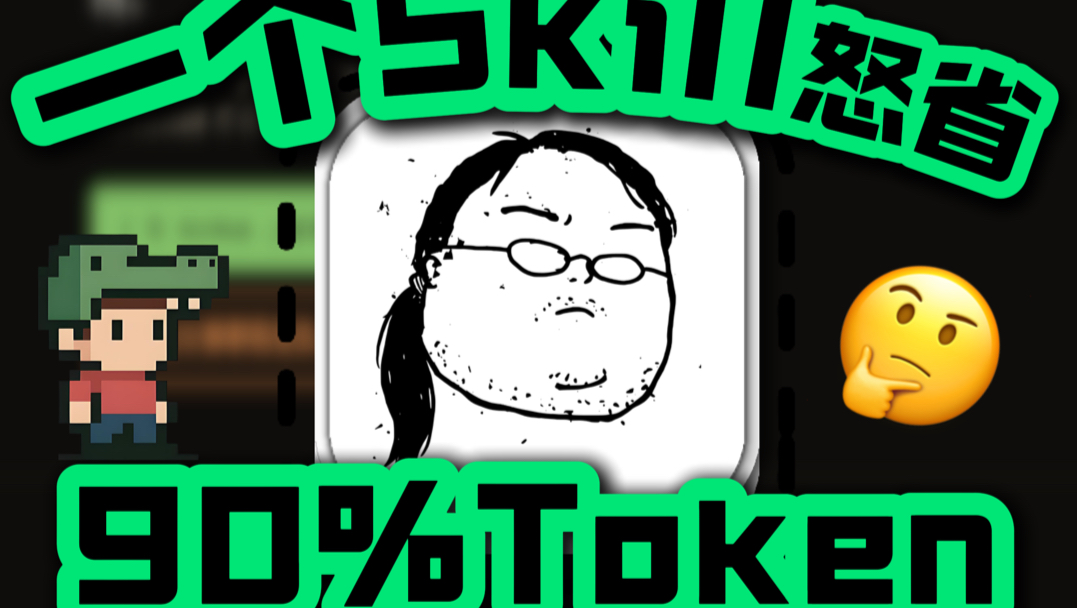
Open-source Skill with 98k Stars — Claims to Save 90% of Tokens
Learn how to check the open-source project referenced from the video (https://www.bilibili.com/video/BV1rCud6XEQy/): find the repo link, read the README, inspect code for token-saving techniques, and run token-count baselines using the same tokenizer and model. Includes a verification checklist and prerequisites for reproducible testing.
Image Analysis
Image 1 — Facts (observable/readable elements)
- Readable text (clear/near-clear):
SkillPI Creation Analysis
Intended use of the asset:
- The thumbnail appears on a video page (source: https://www.bilibili.com/video/BV1rCud6XEQy/) and is intended to advertise or claim that an open-source “Skill” or solution substantially reduces token usage—visually highlighted by the "90%" figure. The thumbnail is promotional; it does not provide implementation details. Whether the claimed savings are real requires code-level verification.
Image evidence summary (what can be directly verified from the thumbnail):
- The only clearly readable technical claim is the number "90%"; other textual claims (top green headline, bottom text aside from 90%) are blurred and unreliable as technical evidence.
- Visual elements (sketch avatar, pixel character, emoji) indicate a thumbnail/promo image but contain no executable or technical information.
Steps to verify or reproduce the claimed token savings (general checklist — requires project/source code to proceed):
1. From the video page (https://www.bilibili.com/video/BV1rCud6XEQy/), locate any links in the description or comments pointing to the project repository or downloads and record the source link.
2. In the project repository, read README, examples, and installation instructions to find where the "90%" claim is contextualized (which models, which input scenarios, what metric is being reported).
3. Inspect implementation files to identify the concrete techniques used (common possibilities include prompt compression, template merging, retrieval augmentation replacing long context, tokenizer changes, batching, or custom inference logic). Note: these are common techniques to reduce tokens but are speculative until verified in the code.
4. Design baseline vs optimized tests: use the same tokenizer and model as specified by the project, run token counts for original prompts and for the optimized versions, and record raw token counts and relative reductions. Document model and tokenizer versions, input samples, batch sizes, and other environment variables.
5. Collect metrics: raw token counts (per request and total), relative reduction percentages, request counts, and overall API cost if cost reduction is the objective.
6. Publish reproducible test scripts and logs (commands, dependency versions, sample inputs) so third parties can validate results.
Reproduction prerequisites and checks (items that must be confirmed before trusting the 90% claim):
- Obtain the project repository/source and the exact context for the "90%" claim (e.g., applicable only for specific tasks, datasets, or models).
- Confirm the exact model and tokenizer versions used; token counts vary significantly across tokenizers.
- Clarify whether "90%" refers to per-request token count reduction, overall cost reduction, or reduction in some specific scenario (e.g., for very long contexts or batched workloads).
- Ensure test samples match the authors' samples; differing sample distributions will change token statistics.
- Confirm whether additional preprocessing/postprocessing (text compression, summarization) was applied that materially affects token counts.
Open items to verify (explicit, do not invent):
- The repository URL, actual Skill name, and implementation details are not provided in the input (Skill field is null). These must be obtained from the video page or author to proceed.
- The experimental conditions and measurement method behind the "90%" claim are unknown and need the original test scripts or a detailed methods description to confirm.
- It is unknown if the reported savings require a specific model, input type, or narrow scenario.
End with factual/operational guidance: once the repository or code link is retrieved from the source video, perform the checklist above—especially confirm model/tokenizer versions and obtain the original test scripts—to determine whether the thumbnail's “90%” claim is reproducible and applicable to your use case.