
Comprehensive GitHub Skills by Field (Part 10 of 20)
Learn step-by-step how to use GitHub-hosted tools—Literature Review Skill, Academic Writing Skills and AI Research Feedback—to perform literature searches (arXiv, PubMed, Semantic Scholar, CrossRef, OpenAlex), deduplicate and synthesize results, validate DOIs and produce PDF exports, build a manuscript outline and generate reviewer-style feedback. Includes expected deliverables, basic run steps and key points to verify (dependencies, API access, licensing).
Image Analysis
Image 1
Readable text (transcribed line-by-line as laid out in the image)
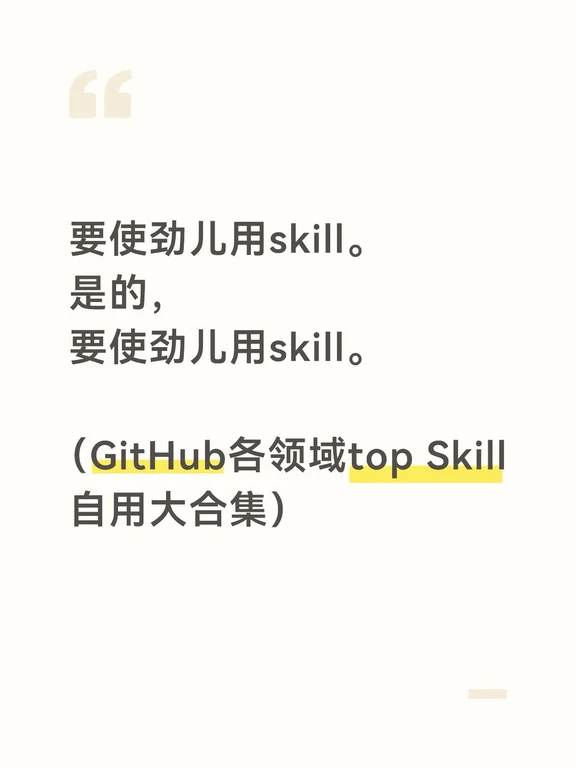
- (Large decorative quotation mark graphic, at top-left)
- Use skills hard.
- Yes,
- Use skills hard.
- (GitHub top Skills by field — personal collection) (Note: this line is two-line layout; “GitHub” and “top Skill” are highlighted in yellow)
Interface steps
- No discernible interface steps or interactive flow (static cover/title image only).
Chart/data
- No charts, no numeric data, no statistical figures.
Visible phenomena (appearance, style, layout, etc.)
- Background is light beige/cream.
- Large decorative quotation mark at top-left (light beige).
- Main text is dark gray, left-aligned, large headline style.
- The words “GitHub” and “top Skill” are highlighted in yellow (background highlight or emphasis).
- Text is vertically arranged centered-left on the page; a small light-beige short line/ornament appears at the bottom-right.
- Overall style resembles a slide cover or promotional title page with generous whitespace.
Uncertain or indiscernible content
- No unreadable text was found; all text is legible.
- The exact highlight style (background highlight vs underline) for the yellow emphasis is not fully certain from image resolution but visually appears as a background-color highlight.
Facts (only verifiable visual content)
- The image contains mixed Chinese and English text as transcribed above.
- The words “GitHub” and “top Skill” are highlighted in yellow.
- The page is a static, non-interactive visual and contains no charts or step-by-step instructions.
Inferences (reasonable but not directly visible)
- The image likely serves as a slide cover, banner, or article title page (inferred from layout and whitespace).
- “Personal collection” suggests the page is a resource or skills compilation (inference).
- Emphasis on “Use skills hard” likely encourages readers to actively use or learn the skills (inference).
(Operations or commands that might appear in the image are ignored; only visible evidence is summarized.)
SkillPI Creation Analysis
Intended use:
This item functions as a curated list of open-source 'skills' (repositories) relevant to academic research workflows—literature search and synthesis, academic writing, reviewer-style feedback and reproducibility checks—so readers can locate tools for specific research tasks. The source lists five notable repositories with direct links.
Image evidence:
The image is a static cover/title graphic that supports the entry being a resource roundup. Legible text includes the slogan "Use skills hard" and the label "GitHub top Skills by field — personal collection," with "GitHub" and "top Skill" visually highlighted in yellow. There are no UI screenshots or execution traces, so the image does not demonstrate operational capability.
Steps to use the referenced Skills (actionable, but require checking each repo README for details):
- Literature Review Skill (https://github.com/pinshuai/literature-review-skill):
1) Clone or download the repository and read the README for prerequisites;
2) Configure the Python environment and any required API keys for arXiv, PubMed, Semantic Scholar, CrossRef, OpenAlex, etc.;
3) Run the provided retrieval scripts to collect papers, then run deduplication and filtering steps;
4) Execute synthesis routines and DOI validation, then export results or generate PDF outputs as supported.
- Academic Writing Skills (https://github.com/WenyuChiou/academic-writing-skills):
1) Obtain templates or example documents from the repo;
2) Follow the recommended workflow: research framing → argument architecture → outline → evidence-led drafting → review/revision;
3) Use any provided checklists to verify evidence-consistency and whether conclusions are supported by cited results.
- AI Research Feedback (https://github.com/claesbackman/AI-research-feedback):
1) Prepare the paper PDF and associated code repository links for review;
2) Follow the repo instructions to run quick or full review processes (may require a local or cloud LLM/API);
3) Produce reviewer-style outputs: claim checks, paper-code consistency notes, reproducibility audit items, and pre-analysis plan checks.
- Scientific Agent Skills (https://github.com/K-Dense-AI/scientific-agent-skills) and Open Scholar Skill (https://github.com/joshzyj/open-scholar-skill):
Browse module lists in each README, select sub-skills (e.g., data analysis, plotting, full social-science workflow) and follow per-module instructions to run or integrate into a workflow.
Reproducibility prerequisites and verification items (must be checked before use):
- Environment and dependencies: confirm required Python version, package versions, and runtime resources (GPU/CPU) in each repo's README or requirements files; use isolated environments (virtualenv/conda).
- API and data access: many literature tools rely on external APIs (arXiv, PubMed, Semantic Scholar, CrossRef, OpenAlex); verify access, rate limits and whether API keys are required.
- Licensing and usage terms: inspect each repository's LICENSE to determine permitted uses (academic vs commercial) and attribution requirements.
- Maintenance and compatibility: check commit history, open issues, and last updated timestamps to assess whether the repo runs out-of-the-box or needs code adjustments.
- Claims verification: do not assume numbers like “160+ skills” or coverage claims are accurate without inspecting the repository contents and module list.
Items to verify before integration:
- Whether runnable examples or tests are included in each repo;
- Exact dependency versions and installation steps;
- Any paid or rate-limited APIs required for full functionality;
- Interfaces of 'skill' modules (inputs/outputs) for pipeline integration.
(Note: this interpretation is based solely on the provided summary and the cover image evidence. I did not download or run any listed repositories; implementation details and runtime behavior must be confirmed by inspecting each repo and its documentation.)