
Skills | A Set of AI Art Style-Transfer Experiments
Learn a practical workflow for preparing sketchbook images and artist references, cleaning and labeling data, creating train/validation splits, fine-tuning a generative model, and evaluating outputs. This summary is based on an author’s experiment to hand-craft “skills” to reproduce their everyday drawing style and outlines actionable steps and verification items for creators who want to personalize AI art generation.
Image Analysis
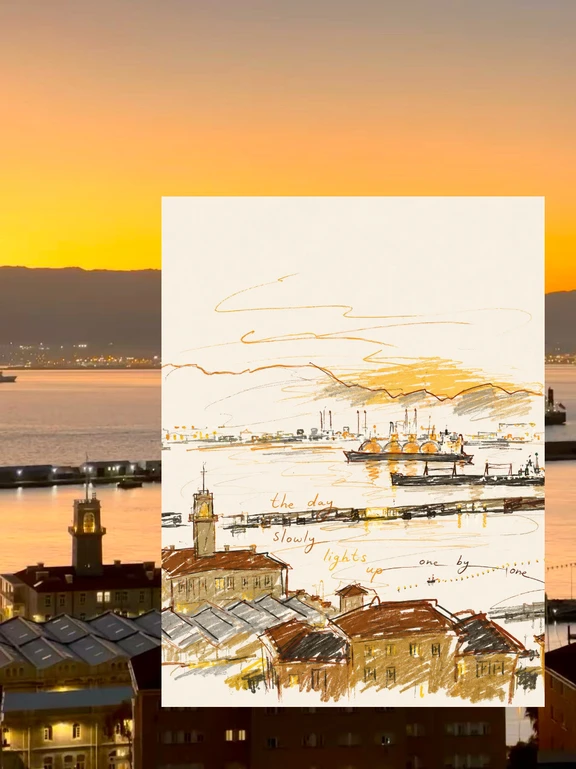
Figure 1
Observed facts (recording only directly observable readable text, UI elements, chart data, and visible phenomena in the image)
- Readable text (handwritten English, inside a pale sketch at the center, toward the lower part):
- “the day”
- “slowly”
- “lights up”
- “one by one”
- A sequence of small dots follows the above words (ellipsis-like small black dots/dot matrix).
- Image composition and visible phenomena:
- The photo background shows a dusk/sunset scene with an orange-to-gold sky gradient.
- The scene is a harbor/coastal cityscape: visible water, a pier (or breakwater), multiple lights and their reflections on the water.
- Low hills or a horizon line are visible in the distance.
- Foreground and midground contain multiple building roofs and at least one lighthouse-like structure (tower with light or lit windows); roofs are mostly dark or ochre-toned.
- There is at least one large vessel or clearly contoured ship on the water (moored or near the pier), with several vertical structures near the hull and port facilities (possibly masts, smokestacks, or cranes).
- A rectangular hand-drawn/sketch image (off-white or light beige background) is overlaid off-center; the sketch uses brown/ochre/light-yellow lines and blocks to outline the harbor, ships, buildings, and sky in a quick-drawing style.
- The sketch is overlaid on the photo with a clear rectangular border distinct from the background photo.
- No UI steps or chart data: the image does not show software interfaces, operation step indicators, or numeric charts.
Inferences and uncertain items (marked as uncertain)
- The full handwritten phrase is likely “The day slowly lights up one by one” (inference), but this is a reasonable concatenation of visible words; some letters or connecting words are written roughly and cannot be asserted with absolute certainty.
- Several small handwritten or cursive annotations in the sketch (near roofs) are illegible.
- Some vertical structures around the harbor/ships are inferred to be masts, smokestacks, or port cranes, but their exact device types cannot be confirmed from the image alone.
- It cannot be determined whether the sketch is an on-site quick study (plein air) or a later illustrative creation (creation time and author unknown).
- It cannot be confirmed whether the lighthouse/tower is actively lit (windows or surrounding lights exist, but tower-top illumination cannot be fully determined).
Unreadable or missing specific content (marked as unreadable)
- Several small words and fine strokes in the sketch are not clearly legible (no other complete words or phrases were identified beyond those listed above).
- No explicit source label, author signature, date, or metadata is visible inside or outside the image (no clear copyright or source information was observed).
SkillPI Creation Analysis
Intended use
- The author reports attempting to hand-craft “skills” to train an AI to reproduce their regular drawing style. The provided image and text appear to illustrate a training/example sample and the author’s ongoing tuning process rather than a finished, published model.
Image evidence (based on the observed facts above)
- The composite image — a photographic harbor scene with an overlaid hand-drawn sketch containing visible handwritten phrases (“the day”, “slowly”, “lights up”, “one by one”) — supports the claim that the author is using personal sketches and visual references as part of the creative/training material.
Steps to use associated skills (derived from the source description and common workflows; implementation details are not provided and must be verified)
1. Collect dataset: gather personal sketchbook scans/photos and reference works from favored artists (verify usage rights).
2. Clean and annotate data: crop, denoise, standardize resolution, and optionally label by style, subject, or color palette.
3. Prepare train/validation splits: reserve samples for validation and visual comparison.
4. Choose a base generative approach or training framework: decide between fine-tuning an existing generative model or training a bespoke style-transfer network (the source mentions “codex skills models” but provides no technical specifics; this must be clarified).
5. Train and tune: iterate on training, adjusting loss functions, learning rates, regularization, and sampling strategies to preserve hand-drawn line quality and compositional traits.
6. Evaluate outputs: use qualitative review and any available quantitative metrics to assess style fidelity; collect failure cases for dataset augmentation or reannotation.
7. Export and deploy: convert the trained model into an inference-ready format and integrate with a front-end or automation pipeline, or publish it as a callable “skill” per the platform used (deployment details are not supplied).
Reproduction prerequisites
- Clear documentation of the model implementation and training pipeline (not provided in the source). Required details include architecture, training duration, loss definitions, and hyperparameters.
- Adequate, representative training data (number of sketch pages and reference images, their resolution, and licensing terms).
- Available compute resources (GPUs/TPUs) and the codebase with dependency versions to run training and evaluation.
- Rights and permissions for using artworks from other artists if included in training data.
Items to verify before attempting reproduction
- The precise meaning and implementation of “codex skills” in this context (open-source vs proprietary, API/interface details).
- The scale and format of the training dataset and whether data augmentation or synthetic data generation was used.
- Specific training hyperparameters, loss functions, and evaluation metrics employed to preserve the artist’s style.
- The number and quality of output examples and the method used for subjective quality assessment.
- Deployment approach and runtime characteristics (inference latency, memory requirements).
Concluding factual statement
- The source documents the author’s intent and a visual example showing sketch+photo composites used as training/reference material. The available information supports understanding the workflow conceptually but is insufficient to reproduce the exact model or training results without additional technical details and data licensing confirmation. The listed verification items must be resolved prior to any faithful reproduction attempt.