
quarkus-verification
Screenshots
Installation
Review the source and dependencies with a prompt.
Install with an AI assistant
Copy the prompt so your assistant can review the pinned revision and dependencies first.
View promptHide prompt
Check whether SkillPI Skill Finder is installed for your current agent. If it is missing, install and enable it using the official instructions at https://github.com/Findskills/skillpi. Then use Skill Finder to locate and install "quarkus-verification" from this exact SkillPI detail page: https://skillpi.com/skills/deepskill-d6bbe3e1b4fca757682c07322eafc6006c3e766ba398e53d3bdf05a5665e66e5. Verify the upstream source and version against https://github.com/affaan-m/ECC before installing. If they do not match, stop and report the mismatch. Report the installed path and source version.
Download permission for this version is unverified or restricted.
Source and setup
github.com
Setup guidance pending
See the original source for supported tools, dependencies, and permissions.
Installation test pending
A verification loop for Quarkus projects covering build, static analysis, tests with coverage, security scans, native compilation, and diff review, used for comprehensive checks before release or submitting a PR.
Introduction source: third_party · affaan-m · 0.0.1 Reference
SkillPi interpretation
- Tasks
- Verification loop for Quarkus projects: build, static analysis, tests with coverage, security scans, native compilation, and diff review before release or PR.
- Audience
- Not specified in the source documentation.
- Inputs and outputs
- Not specified in the source documentation.
- Software, accounts and paid services
- Not specified in the source documentation.
- Limits and differences
- Not specified in the source documentation.
- Testing
- Not tested
Browse files
A verified file list is not available on Skillπ yet.
Browse files at the source ↗Frontmatter
name: quarkus-verification
description: "Verification loop for Quarkus projects: build, static analysis, tests with coverage, security scans, native compilation, and diff review before release or PR."
metadata:
  origin: ECC
Quarkus Verification Loop
Run before PRs, after major changes, and pre-deploy.
When to Activate
- Before opening a pull request for a Quarkus service
- After major refactoring or dependency upgrades
- Pre-deployment verification for staging or production
- Running full build → lint → test → security scan → native compilation pipeline
- Validating test coverage meets thresholds (80%+)
- Testing native image compatibility
Phase 1: Build
# Maven
mvn clean verify -DskipTests

# Gradle
./gradlew clean assemble -x test
If build fails, stop and fix compilation errors.
Phase 2: Static Analysis
Checkstyle, PMD, SpotBugs (Maven)
mvn checkstyle:check pmd:check spotbugs:checkSonarQube (if configured)
mvn sonar:sonar \
  -Dsonar.projectKey=my-quarkus-project \
  -Dsonar.host.url=http://localhost:9000 \
  -Dsonar.login=${SONAR_TOKEN}
Common Issues to Address
- Unused imports or variables
- Complex methods (high cyclomatic complexity)
- Potential null pointer dereferences
- Security issues flagged by SpotBugs
Phase 3: Tests + Coverage
# Run all tests
mvn clean test

# Generate coverage report
mvn jacoco:report

# Enforce coverage threshold (80%)
mvn jacoco:check

# Or with Gradle
./gradlew test jacocoTestReport jacocoTestCoverageVerification
Test Categories
Unit Tests
Test service logic with mocked dependencies:
@ExtendWith(MockitoExtension.class)
class UserServiceTest {
  @Mock UserRepository userRepository;
  @InjectMocks UserService userService;

  @Test
  void createUser_validInput_returnsUser() {
    var dto = new CreateUserDto("Alice", "alice@example.com");

    // Panache persist() is void — use doNothing + verify
    doNothing().when(userRepository).persist(any(User.class));

    User result = userService.create(dto);

    assertThat(result.name).isEqualTo("Alice");
    verify(userRepository).persist(any(User.class));
  }
}
Integration Tests
Test with real database (Testcontainers):
@QuarkusTest
@QuarkusTestResource(PostgresTestResource.class)
class UserRepositoryIntegrationTest {

  @Inject
  UserRepository userRepository;

  @Test
  @Transactional
  void findByEmail_existingUser_returnsUser() {
    User user = new User();
    user.name = "Alice";
    user.email = "alice@example.com";
    userRepository.persist(user);

    Optional<User> found = userRepository.findByEmail("alice@example.com");

    assertThat(found).isPresent();
    assertThat(found.get().name).isEqualTo("Alice");
  }
}
API Tests
Test REST endpoints with REST Assured:
@QuarkusTest
class UserResourceTest {

  @Test
  void createUser_validInput_returns201() {
    given()
        .contentType(ContentType.JSON)
        .body("""
            {"name": "Alice", "email": "alice@example.com"}
            """)
        .when().post("/api/users")
        .then()
        .statusCode(201)
        .body("name", equalTo("Alice"));
  }

  @Test
  void createUser_invalidEmail_returns400() {
    given()
        .contentType(ContentType.JSON)
        .body("""
            {"name": "Alice", "email": "invalid"}
            """)
        .when().post("/api/users")
        .then()
        .statusCode(400);
  }
}
Coverage Report
Check target/site/jacoco/index.html for detailed coverage:
- Overall line coverage (target: 80%+)
- Branch coverage (target: 70%+)
- Identify uncovered critical paths
Phase 4: Security Scanning
Dependency Vulnerabilities (Maven)
mvn org.owasp:dependency-check-maven:checkReview target/dependency-check-report.html for CVEs.
Quarkus Security Audit
# Check vulnerable extensions
mvn quarkus:audit

# List all extensions
mvn quarkus:list-extensions
OWASP ZAP (API Security Testing)
docker run -t ghcr.io/zaproxy/zaproxy:stable zap-api-scan.py \
  -t http://localhost:8080/q/openapi \
  -f openapi
Common Security Checks
- [ ] All secrets in environment variables (not in code)
- [ ] Input validation on all endpoints
- [ ] Authentication/authorization configured
- [ ] CORS properly configured
- [ ] Security headers set
- [ ] Passwords hashed with BCrypt
- [ ] SQL injection protection (parameterized queries)
- [ ] Rate limiting on public endpoints
Phase 5: Native Compilation
Test GraalVM native image compatibility:
# Build native executable
mvn package -Dnative

# Or with container
mvn package -Dnative -Dquarkus.native.container-build=true

# Test native executable
./target/*-runner

# Run basic smoke tests
curl http://localhost:8080/q/health/live
curl http://localhost:8080/q/health/ready
Native Image Troubleshooting
Common issues:
- Reflection: Add reflection config for dynamic classes
- Resources: Include resources with
quarkus.native.resources.includes - JNI: Register JNI classes if using native libraries
Example reflection config:
@RegisterForReflection(targets = {MyDynamicClass.class})
public class ReflectionConfiguration {}
Phase 6: Performance Testing
Load Testing with K6
// load-test.js
import http from 'k6/http';
import { check } from 'k6';

export const options = {
  stages: [
    { duration: '30s', target: 50 },
    { duration: '1m', target: 100 },
    { duration: '30s', target: 0 },
  ],
};

export default function () {
  const res = http.get('http://localhost:8080/api/markets');
  check(res, {
    'status is 200': (r) => r.status === 200,
    'response time < 200ms': (r) => r.timings.duration < 200,
  });
}
Run:
k6 run load-test.jsMetrics to Monitor
- Response time (p50, p95, p99)
- Throughput (requests/sec)
- Error rate
- Memory usage
- CPU usage
Phase 7: Health Checks
# Liveness
curl http://localhost:8080/q/health/live

# Readiness
curl http://localhost:8080/q/health/ready

# All health checks
curl http://localhost:8080/q/health

# Metrics (if enabled)
curl http://localhost:8080/q/metrics
Expected responses:
{
  "status": "UP",
  "checks": [
    {
      "name": "Database connection",
      "status": "UP"
    }
  ]
}
Phase 8: Container Image Build
# Build container image
mvn package -Dquarkus.container-image.build=true

# Or with specific registry
mvn package \
  -Dquarkus.container-image.build=true \
  -Dquarkus.container-image.registry=docker.io \
  -Dquarkus.container-image.group=myorg \
  -Dquarkus.container-image.tag=1.0.0

# Test container
docker run -p 8080:8080 myorg/my-quarkus-app:1.0.0
Container Security Scan
# Trivy
trivy image myorg/my-quarkus-app:1.0.0

# Grype
grype myorg/my-quarkus-app:1.0.0
Phase 9: Configuration Validation
# Check all configuration properties
mvn quarkus:info

# List all config sources
curl http://localhost:8080/q/dev/io.quarkus.quarkus-vertx-http/config
Environment-Specific Checks
- [ ] Database URLs configured per environment
- [ ] Secrets externalized (Vault, env vars)
- [ ] Logging levels appropriate
- [ ] CORS origins set correctly
- [ ] Rate limiting configured
- [ ] Monitoring/tracing enabled
Phase 10: Documentation Review
- [ ] OpenAPI/Swagger docs up to date (
/q/swagger-ui) - [ ] README has setup instructions
- [ ] API changes documented
- [ ] Migration guide for breaking changes
- [ ] Configuration properties documented
Generate OpenAPI spec:
curl http://localhost:8080/q/openapi -o openapi.jsonVerification Checklist
Code Quality
- [ ] Build passes without warnings
- [ ] Static analysis clean (no high/medium issues)
- [ ] Code follows team conventions
- [ ] No commented-out code or TODOs in PR
Testing
- [ ] All tests pass
- [ ] Code coverage ≥ 80%
- [ ] Integration tests with real database
- [ ] Security tests pass
- [ ] Performance within acceptable limits
Security
- [ ] No dependency vulnerabilities
- [ ] Authentication/authorization tested
- [ ] Input validation complete
- [ ] Secrets not in source code
- [ ] Security headers configured
Deployment
- [ ] Native compilation successful
- [ ] Container image builds
- [ ] Health checks respond correctly
- [ ] Configuration valid for target environment
Native Image
- [ ] Native executable builds
- [ ] Native tests pass
- [ ] Startup time < 100ms
- [ ] Memory footprint acceptable
Automated Verification Script
#!/bin/bash
set -e

echo "=== Phase 1: Build ==="
mvn clean verify -DskipTests

echo "=== Phase 2: Static Analysis ==="
mvn checkstyle:check pmd:check spotbugs:check

echo "=== Phase 3: Tests + Coverage ==="
mvn test jacoco:report jacoco:check

echo "=== Phase 4: Security Scan ==="
mvn org.owasp:dependency-check-maven:check

echo "=== Phase 5: Native Compilation ==="
mvn package -Dnative -Dquarkus.native.container-build=true

echo "=== All Phases Complete ==="
echo "Review reports:"
echo "  - Coverage: target/site/jacoco/index.html"
echo "  - Security: target/dependency-check-report.html"
echo "  - Native: target/*-runner"
CI/CD Integration
GitHub Actions Example
name: Verification

on: [push, pull_request]

jobs:
  verify:
    runs-on: ubuntu-latest
    steps:
      - uses: actions/checkout@v7

      - name: Set up JDK 21
        uses: actions/setup-java@v5
        with:
          java-version: '21'
          distribution: 'temurin'

      - name: Cache Maven packages
        uses: actions/cache@v6
        with:
          path: ~/.m2
          key: ${{ runner.os }}-m2-${{ hashFiles('**/pom.xml') }}

      - name: Build
        run: mvn clean verify -DskipTests

      - name: Test with Coverage
        run: mvn test jacoco:report jacoco:check

      - name: Security Scan
        run: mvn org.owasp:dependency-check-maven:check

      - name: Upload Coverage
        uses: codecov/codecov-action@v7
        with:
          token: ${{ secrets.CODECOV_TOKEN }}
          files: target/site/jacoco/jacoco.xml
Best Practices
- Run verification loop before every PR
- Automate in CI/CD pipeline
- Fix issues immediately; don't accumulate debt
- Keep coverage above 80%
- Update dependencies regularly
- Test native compilation periodically
- Monitor performance trends
- Document breaking changes
- Review security scan results
- Validate configuration for each environment
Version history
-
v2.2.3
GitHub ↗
Original release notes
# ECC 2.2.3 ECC 2.2.3 is a naming and release-reliability update. The project is called ECC everywhere it ships, starting with the `pi/core` profile, and the release workflow now waits long enough for npm to serve a freshly published version. ## Naming - `pi/core` no longer expands the project name: its README and the bundled `blueprint` skill refer to ECC only. The profile contents are otherwise unchanged: 123 curated skills and 24 prompt commands, 35,006 characters of skill description text. - Downstream packagers need no changes. The package is still `ecc-pi-core`, the directory is still `pi/core/`, and existing install paths keep working. ## Release workflow - After `npm publish`, the release workflow polls the registry for up to five minutes before verifying the published artifact. In 2.2.2 it gave up after about 30 seconds while npm was still processing the upload, so the run failed before promoting `latest` and creating the GitHub Release, and had to be re-run. Downstream consumption is unchanged: poll `/releases`, download `archive/refs/tags/vX.Y.Z.tar.gz`, pin its sha256, copy `pi/core/`, and load it offline.
-
v2.2.2
GitHub ↗
Original release notes
# ECC 2.2.2 ECC 2.2.2 adds `pi/core`, a curated Pi-native skills+prompts-only profile built for downstream packagers that mirror GitHub Releases, plus a set of packaging, memory, hooks, and Windows compatibility fixes. ## Pi core profile `pi/core/` is a self-contained package (`ecc-pi-core`) that downstream mirrors of the release tarball can copy directly: no build step, no extensions, no hooks, no runtime downloads, and no network or SaaS dependencies. - 123 curated skills (language and framework patterns, testing/TDD, code review, non-offensive security review, planning, refactoring, docs, and git/PR workflows) and 24 prompt commands that are pure prompt workflows. - Generated deterministically from the explicit include/exclude lists in `manifests/pi-core.json` by `scripts/build-pi-core.js` and committed, so the release tarball contains it verbatim. `pi/core/CURATION.md` lists every excluded skill and command with its reason; the `council` skill ships as `ecc-council` inside pi/core to avoid catalog name clashes. - The build fails on safety violations: non-allowlisted URL hosts, pipe-to-shell or fetch-and-run download forms, secrets or tokens, absolute per-user home paths, symlinks, invalid SKILL.md frontmatter, and duplicate skill names. - CI rebuilds pi/core on every PR and verifies it is up to date, then installs the Pi coding agent CLI and proves the profile loads fully offline (`PI_OFFLINE=1`), asserting that every curated command actually registers. - The release workflow additionally verifies that `VERSION` matches the tag and that pi/core is current before publishing. Downstream consumption: poll `/releases`, download `archive/refs/tags/vX.Y.Z.tar.gz`, pin its sha256, copy `pi/core/`, and load it offline with `pi --offline --skill pi/core/skills --prompt-template pi/core/commands`. ## Packaging - The compiled OpenCode payload is explicitly included in the npm package, and packing is verified from a clean state with lifecycle scripts enabled. ## Memory and MCP - Incomplete memory reads are distinguished from missing records, and directory traversal failures are classified. - The reserved `_meta` parameter is accepted on memory MCP ping requests. ## Hooks and Windows compatibility - `hooks.json` stays within Claude Code's schema; stable hook metadata moved into a validated sidecar. - The no-verify guard handles stuck optional values and long-option prefixes. - Windows linter paths and ESLint 9 are supported, and settings updates tolerate missing Windows device IDs while retaining full-precision inode checks. ## Workflow guidance, catalog, and dependency security - Epic sync filters issues by label; dependency bumps no longer document auto-merge; naming and Boolean guidance is language-neutral; the `prp-pr` command alias is distinguished; Rails skill discovery, invoice tax calculation order, and framework documentation were corrected; Serply and Squish catalog entries were removed. - `lru` updated to 0.18.2 (RUSTSEC-2026-0253) and `js-yaml` to 4.3.2 (GHSA-2883-xcg3-v3hh).
-
v2.2.1
GitHub ↗
Original release notes
# ECC 2.2.1 ECC 2.2.1 is a bug and security patch for ECC 2.2. It keeps the published `v2.2.0` history immutable. These notes describe the prepared patch; publication and signing evidence are tracked separately in the release checklist. ## Security and data protection - GateGuard and governance capture recognize destructive PowerShell commands, including the native PowerShell tool path. Dynamic command handling prevents later variable assignments from concealing earlier unresolved invocations ([#2961](https://github.com/affaan-m/ECC/pull/2961)). - Relative GateGuard exemption globs stay within the project root. Explicit absolute exemptions remain supported ([#2921](https://github.com/affaan-m/ECC/issues/2921)). - Installer writes reject collisions with untracked user-owned files. Failed installs refresh ownership hashes only for files they actually wrote, preserving the previous ownership hashes of untouched managed files ([#2964](https://github.com/affaan-m/ECC/issues/2964)). - Guided setup revalidates its preview before ownership filtering, so files appearing between preview and apply cause a clear retry instead of a false success. Existing identical user files stay outside ECC ownership. - Uninstall respects `ECC_DRY_RUN=1`, including legacy Codex paths, and rejects invalid dry-run values instead of silently allowing deletion ([#2952](https://github.com/affaan-m/ECC/issues/2952)). - Observer analysis retains observations on unsuccessful or unconfirmed processing. Exit code zero alone no longer permits archival ([#2971](https://github.com/affaan-m/ECC/pull/2971)). - The Yarn lockfile updates `toml` to 4.3.0, matching the npm lockfile and removing the affected older resolution. ## Hooks and installation - Manual Claude installs register ECC-owned hook entries in Claude settings. Repair, consent changes, and uninstall reconcile those entries while preserving unrelated settings. Atomic settings updates check directory identity and retry detected concurrent edits ([#2992](https://github.com/affaan-m/ECC/pull/2992)). - Direct hook entrypoints handle larger JSON payloads with bounded, UTF-8-safe reads instead of silently truncating valid inputs. Existing production wrapper limits remain unchanged ([#2924](https://github.com/affaan-m/ECC/issues/2924)). - The Pi adapter selects an actual Node runtime instead of recursively executing a compiled OMP host as Node ([#2909](https://github.com/affaan-m/ECC/issues/2909)). - Installer listing and control-pane help avoid eager third-party dependency loading. Features that require absent runtime packages report the missing dependency explicitly ([#2994](https://github.com/affaan-m/ECC/pull/2994)). - Autonomous harness setup documentation replaces nonexistent package names and unsupported CLI flags with documented interfaces, and distinguishes session scheduling from a durable external scheduler ([#2957](https://github.com/affaan-m/ECC/issues/2957)). ## Installer and release-surface hardening - Public and packaged install docs now consistently point at the published `ecc-universal` commands instead of stale or unrelated package names. - The AdaL adapter docs use the correct `npx ecc-universal doctor --target adal` command. - Claude setup preflights `git` before provider-specific work starts, so missing prerequisites fail fast with the right action. - Guided setup dry runs use isolated HOME, config, XDG, temp, and Windows app data roots to avoid ambient host state affecting review or tests. - The exact packed artifact now has stronger lifecycle coverage for Claude and Kimi setup, update, doctor, repeat install, uninstall, and dry-run flows. - Identifier regression coverage blocks stale `ecc`, `ecc-install`, and other mismatched release-path commands from creeping back into user-facing docs. ## Current-main documentation included in this patch - The canonical Itô workflow now documents `ecc ito accept <ticket-id>` and the `ito_accept` MCP tool. - Acceptance is explicitly bounded to buyer-authority routing. It routes the active desk quote to human review and does not claim to place a trade. ## Provenance boundary - `v2.2.1` is intended to be a signed annotated tag on exact green `main`. - `v2.2.0` remains the immutable historical unsigned exception. Do not move, recreate, or reuse that tag. ## Scope and limitations - Plugin dependency handling does not bundle or automatically install missing modules. Database and schema-validation features require their declared runtime dependencies. - Ownership protection covers untracked collisions and failed-install checkpoints. Successful upgrades retain the existing contract for replacing previously managed files. Back up intentional edits before upgrading. - This patch does not introduce new harness platforms or claim that every open community issue is resolved. ## Upgrade After the release workflow publishes 2.2.1 and verifies registry integrity, install or update the package, then run the same ECC command path you already use. Until publication completes, the exact-version command below returns E404. ```bash npm install -g [email protected] ecc doctor ``` For first-time or guided terminal setup: ```bash npx ecc-universal setup ``` The native Claude marketplace path remains supported: ```text /plugin marketplace add https://github.com/affaan-m/ECC /plugin install ecc@ecc ```
-
v2.2.0
GitHub ↗
Original release notes
ECC 2.2 is here, led by one guided installer for Claude Code, Codex, and Kimi. It also adds native Antigravity 2.0 support and an experimental, opt-in Nasiko CLI lifecycle bridge. The release pipeline is stricter too: the exact npm archive must pass lifecycle tests on Linux, macOS, and Windows before `latest` moves. ## One guided path into ECC  Start the guided installer with: ```bash npx --yes [email protected] install --guided ``` The installer checks every selected harness before writing files, then applies the setup as one operation. Provider-owned model and authentication settings stay under the provider's control. The terminal welcome appears only after a successful interactive install. ## Nasiko: experimental, opt-in, and explicit  ECC 2.2 can inspect, install, and remove one pinned Nasiko `v0.1.0` CLI build: ```bash npm install -g [email protected] ecc nasiko status --json ecc nasiko install --version v0.1.0 --dry-run --json ecc nasiko install --version v0.1.0 --yes --json ``` Downloads are content-addressed and SHA-256 verified, status is read-only, and uninstall protects modified or unqualified binaries. The dashboard above is Nasiko's own product. ECC does not connect agents, start a server, enable telemetry, share data, or operate that control plane. The bridge remains experimental and opt-in. Learn more in the [Nasiko repository](https://github.com/Nasiko-Labs/nasiko). ## More reliable across every harness - **Native Antigravity 2.0:** ECC installs to `.agents/{rules,workflows,skills,agents}` and safely migrates legacy ownership. - **Reliable uninstall:** repeated selective installs keep a complete ownership ledger, so unchanged ECC-managed files can be removed cleanly. - **Safer migrations:** OpenCode uses `~/.config/opencode`, while OpenCode and Codex preserve edited or untracked files during cleanup. - **More workflows:** Pi, Itô, agent evaluation, multi-model council, dev-team, living docs, secure terminal, TasteForge, and `skill-comply` all expand the shipped distribution. ECC 2.2 ships **68 agents, 286 skills, and 94 command shims**, plus the rules, hooks, memory, continuous-learning, and installation surfaces around them. ## Release assurance The tagged commit must match `origin/main`. One npm archive is packed, hashed, and tested on all three operating systems, then published under a staging tag. Registry integrity must match before `latest` moves. The prior 2.1.0 package remains the immediate rollback target. ## Install or upgrade For the native Claude Code plugin: ```text /plugin marketplace add https://github.com/affaan-m/ECC /plugin install ecc@ecc ``` Existing Claude installs can run `/plugin update ecc`. ## Thank you A special thank you to returning contributors [@gaurav0107](https://github.com/gaurav0107), [@Seekers2001](https://github.com/Seekers2001), and [@t0kubetsu](https://github.com/t0kubetsu) for substantial work on learning workflows, collaborative skills, and shared testing. Among our first-time contributors, [@renan-tiberio](https://github.com/affaan-m/ECC/pull/2759) brought Pi support, [@romanclaudersoai1](https://github.com/affaan-m/ECC/pull/2664) repaired `/evolve`, and [@djpjronline-netizen](https://github.com/affaan-m/ECC/pull/2405) hardened hook parsing. Eighteen people made their first ECC contribution in 2.2. Thank you to everyone who tested the installer, reported issues, and helped harden the release across harnesses and operating systems. ### New contributors - @AlbertChiu777 in [#2483](https://github.com/affaan-m/ECC/pull/2483) - @djpjronline-netizen in [#2405](https://github.com/affaan-m/ECC/pull/2405) - @shanujans in [#2538](https://github.com/affaan-m/ECC/pull/2538) - @HouMinXi in [#2609](https://github.com/affaan-m/ECC/pull/2609) - @agent-jeong in [#2670](https://github.com/affaan-m/ECC/pull/2670) - @karimfarahat in [#2462](https://github.com/affaan-m/ECC/pull/2462) - @romanclaudersoai1 in [#2664](https://github.com/affaan-m/ECC/pull/2664) - @Peopleoftech in [#2668](https://github.com/affaan-m/ECC/pull/2668) - @alejandorosumah-mansa in [#2700](https://github.com/affaan-m/ECC/pull/2700) - @imkp1 in [#2637](https://github.com/affaan-m/ECC/pull/2637) - @shivaG5 in [#2446](https://github.com/affaan-m/ECC/pull/2446) - @vitalii-novikov in [#2520](https://github.com/affaan-m/ECC/pull/2520) - @etisamhaq in [#2364](https://github.com/affaan-m/ECC/pull/2364) - @phumchai1515-prog in [#2723](https://github.com/affaan-m/ECC/pull/2723) - @cagrisolakoglu in [#2618](https://github.com/affaan-m/ECC/pull/2618) - @brianjkelly in [#2703](https://github.com/affaan-m/ECC/pull/2703) - @renan-tiberio in [#2759](https://github.com/affaan-m/ECC/pull/2759) - @ronimuliawan in [#2793](https://github.com/affaan-m/ECC/pull/2793) Join us in the [ECC Discord](https://discord.gg/36yGMHGFbR). Full changelog: <https://github.com/affaan-m/ECC/compare/v2.1.0...v2.2.0>
-
v2.1.0
GitHub ↗
Original release notes
# ECC 2.1.0: Plan Canvas, Kimi Harness, and Self-Hosted Compute ECC 2.1 turns plan review into a visual loop and opens the harness to self-hosted models. Plan Canvas lets you review agent plans in the browser. Point at the part you mean instead of retyping it in chat. A new Kimi Code install target and a verified Itô GPU path make ECC + open-source models a first-class setup, backed by our public sponsors: Moonshot AI (Kimi), Itô, and Atlas Cloud. ## Plan Canvas: review plans by pointing, not retyping 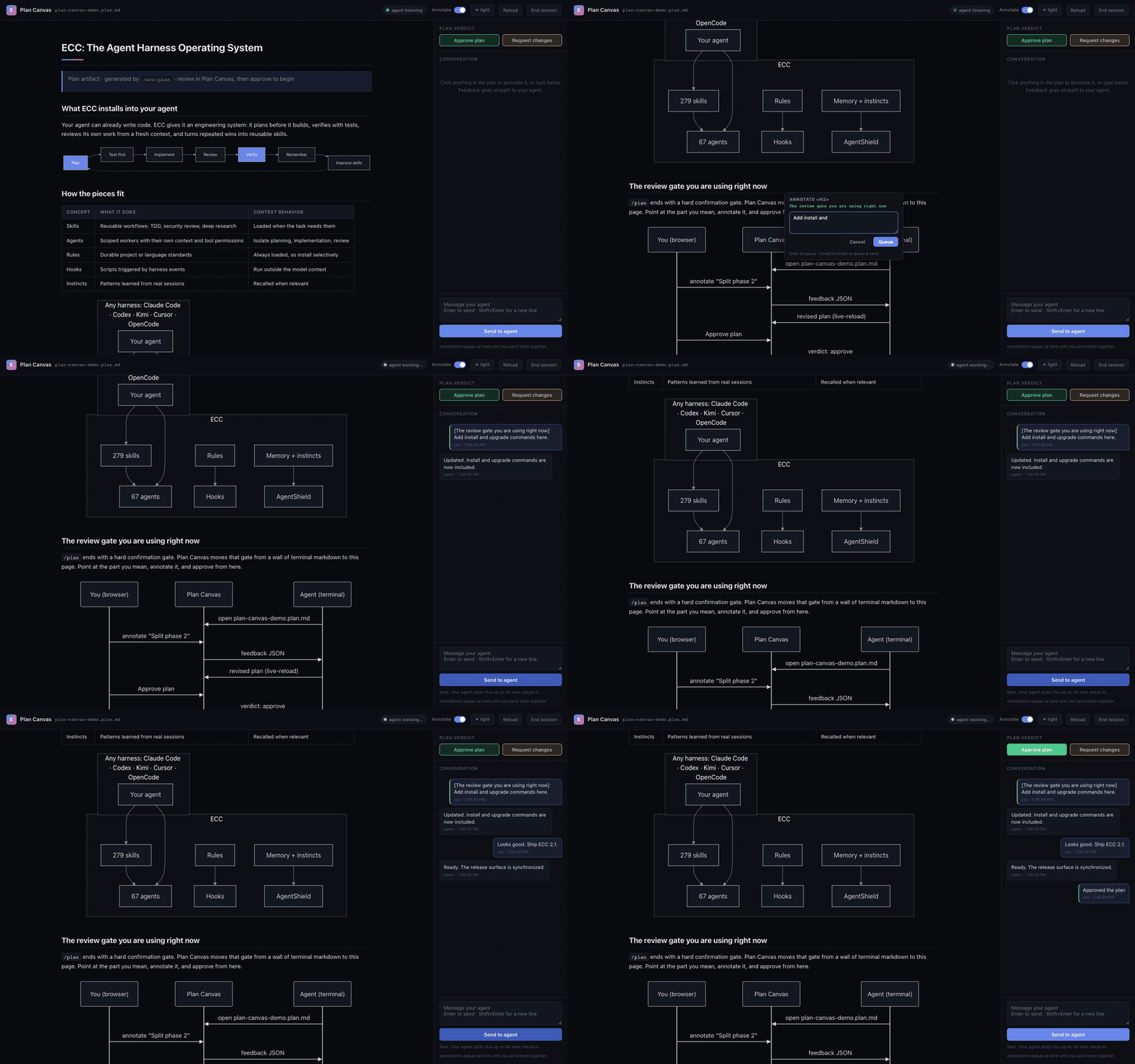 [Download the MP4 demo](https://raw.githubusercontent.com/affaan-m/ECC/main/docs/releases/2.1.0/assets/ecc-plan-canvas-demo.mp4) `/plan` ends with a confirm gate, and until now that review was a wall of markdown in the terminal. Now the agent opens the plan in a loopback-only browser canvas: - Click elements or select text to attach numbered annotations - Chat with the agent from a side rail while it works in the terminal - **Approve plan** / **Request changes** buttons map directly onto `/plan`'s CONFIRM gate - Mermaid diagrams, tables, and task lists render natively; file edits live-reload the page - Model- and harness-agnostic: a plain CLI + JSON protocol (`ecc-plan-canvas`), no Claude-only dependency ## Kimi harness: Moonshot AI partnership ECC now installs directly into [Kimi Code](https://moonshotai.github.io/kimi-cli/) (`--target kimi`). Kimi Code discovers the installed `.kimi/AGENTS.md` instructions and `.kimi/skills/` workflows natively: ```bash bash ./install.sh --target kimi --profile minimal npx ecc doctor --target kimi kimi ``` ## Self-host on Itô GPUs Run ECC against any self-hosted open-source model. If you need GPU capacity, [Itô](https://compute.itomarkets.com) is ECC's preferred compute sponsor. The integration shipped guarded end to end: - `ecc ito find`: opt-in bridge to the canonical Itô CLI that submits a live, authenticated RFQ (it does not reserve capacity) - Guarded live node qualification and read-only compute handoff - Credential-bearing CLI shims are rejected outright The sponsorship link itself is passive: it does not invoke an RFQ, reserve capacity, provision compute, or configure serving. Managed inference through Itô is not live yet. Any GPU provider works, and ECC stays provider-agnostic. ## Partners [Moonshot AI (Kimi)](https://www.moonshot.ai), [Itô](https://compute.itomarkets.com), and [Atlas Cloud](https://www.atlascloud.ai) are now public sponsors of ECC. The README documents a recommended self-host path: Itô for GPU capacity, a Kimi checkpoint served behind a compatible endpoint, then Kimi Code + ECC on top. Each choice remains separate and swappable. ## Also in 2.1 - **Hermes and OpenClaw install targets**: two more harnesses join Claude Code, Codex, OpenCode, Cursor, Gemini, Zed, Copilot, and Kimi - **Codex ECC navigation guide**: find the right skill/command surface from inside Codex - **GateGuard path exemptions** (`GATEGUARD_EXEMPT_GLOBS`) and configurable instinct injection (count + confidence threshold) - **PostToolUse hooks consolidated** into sync/async dispatchers, with fewer processes per tool call - **Supply-chain hardening**: the installer runtime passes strict vetting, and the pre-commit secret scan now catches Anthropic API keys (`sk-ant-...`) - A long tail of community fixes across OpenCode, Windows, bun lockfiles, the dashboard, and project detection The catalog now stands at **67 agents, 281 skills, and 94 command shims** (2.0.0 shipped 64/261/84), plus hooks, rules, memory, continuous learning, and AgentShield. ## Install or upgrade ```text /plugin marketplace add https://github.com/affaan-m/ECC /plugin install ecc@ecc ``` Existing installs: `/plugin update ecc` ## Community Join the ECC community for release announcements, questions, and Show and Tell: <https://discord.gg/36yGMHGFbR> Full changelog: <https://github.com/affaan-m/ECC/compare/v2.0.0...v2.1.0> ## New Contributors * @legeZZZ made their first contribution in https://github.com/affaan-m/ECC/pull/2200 * @tongshu2023 made their first contribution in https://github.com/affaan-m/ECC/pull/2216 * @mohameddsh3ban made their first contribution in https://github.com/affaan-m/ECC/pull/2195 * @fiedler-itlabs made their first contribution in https://github.com/affaan-m/ECC/pull/2240 * @daiki75 made their first contribution in https://github.com/affaan-m/ECC/pull/2245 * @wellkilo made their first contribution in https://github.com/affaan-m/ECC/pull/2194 * @rameshvr made their first contribution in https://github.com/affaan-m/ECC/pull/2144 * @aaronjmars made their first contribution in https://github.com/affaan-m/ECC/pull/2185 * @orbisai0security made their first contribution in https://github.com/affaan-m/ECC/pull/2149 * @xwang4-svg made their first contribution in https://github.com/affaan-m/ECC/pull/2186 * @kriptoburak made their first contribution in https://github.com/affaan-m/ECC/pull/2199 * @lamenting-hawthorn made their first contribution in https://github.com/affaan-m/ECC/pull/2235 * @mdayan8 made their first contribution in https://github.com/affaan-m/ECC/pull/2100 * @Naominour made their first contribution in https://github.com/affaan-m/ECC/pull/2188 * @Malphite10 made their first contribution in https://github.com/affaan-m/ECC/pull/2197 * @cogiwimute367-create made their first contribution in https://github.com/affaan-m/ECC/pull/2251 * @z3tz3r0 made their first contribution in https://github.com/affaan-m/ECC/pull/2250 * @rockwellwindsor made their first contribution in https://github.com/affaan-m/ECC/pull/2258 * @stroland02 made their first contribution in https://github.com/affaan-m/ECC/pull/2202 * @hretheum made their first contribution in https://github.com/affaan-m/ECC/pull/2221 * @BERORINPO made their first contribution in https://github.com/affaan-m/ECC/pull/2234 * @Victor-Casado made their first contribution in https://github.com/affaan-m/ECC/pull/2236 * @itkdm made their first contribution in https://github.com/affaan-m/ECC/pull/2241 * @leoeletronics made their first contribution in https://github.com/affaan-m/ECC/pull/2267 * @Seekers2001 made their first contribution in https://github.com/affaan-m/ECC/pull/2118 * @lucaszhu-hue made their first contribution in https://github.com/affaan-m/ECC/pull/2279 * @kapil971390 made their first contribution in https://github.com/affaan-m/ECC/pull/2292 * @danielnguyenfinhub made their first contribution in https://github.com/affaan-m/ECC/pull/2342 * @gpitrella made their first contribution in https://github.com/affaan-m/ECC/pull/2355 * @Angad2005 made their first contribution in https://github.com/affaan-m/ECC/pull/2366 * @quadcent made their first contribution in https://github.com/affaan-m/ECC/pull/2133 * @SiaoZeng made their first contribution in https://github.com/affaan-m/ECC/pull/2383 * @Tahiti18 made their first contribution in https://github.com/affaan-m/ECC/pull/2307 * @phobicdotno made their first contribution in https://github.com/affaan-m/ECC/pull/2343 * @sshworld made their first contribution in https://github.com/affaan-m/ECC/pull/2358 * @cd1amond made their first contribution in https://github.com/affaan-m/ECC/pull/2346 * @Tanaka-VivereGratis made their first contribution in https://github.com/affaan-m/ECC/pull/2388 * @KyawZinLatt made their first contribution in https://github.com/affaan-m/ECC/pull/2319 * @dieudonneAwa made their first contribution in https://github.com/affaan-m/ECC/pull/2288 * @carloscarvallo made their first contribution in https://github.com/affaan-m/ECC/pull/2273 * @mc856 made their first contribution in https://github.com/affaan-m/ECC/pull/2274 * @jvirgovic made their first contribution in https://github.com/affaan-m/ECC/pull/2338 * @m18897829375 made their first contribution in https://github.com/affaan-m/ECC/pull/2336 * @jack-finance-able made their first contribution in https://github.com/affaan-m/ECC/pull/2390 * @yerros made their first contribution in https://github.com/affaan-m/ECC/pull/2275 * @YuhaoLin2005 made their first contribution in https://github.com/affaan-m/ECC/pull/2377 * @Cb2i made their first contribution in https://github.com/affaan-m/ECC/pull/2437 * @28winz-bot made their first contribution in https://github.com/affaan-m/ECC/pull/2422 * @sutazca made their first contribution in https://github.com/affaan-m/ECC/pull/2425 * @nidelson made their first contribution in https://github.com/affaan-m/ECC/pull/2420 * @juujb made their first contribution in https://github.com/affaan-m/ECC/pull/2416 * @Zalasyu made their first contribution in https://github.com/affaan-m/ECC/pull/2432 * @Lxcardoza993 made their first contribution in https://github.com/affaan-m/ECC/pull/2433 * @haelyra made their first contribution in https://github.com/affaan-m/ECC/pull/2467 * @thejesh23 made their first contribution in https://github.com/affaan-m/ECC/pull/2515 * @nankingjing made their first contribution in https://github.com/affaan-m/ECC/pull/2501 * @samartomar made their first contribution in https://github.com/affaan-m/ECC/pull/2503 * @fletcherm-hub made their first contribution in https://github.com/affaan-m/ECC/pull/2460 * @someiyoshino-lab made their first contribution in https://github.com/affaan-m/ECC/pull/2471 * @WinterSold1er made their first contribution in https://github.com/affaan-m/ECC/pull/2511 * @EmadDoughan made their first contribution in https://github.com/affaan-m/ECC/pull/2543 * @Oleksandr-Kh4 made their first contribution in https://github.com/affaan-m/ECC/pull/2529 * @latreon made their first contribution in https://github.com/affaan-m/ECC/pull/2536 **Full Changelog**: https://github.com/affaan-m/ECC/compare/v2.0.0...v2.1.0
Only the five most recent versions are shown. View full version history at the source ↗
Current listing version
0.0.1
Safety and assessment details
Quality assessment
Out of 100 · Assessment report from SkillPi LAB.
Highlights
- 提供完整的Quarkus项目验证流程,涵盖构建、静态分析、测试、安全扫描、原生编译等关键环节
- 针对Java开发者CI/CD和质量保障的核心痛点,显著提升日常高频场景的效率
- 包含详细的测试示例、安全检查和性能监控指导,实用性强
Highlights
- 触发词精准完整,覆盖多种变体(PR前、重大变更后、部署前等)
- 边界清晰,明确列出了激活条件和具体场景
Highlights
- Phase/步骤清晰,有明确的出口条件和执行顺序
- 包含端到端示例,frontmatter完整,文档结构良好
- 提供了自动化脚本和CI/CD集成示例,便于实际使用
Highlights
- 工具来源明确,参数正确,覆盖主要异常情况
- 提供了详细的错误处理指导和故障排除建议
- 包含验证清单和最佳实践,确保执行可靠性
The arithmetic mean of the first four original scores, rounded to a whole number.
Static text checks
100 / 100 · skillpi-20261123-no-r3-v1
No current rules matched the text.
This score reflects rule matches in the text and is provided for reference before use. It excludes attachments and runtime behavior.
Permissions and checks before use
Automatically summarized from this main document. Matches may be examples or defensive advice; they are not actual permission declarations. Attachments, external dependencies and runtime behavior are not covered.
These common operations were not identified in the main document. This does not mean no permissions or risks exist.
Domains or addresses referenced in the document
These addresses may be documentation links or examples, not an approved network allowlist. Verify actual destinations and outgoing data before use.
- localhost
Security rating and access scope
risk · Static evidence review; not a runtime safety guarantee.
Not specified in the source documentation.
Before use, confirm and authorize actual file access, external services and network destinations in your host. This review grants no runtime permissions.
User discussion
No verified reviews yet.