
motion-ui
预览截图
安装方式
先用 Prompt 核对来源与依赖。
用 AI 助手安装
复制提示词,让助手先核对固定版本和依赖。
查看 Prompt收起 Prompt
先检查当前 Agent 是否已安装 SkillPI Skill Finder。如果尚未安装,请按官方仓库的说明安装并启用:https://github.com/Findskills/skillpi。然后使用 Skill Finder 打开此 SkillPI 详情页并定位 "motion-ui":https://skillpi.com/zh/skills/deepskill-253b30af34065fda762ea1e3739c56d8b9d32e3097e519329ff14c89953c3df5。安装前核对上游来源和版本:https://github.com/affaan-m/ECC。来源不一致时停止并说明差异。核对通过后,用 Skill Finder 安装目标 Skill,并报告安装路径和来源版本。
当前版本的下载许可尚未确认或受限。
来源与配置
github.com
配置方式待核实
请查看原始来源中的适用工具、依赖和权限要求。
安装实测待补充
面向 React/Next.js 的生产就绪 UI 动效系统。用于实现动画、过渡或运动模式。
介绍来源: third_party · affaan-m · 0.0.1 参考来源
SkillPi 解读
- 能完成的任务
- React/Next.js的制备UI运动系统. 在执行动画,过渡,或运动模式时使用.
- 适合谁
- 当运动时使用此运动系统: 引导注意( 如登机, 关键动作) 通信状态( 装入, 成功, 错误, 过渡) 保持空间连续性(线程变化、导航)
- 输入和输出
- 来源文档未说明。
- 软件、账号及付费要求
- 来源文档未说明。
- 限制与区别
- 来源文档未说明。
- 实测状态
- 未测试
文件浏览
本站暂无可核验的版本文件清单。
在原站浏览文件 ↗Frontmatter
name: motion-ui
description: "Production-ready UI motion system for React/Next.js. Use when implementing animations, transitions, or motion patterns."
metadata:
  origin: ECC
Motion System v4.2
Production-ready UI motion system for React / Next.js.
Focused on performance, accessibility, and usability — not decoration.
When to Use
Use this motion system when motion:
- Guides attention (e.g., onboarding, key actions)
- Communicates state (loading, success, error, transitions)
- Preserves spatial continuity (layout changes, navigation)
Appropriate Scenarios
- Interactive components (buttons, modals, menus)
- State transitions (loading → loaded, open → closed)
- Navigation and layout continuity (shared elements, crossfade)
Considerations
- Accessibility: Always support reduced motion
- Device adaptation: Adjust for low-end devices
- Performance trade-offs: Prefer responsiveness over visual smoothness
Avoid Using Motion When
- It is purely decorative
- It reduces usability or clarity
- It impacts performance negatively
How It Works
Core Principle
Motion must:
- Guide attention
- Communicate state
- Preserve spatial continuity
If it does none → remove it.
Installation
npm install motionVersion
motion/react- default for current Motion for React projects (package:motion)framer-motion- legacy import path for projects that still depend on Framer Motion
Do not mix. Mixing causes conflicting internal schedulers and broken AnimatePresence contexts — components from one package will not coordinate exit animations with components from the other.
To check which version your project uses:
cat package.json | grep -E '"motion"|"framer-motion"'Always import from one source consistently:
// Correct (modern)
import { motion, AnimatePresence } from "motion/react"

// Correct (legacy)
import { motion, AnimatePresence } from "framer-motion"

// Never mix both in the same project
Motion Tokens
// motionTokens.ts
export const motionTokens = {
  duration: {
    fast: 0.18,
    normal: 0.35,
    slow: 0.6
  },
  // Use these as the `ease` value inside a `transition` object:
  // transition={{ duration: motionTokens.duration.normal, ease: motionTokens.easing.smooth }}
  easing: {
    smooth: [0.22, 1, 0.36, 1] as [number, number, number, number],
    sharp:  [0.4,  0, 0.2, 1] as [number, number, number, number]
  },
  distance: {
    sm: 8,
    md: 16,
    lg: 24
  }
}
Usage example:
import { motionTokens } from "@/lib/motionTokens"

<motion.div
  initial={{ opacity: 0, y: motionTokens.distance.md }}
  animate={{ opacity: 1, y: 0 }}
  transition={{
    duration: motionTokens.duration.normal,
    ease: motionTokens.easing.smooth
  }}
/>
Performance Rules
Safe
- transform
- opacity
Avoid
- width / height
- top / left
Rule: responsiveness > smoothness
Device Adaptation
The heuristic combines CPU core count and available memory for a more reliable signal. deviceMemory is available on Chrome/Android; the fallback covers Safari and Firefox.
const isLowEnd =
  typeof navigator !== "undefined" && (
    // Low memory (Chrome/Android only; undefined elsewhere → treat as capable)
    (navigator.deviceMemory !== undefined && navigator.deviceMemory <= 2) ||
    // Few cores AND no memory API (covers Safari/Firefox on weak hardware)
    (navigator.deviceMemory === undefined && navigator.hardwareConcurrency <= 4)
  )

const duration = isLowEnd ? 0.2 : 0.4
Accessibility
JS (useReducedMotion)
import { motion, useReducedMotion } from "motion/react"

export function FadeIn() {
  const reduce = useReducedMotion()

  return (
    <motion.div
      initial={{ opacity: 0, y: reduce ? 0 : 24 }}
      animate={{ opacity: 1, y: 0 }}
    />
  )
}
CSS
@media (prefers-reduced-motion: reduce) {
  .motion-safe-transition {
    transition: opacity 0.2s;
  }

  .motion-reduce-transform {
    transform: none !important;
  }
}
Tailwind
<div class="motion-safe:animate-fade motion-reduce:opacity-100"></div>Architecture & Patterns
Core Patterns
| Scenario | Pattern |
|---|---|
| Hover feedback | whileHover |
| Tap / press feedback | whileTap |
| Reveal on scroll | whileInView |
| Scroll-linked value | useScroll + useTransform |
| Conditional mount/unmount | AnimatePresence |
| Small layout shifts (single element, < ~300px change) | layout prop |
| Large layout shifts or full-page reflows | Avoid layout; use CSS transitions or page-level routing instead |
| Complex, imperative sequences | useAnimate |
Why avoid
layouton large containers? Framer's layout animation usestransformto reconcile positions, but on elements that span the full viewport or trigger deep reflow, the measurement cost causes visible jank and CLS. Prefer CSS Grid/Flexbox transitions or coordinate withlayoutIdon specific child elements only.
Layout & Transitions
- Shared element transitions →
layoutId(must be unique per mounted instance) - Enter / exit transitions →
AnimatePresence(seemodeguidance below)
AnimatePresence mode
Always specify mode explicitly — the default ("sync") runs enter and exit simultaneously, which causes visual overlap in most UI patterns.
mode |
When to use |
|---|---|
"wait" |
Exit completes before enter starts. Use for modals, toasts, page transitions. |
"sync" (default) |
Enter and exit overlap. Use only when overlap is intentional (e.g., crossfade carousels). |
"popLayout" |
Exiting element is popped out of flow immediately; remaining items animate to fill. Use for lists, tabs, dismissible cards. |
// Modal — always use "wait"
<AnimatePresence mode="wait">
  {open && <Modal key="modal" />}
</AnimatePresence>

// Dismissible list item — use "popLayout"
<AnimatePresence mode="popLayout">
  {items.map(item => <Card key={item.id} />)}
</AnimatePresence>
Advanced Patterns (Concepts)
- Parallax (scroll-linked transforms)
- Scroll storytelling (sticky sections)
- 3D tilt (pointer-based transforms)
- Crossfade (shared
layoutId) - Progressive reveal (clip-path)
- Skeleton loading (looped opacity)
- Micro-interactions (hover/tap feedback)
- Spring system (physics-based motion)
Modal Essentials
- Focus trap
- Escape close
- Scroll lock
- ARIA roles
- Use
AnimatePresence mode="wait"so exit animation completes before the next modal enters
Full Example
import React, { useEffect, useRef, useState } from "react"
import { motion, AnimatePresence } from "motion/react"

function useFocusTrap(ref: React.RefObject<HTMLDivElement | null>, active: boolean) {
  useEffect(() => {
    if (!active || !ref.current) return
    const el = ref.current
    const focusable = el.querySelectorAll<HTMLElement>(
      'button, [href], input, select, textarea, [tabindex]:not([tabindex="-1"])'
    )
    const first = focusable[0]
    const last  = focusable[focusable.length - 1]

    function handleKey(e: KeyboardEvent) {
      if (e.key !== "Tab") return
      if (e.shiftKey && document.activeElement === first) {
        e.preventDefault()
        last?.focus()
      } else if (!e.shiftKey && document.activeElement === last) {
        e.preventDefault()
        first?.focus()
      }
    }

    el.addEventListener("keydown", handleKey)
    first?.focus()
    return () => el.removeEventListener("keydown", handleKey)
  }, [active, ref])
}

function useScrollLock(active: boolean) {
  useEffect(() => {
    if (!active) return
    const prev = document.body.style.overflow
    document.body.style.overflow = "hidden"
    return () => { document.body.style.overflow = prev }
  }, [active])
}

function Modal({ open, closeModal }: { open: boolean; closeModal: () => void }) {
  const ref = useRef<HTMLDivElement>(null)

  useFocusTrap(ref, open)
  useScrollLock(open)

  useEffect(() => {
    function onKey(e: KeyboardEvent) {
      if (e.key === "Escape") closeModal()
    }
    if (open) window.addEventListener("keydown", onKey)
    return () => window.removeEventListener("keydown", onKey)
  }, [open, closeModal])

  return (
    // mode="wait" ensures exit animation finishes before any new modal enters
    <AnimatePresence mode="wait">
      {open && (
        <motion.div
          role="dialog"
          aria-modal="true"
          aria-labelledby="modal-title"
          initial={{ opacity: 0 }}
          animate={{ opacity: 1 }}
          exit={{ opacity: 0 }}
          transition={{ duration: 0.2 }}
          className="fixed inset-0 flex items-center justify-center bg-black/40"
        >
          <motion.div
            ref={ref}
            initial={{ scale: 0.95, opacity: 0 }}
            animate={{ scale: 1,    opacity: 1 }}
            exit={{    scale: 0.95, opacity: 0 }}
            transition={{ duration: 0.2, ease: [0.22, 1, 0.36, 1] }}
            className="bg-white p-6 rounded"
          >
            <h2 id="modal-title">Dialog Title</h2>
            <button onClick={closeModal}>Close</button>
          </motion.div>
        </motion.div>
      )}
    </AnimatePresence>
  )
}

export function Example() {
  const [open, setOpen] = useState(false)

  return (
    <>
      <button onClick={() => setOpen(true)}>Open</button>
      <Modal open={open} closeModal={() => setOpen(false)} />
    </>
  )
}
SSR Safety
- Match initial states between server and client renders
- Avoid implicit animation origins (always set
initialexplicitly) - Wrap motion components in
"use client"in Next.js App Router
Debugging
Check:
- Wrong import (mixing
motion/reactandframer-motion) - Missing
"use client"directive in Next.js App Router - Missing
keyprop onAnimatePresencechildren - Hydration mismatch (initial state differs between SSR and client)
layoutprop misuse on large containers causing reflow jank- State-driven animation not triggering (check dependency arrays)
QA
- No CLS
- Keyboard works
- Focus trapped in modals
- ARIA roles correct (
role="dialog",aria-modal="true") - Reduced motion respected (
useReducedMotion+ CSS media query) - No hydration warnings in Next.js
- Animations stop cleanly on unmount (no memory leaks)
AnimatePresence modeset explicitly on all usage sites
Anti-Patterns
- Animating layout properties (
width,height,top,left) - Infinite animations without purpose (always ask: what state does this communicate?)
- Over-staggering lists (keep
staggerChildren≤ 0.1s; beyond that it feels slow) - Ignoring reduced motion preferences
- Using
layouton large or full-viewport containers - Omitting
modeonAnimatePresence(default"sync"causes visual overlap) - Using motion purely for decoration
Philosophy
Motion is interaction design.
Final Rule
If motion does not improve UX → remove it.
Examples
Button Interaction
import { motion } from "motion/react"

export function Button() {
  return (
    <motion.button
      whileHover={{ scale: 1.02 }}
      whileTap={{ scale: 0.97 }}
      transition={{ duration: 0.15, ease: [0.4, 0, 0.2, 1] }}
    >
      Click me
    </motion.button>
  )
}
Reduced Motion Example
import { motion, useReducedMotion } from "motion/react"

export function FadeIn() {
  const reduce = useReducedMotion()

  return (
    <motion.div
      initial={{ opacity: 0, y: reduce ? 0 : 24 }}
      animate={{ opacity: 1, y: 0 }}
      transition={{ duration: reduce ? 0.1 : 0.35, ease: [0.22, 1, 0.36, 1] }}
    />
  )
}
Stagger List
import { motion } from "motion/react"

const container = {
  hidden: {},
  visible: {
    transition: { staggerChildren: 0.08 } // keep ≤ 0.1s to avoid sluggishness
  }
}

const item = {
  hidden:  { opacity: 0, y: 10 },
  visible: { opacity: 1, y: 0,  transition: { duration: 0.3, ease: [0.22, 1, 0.36, 1] } }
}

export function List() {
  return (
    <motion.ul variants={container} initial="hidden" animate="visible">
      {[1, 2, 3].map(i => (
        <motion.li key={i} variants={item}>Item {i}</motion.li>
      ))}
    </motion.ul>
  )
}
Modal with AnimatePresence
import { motion, AnimatePresence } from "motion/react"

export function Modal({ open }: { open: boolean }) {
  return (
    <AnimatePresence mode="wait">
      {open && (
        <motion.div
          initial={{ opacity: 0, scale: 0.95 }}
          animate={{ opacity: 1, scale: 1    }}
          exit={{    opacity: 0, scale: 0.95 }}
          transition={{ duration: 0.2, ease: [0.22, 1, 0.36, 1] }}
        />
      )}
    </AnimatePresence>
  )
}
Scroll Parallax
import { useScroll, useTransform, motion } from "motion/react"

export function Parallax() {
  const { scrollYProgress } = useScroll()
  const y = useTransform(scrollYProgress, [0, 1], [0, -80])

  return <motion.div style={{ y }} />
}
Skeleton Loading
import { motion } from "motion/react"

export function Skeleton() {
  return (
    <motion.div
      className="bg-gray-200 h-6 w-full rounded"
      animate={{ opacity: [0.5, 1, 0.5] }}
      transition={{
        duration: 1.5,       // comfortable pulse — was missing, caused fast flash
        repeat: Infinity,
        ease: "easeInOut"
      }}
    />
  )
}
Shared Layout (Crossfade)
import { motion } from "motion/react"

// layoutId must be unique per mounted instance.
// If multiple instances can exist simultaneously, append a unique id:
// layoutId={`shared-${item.id}`}
export function Shared() {
  return <motion.div layoutId="shared" />
}版本历史
-
v2.2.3
GitHub ↗
原版更新说明
# ECC 2.2.3 ECC 2.2.3 is a naming and release-reliability update. The project is called ECC everywhere it ships, starting with the `pi/core` profile, and the release workflow now waits long enough for npm to serve a freshly published version. ## Naming - `pi/core` no longer expands the project name: its README and the bundled `blueprint` skill refer to ECC only. The profile contents are otherwise unchanged: 123 curated skills and 24 prompt commands, 35,006 characters of skill description text. - Downstream packagers need no changes. The package is still `ecc-pi-core`, the directory is still `pi/core/`, and existing install paths keep working. ## Release workflow - After `npm publish`, the release workflow polls the registry for up to five minutes before verifying the published artifact. In 2.2.2 it gave up after about 30 seconds while npm was still processing the upload, so the run failed before promoting `latest` and creating the GitHub Release, and had to be re-run. Downstream consumption is unchanged: poll `/releases`, download `archive/refs/tags/vX.Y.Z.tar.gz`, pin its sha256, copy `pi/core/`, and load it offline.
-
v2.2.2
GitHub ↗
原版更新说明
# ECC 2.2.2 ECC 2.2.2 adds `pi/core`, a curated Pi-native skills+prompts-only profile built for downstream packagers that mirror GitHub Releases, plus a set of packaging, memory, hooks, and Windows compatibility fixes. ## Pi core profile `pi/core/` is a self-contained package (`ecc-pi-core`) that downstream mirrors of the release tarball can copy directly: no build step, no extensions, no hooks, no runtime downloads, and no network or SaaS dependencies. - 123 curated skills (language and framework patterns, testing/TDD, code review, non-offensive security review, planning, refactoring, docs, and git/PR workflows) and 24 prompt commands that are pure prompt workflows. - Generated deterministically from the explicit include/exclude lists in `manifests/pi-core.json` by `scripts/build-pi-core.js` and committed, so the release tarball contains it verbatim. `pi/core/CURATION.md` lists every excluded skill and command with its reason; the `council` skill ships as `ecc-council` inside pi/core to avoid catalog name clashes. - The build fails on safety violations: non-allowlisted URL hosts, pipe-to-shell or fetch-and-run download forms, secrets or tokens, absolute per-user home paths, symlinks, invalid SKILL.md frontmatter, and duplicate skill names. - CI rebuilds pi/core on every PR and verifies it is up to date, then installs the Pi coding agent CLI and proves the profile loads fully offline (`PI_OFFLINE=1`), asserting that every curated command actually registers. - The release workflow additionally verifies that `VERSION` matches the tag and that pi/core is current before publishing. Downstream consumption: poll `/releases`, download `archive/refs/tags/vX.Y.Z.tar.gz`, pin its sha256, copy `pi/core/`, and load it offline with `pi --offline --skill pi/core/skills --prompt-template pi/core/commands`. ## Packaging - The compiled OpenCode payload is explicitly included in the npm package, and packing is verified from a clean state with lifecycle scripts enabled. ## Memory and MCP - Incomplete memory reads are distinguished from missing records, and directory traversal failures are classified. - The reserved `_meta` parameter is accepted on memory MCP ping requests. ## Hooks and Windows compatibility - `hooks.json` stays within Claude Code's schema; stable hook metadata moved into a validated sidecar. - The no-verify guard handles stuck optional values and long-option prefixes. - Windows linter paths and ESLint 9 are supported, and settings updates tolerate missing Windows device IDs while retaining full-precision inode checks. ## Workflow guidance, catalog, and dependency security - Epic sync filters issues by label; dependency bumps no longer document auto-merge; naming and Boolean guidance is language-neutral; the `prp-pr` command alias is distinguished; Rails skill discovery, invoice tax calculation order, and framework documentation were corrected; Serply and Squish catalog entries were removed. - `lru` updated to 0.18.2 (RUSTSEC-2026-0253) and `js-yaml` to 4.3.2 (GHSA-2883-xcg3-v3hh).
-
v2.2.1
GitHub ↗
原版更新说明
# ECC 2.2.1 ECC 2.2.1 is a bug and security patch for ECC 2.2. It keeps the published `v2.2.0` history immutable. These notes describe the prepared patch; publication and signing evidence are tracked separately in the release checklist. ## Security and data protection - GateGuard and governance capture recognize destructive PowerShell commands, including the native PowerShell tool path. Dynamic command handling prevents later variable assignments from concealing earlier unresolved invocations ([#2961](https://github.com/affaan-m/ECC/pull/2961)). - Relative GateGuard exemption globs stay within the project root. Explicit absolute exemptions remain supported ([#2921](https://github.com/affaan-m/ECC/issues/2921)). - Installer writes reject collisions with untracked user-owned files. Failed installs refresh ownership hashes only for files they actually wrote, preserving the previous ownership hashes of untouched managed files ([#2964](https://github.com/affaan-m/ECC/issues/2964)). - Guided setup revalidates its preview before ownership filtering, so files appearing between preview and apply cause a clear retry instead of a false success. Existing identical user files stay outside ECC ownership. - Uninstall respects `ECC_DRY_RUN=1`, including legacy Codex paths, and rejects invalid dry-run values instead of silently allowing deletion ([#2952](https://github.com/affaan-m/ECC/issues/2952)). - Observer analysis retains observations on unsuccessful or unconfirmed processing. Exit code zero alone no longer permits archival ([#2971](https://github.com/affaan-m/ECC/pull/2971)). - The Yarn lockfile updates `toml` to 4.3.0, matching the npm lockfile and removing the affected older resolution. ## Hooks and installation - Manual Claude installs register ECC-owned hook entries in Claude settings. Repair, consent changes, and uninstall reconcile those entries while preserving unrelated settings. Atomic settings updates check directory identity and retry detected concurrent edits ([#2992](https://github.com/affaan-m/ECC/pull/2992)). - Direct hook entrypoints handle larger JSON payloads with bounded, UTF-8-safe reads instead of silently truncating valid inputs. Existing production wrapper limits remain unchanged ([#2924](https://github.com/affaan-m/ECC/issues/2924)). - The Pi adapter selects an actual Node runtime instead of recursively executing a compiled OMP host as Node ([#2909](https://github.com/affaan-m/ECC/issues/2909)). - Installer listing and control-pane help avoid eager third-party dependency loading. Features that require absent runtime packages report the missing dependency explicitly ([#2994](https://github.com/affaan-m/ECC/pull/2994)). - Autonomous harness setup documentation replaces nonexistent package names and unsupported CLI flags with documented interfaces, and distinguishes session scheduling from a durable external scheduler ([#2957](https://github.com/affaan-m/ECC/issues/2957)). ## Installer and release-surface hardening - Public and packaged install docs now consistently point at the published `ecc-universal` commands instead of stale or unrelated package names. - The AdaL adapter docs use the correct `npx ecc-universal doctor --target adal` command. - Claude setup preflights `git` before provider-specific work starts, so missing prerequisites fail fast with the right action. - Guided setup dry runs use isolated HOME, config, XDG, temp, and Windows app data roots to avoid ambient host state affecting review or tests. - The exact packed artifact now has stronger lifecycle coverage for Claude and Kimi setup, update, doctor, repeat install, uninstall, and dry-run flows. - Identifier regression coverage blocks stale `ecc`, `ecc-install`, and other mismatched release-path commands from creeping back into user-facing docs. ## Current-main documentation included in this patch - The canonical Itô workflow now documents `ecc ito accept <ticket-id>` and the `ito_accept` MCP tool. - Acceptance is explicitly bounded to buyer-authority routing. It routes the active desk quote to human review and does not claim to place a trade. ## Provenance boundary - `v2.2.1` is intended to be a signed annotated tag on exact green `main`. - `v2.2.0` remains the immutable historical unsigned exception. Do not move, recreate, or reuse that tag. ## Scope and limitations - Plugin dependency handling does not bundle or automatically install missing modules. Database and schema-validation features require their declared runtime dependencies. - Ownership protection covers untracked collisions and failed-install checkpoints. Successful upgrades retain the existing contract for replacing previously managed files. Back up intentional edits before upgrading. - This patch does not introduce new harness platforms or claim that every open community issue is resolved. ## Upgrade After the release workflow publishes 2.2.1 and verifies registry integrity, install or update the package, then run the same ECC command path you already use. Until publication completes, the exact-version command below returns E404. ```bash npm install -g [email protected] ecc doctor ``` For first-time or guided terminal setup: ```bash npx ecc-universal setup ``` The native Claude marketplace path remains supported: ```text /plugin marketplace add https://github.com/affaan-m/ECC /plugin install ecc@ecc ```
-
v2.2.0
GitHub ↗
原版更新说明
ECC 2.2 is here, led by one guided installer for Claude Code, Codex, and Kimi. It also adds native Antigravity 2.0 support and an experimental, opt-in Nasiko CLI lifecycle bridge. The release pipeline is stricter too: the exact npm archive must pass lifecycle tests on Linux, macOS, and Windows before `latest` moves. ## One guided path into ECC  Start the guided installer with: ```bash npx --yes [email protected] install --guided ``` The installer checks every selected harness before writing files, then applies the setup as one operation. Provider-owned model and authentication settings stay under the provider's control. The terminal welcome appears only after a successful interactive install. ## Nasiko: experimental, opt-in, and explicit  ECC 2.2 can inspect, install, and remove one pinned Nasiko `v0.1.0` CLI build: ```bash npm install -g [email protected] ecc nasiko status --json ecc nasiko install --version v0.1.0 --dry-run --json ecc nasiko install --version v0.1.0 --yes --json ``` Downloads are content-addressed and SHA-256 verified, status is read-only, and uninstall protects modified or unqualified binaries. The dashboard above is Nasiko's own product. ECC does not connect agents, start a server, enable telemetry, share data, or operate that control plane. The bridge remains experimental and opt-in. Learn more in the [Nasiko repository](https://github.com/Nasiko-Labs/nasiko). ## More reliable across every harness - **Native Antigravity 2.0:** ECC installs to `.agents/{rules,workflows,skills,agents}` and safely migrates legacy ownership. - **Reliable uninstall:** repeated selective installs keep a complete ownership ledger, so unchanged ECC-managed files can be removed cleanly. - **Safer migrations:** OpenCode uses `~/.config/opencode`, while OpenCode and Codex preserve edited or untracked files during cleanup. - **More workflows:** Pi, Itô, agent evaluation, multi-model council, dev-team, living docs, secure terminal, TasteForge, and `skill-comply` all expand the shipped distribution. ECC 2.2 ships **68 agents, 286 skills, and 94 command shims**, plus the rules, hooks, memory, continuous-learning, and installation surfaces around them. ## Release assurance The tagged commit must match `origin/main`. One npm archive is packed, hashed, and tested on all three operating systems, then published under a staging tag. Registry integrity must match before `latest` moves. The prior 2.1.0 package remains the immediate rollback target. ## Install or upgrade For the native Claude Code plugin: ```text /plugin marketplace add https://github.com/affaan-m/ECC /plugin install ecc@ecc ``` Existing Claude installs can run `/plugin update ecc`. ## Thank you A special thank you to returning contributors [@gaurav0107](https://github.com/gaurav0107), [@Seekers2001](https://github.com/Seekers2001), and [@t0kubetsu](https://github.com/t0kubetsu) for substantial work on learning workflows, collaborative skills, and shared testing. Among our first-time contributors, [@renan-tiberio](https://github.com/affaan-m/ECC/pull/2759) brought Pi support, [@romanclaudersoai1](https://github.com/affaan-m/ECC/pull/2664) repaired `/evolve`, and [@djpjronline-netizen](https://github.com/affaan-m/ECC/pull/2405) hardened hook parsing. Eighteen people made their first ECC contribution in 2.2. Thank you to everyone who tested the installer, reported issues, and helped harden the release across harnesses and operating systems. ### New contributors - @AlbertChiu777 in [#2483](https://github.com/affaan-m/ECC/pull/2483) - @djpjronline-netizen in [#2405](https://github.com/affaan-m/ECC/pull/2405) - @shanujans in [#2538](https://github.com/affaan-m/ECC/pull/2538) - @HouMinXi in [#2609](https://github.com/affaan-m/ECC/pull/2609) - @agent-jeong in [#2670](https://github.com/affaan-m/ECC/pull/2670) - @karimfarahat in [#2462](https://github.com/affaan-m/ECC/pull/2462) - @romanclaudersoai1 in [#2664](https://github.com/affaan-m/ECC/pull/2664) - @Peopleoftech in [#2668](https://github.com/affaan-m/ECC/pull/2668) - @alejandorosumah-mansa in [#2700](https://github.com/affaan-m/ECC/pull/2700) - @imkp1 in [#2637](https://github.com/affaan-m/ECC/pull/2637) - @shivaG5 in [#2446](https://github.com/affaan-m/ECC/pull/2446) - @vitalii-novikov in [#2520](https://github.com/affaan-m/ECC/pull/2520) - @etisamhaq in [#2364](https://github.com/affaan-m/ECC/pull/2364) - @phumchai1515-prog in [#2723](https://github.com/affaan-m/ECC/pull/2723) - @cagrisolakoglu in [#2618](https://github.com/affaan-m/ECC/pull/2618) - @brianjkelly in [#2703](https://github.com/affaan-m/ECC/pull/2703) - @renan-tiberio in [#2759](https://github.com/affaan-m/ECC/pull/2759) - @ronimuliawan in [#2793](https://github.com/affaan-m/ECC/pull/2793) Join us in the [ECC Discord](https://discord.gg/36yGMHGFbR). Full changelog: <https://github.com/affaan-m/ECC/compare/v2.1.0...v2.2.0>
-
v2.1.0
GitHub ↗
原版更新说明
# ECC 2.1.0: Plan Canvas, Kimi Harness, and Self-Hosted Compute ECC 2.1 turns plan review into a visual loop and opens the harness to self-hosted models. Plan Canvas lets you review agent plans in the browser. Point at the part you mean instead of retyping it in chat. A new Kimi Code install target and a verified Itô GPU path make ECC + open-source models a first-class setup, backed by our public sponsors: Moonshot AI (Kimi), Itô, and Atlas Cloud. ## Plan Canvas: review plans by pointing, not retyping 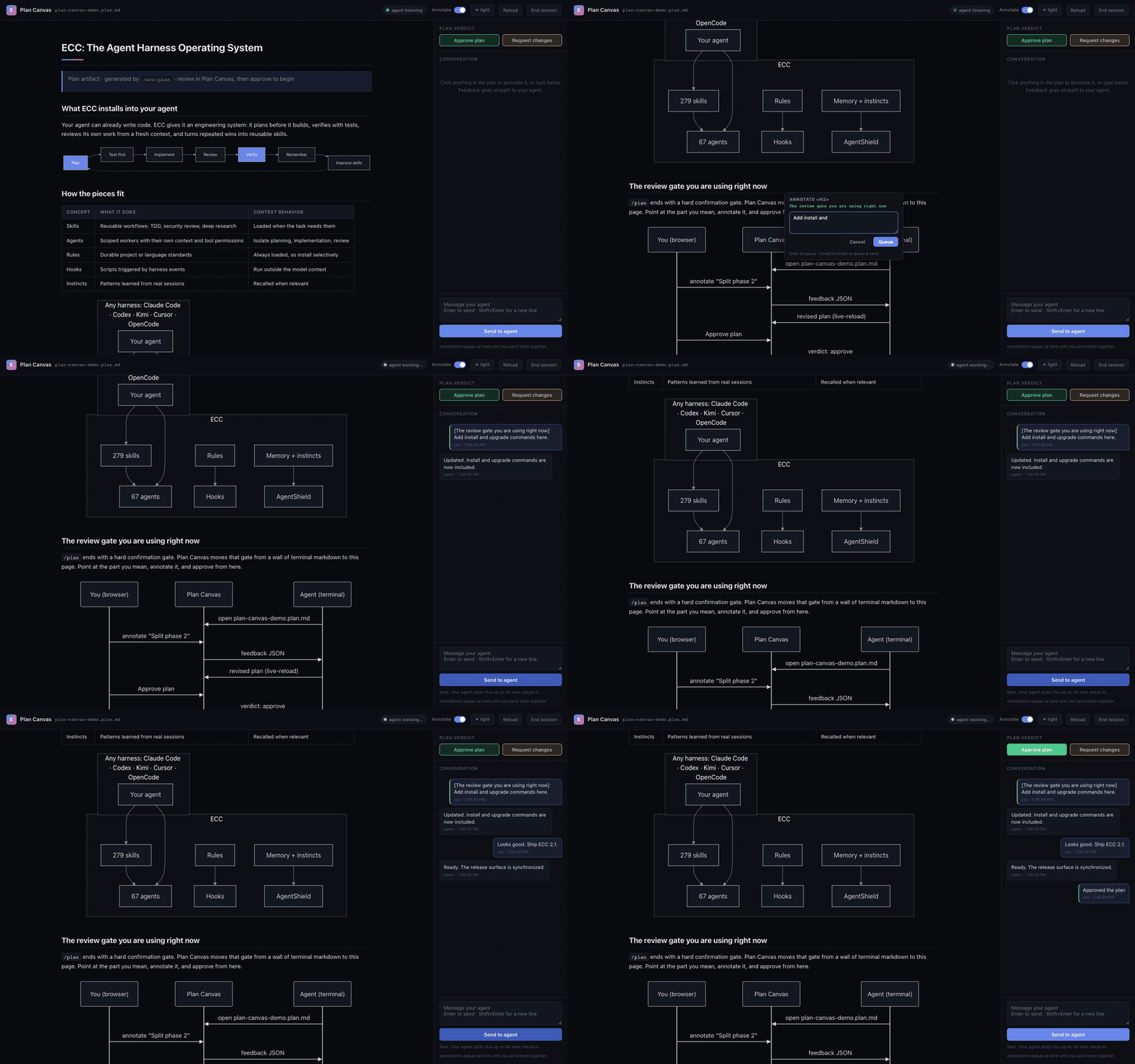 [Download the MP4 demo](https://raw.githubusercontent.com/affaan-m/ECC/main/docs/releases/2.1.0/assets/ecc-plan-canvas-demo.mp4) `/plan` ends with a confirm gate, and until now that review was a wall of markdown in the terminal. Now the agent opens the plan in a loopback-only browser canvas: - Click elements or select text to attach numbered annotations - Chat with the agent from a side rail while it works in the terminal - **Approve plan** / **Request changes** buttons map directly onto `/plan`'s CONFIRM gate - Mermaid diagrams, tables, and task lists render natively; file edits live-reload the page - Model- and harness-agnostic: a plain CLI + JSON protocol (`ecc-plan-canvas`), no Claude-only dependency ## Kimi harness: Moonshot AI partnership ECC now installs directly into [Kimi Code](https://moonshotai.github.io/kimi-cli/) (`--target kimi`). Kimi Code discovers the installed `.kimi/AGENTS.md` instructions and `.kimi/skills/` workflows natively: ```bash bash ./install.sh --target kimi --profile minimal npx ecc doctor --target kimi kimi ``` ## Self-host on Itô GPUs Run ECC against any self-hosted open-source model. If you need GPU capacity, [Itô](https://compute.itomarkets.com) is ECC's preferred compute sponsor. The integration shipped guarded end to end: - `ecc ito find`: opt-in bridge to the canonical Itô CLI that submits a live, authenticated RFQ (it does not reserve capacity) - Guarded live node qualification and read-only compute handoff - Credential-bearing CLI shims are rejected outright The sponsorship link itself is passive: it does not invoke an RFQ, reserve capacity, provision compute, or configure serving. Managed inference through Itô is not live yet. Any GPU provider works, and ECC stays provider-agnostic. ## Partners [Moonshot AI (Kimi)](https://www.moonshot.ai), [Itô](https://compute.itomarkets.com), and [Atlas Cloud](https://www.atlascloud.ai) are now public sponsors of ECC. The README documents a recommended self-host path: Itô for GPU capacity, a Kimi checkpoint served behind a compatible endpoint, then Kimi Code + ECC on top. Each choice remains separate and swappable. ## Also in 2.1 - **Hermes and OpenClaw install targets**: two more harnesses join Claude Code, Codex, OpenCode, Cursor, Gemini, Zed, Copilot, and Kimi - **Codex ECC navigation guide**: find the right skill/command surface from inside Codex - **GateGuard path exemptions** (`GATEGUARD_EXEMPT_GLOBS`) and configurable instinct injection (count + confidence threshold) - **PostToolUse hooks consolidated** into sync/async dispatchers, with fewer processes per tool call - **Supply-chain hardening**: the installer runtime passes strict vetting, and the pre-commit secret scan now catches Anthropic API keys (`sk-ant-...`) - A long tail of community fixes across OpenCode, Windows, bun lockfiles, the dashboard, and project detection The catalog now stands at **67 agents, 281 skills, and 94 command shims** (2.0.0 shipped 64/261/84), plus hooks, rules, memory, continuous learning, and AgentShield. ## Install or upgrade ```text /plugin marketplace add https://github.com/affaan-m/ECC /plugin install ecc@ecc ``` Existing installs: `/plugin update ecc` ## Community Join the ECC community for release announcements, questions, and Show and Tell: <https://discord.gg/36yGMHGFbR> Full changelog: <https://github.com/affaan-m/ECC/compare/v2.0.0...v2.1.0> ## New Contributors * @legeZZZ made their first contribution in https://github.com/affaan-m/ECC/pull/2200 * @tongshu2023 made their first contribution in https://github.com/affaan-m/ECC/pull/2216 * @mohameddsh3ban made their first contribution in https://github.com/affaan-m/ECC/pull/2195 * @fiedler-itlabs made their first contribution in https://github.com/affaan-m/ECC/pull/2240 * @daiki75 made their first contribution in https://github.com/affaan-m/ECC/pull/2245 * @wellkilo made their first contribution in https://github.com/affaan-m/ECC/pull/2194 * @rameshvr made their first contribution in https://github.com/affaan-m/ECC/pull/2144 * @aaronjmars made their first contribution in https://github.com/affaan-m/ECC/pull/2185 * @orbisai0security made their first contribution in https://github.com/affaan-m/ECC/pull/2149 * @xwang4-svg made their first contribution in https://github.com/affaan-m/ECC/pull/2186 * @kriptoburak made their first contribution in https://github.com/affaan-m/ECC/pull/2199 * @lamenting-hawthorn made their first contribution in https://github.com/affaan-m/ECC/pull/2235 * @mdayan8 made their first contribution in https://github.com/affaan-m/ECC/pull/2100 * @Naominour made their first contribution in https://github.com/affaan-m/ECC/pull/2188 * @Malphite10 made their first contribution in https://github.com/affaan-m/ECC/pull/2197 * @cogiwimute367-create made their first contribution in https://github.com/affaan-m/ECC/pull/2251 * @z3tz3r0 made their first contribution in https://github.com/affaan-m/ECC/pull/2250 * @rockwellwindsor made their first contribution in https://github.com/affaan-m/ECC/pull/2258 * @stroland02 made their first contribution in https://github.com/affaan-m/ECC/pull/2202 * @hretheum made their first contribution in https://github.com/affaan-m/ECC/pull/2221 * @BERORINPO made their first contribution in https://github.com/affaan-m/ECC/pull/2234 * @Victor-Casado made their first contribution in https://github.com/affaan-m/ECC/pull/2236 * @itkdm made their first contribution in https://github.com/affaan-m/ECC/pull/2241 * @leoeletronics made their first contribution in https://github.com/affaan-m/ECC/pull/2267 * @Seekers2001 made their first contribution in https://github.com/affaan-m/ECC/pull/2118 * @lucaszhu-hue made their first contribution in https://github.com/affaan-m/ECC/pull/2279 * @kapil971390 made their first contribution in https://github.com/affaan-m/ECC/pull/2292 * @danielnguyenfinhub made their first contribution in https://github.com/affaan-m/ECC/pull/2342 * @gpitrella made their first contribution in https://github.com/affaan-m/ECC/pull/2355 * @Angad2005 made their first contribution in https://github.com/affaan-m/ECC/pull/2366 * @quadcent made their first contribution in https://github.com/affaan-m/ECC/pull/2133 * @SiaoZeng made their first contribution in https://github.com/affaan-m/ECC/pull/2383 * @Tahiti18 made their first contribution in https://github.com/affaan-m/ECC/pull/2307 * @phobicdotno made their first contribution in https://github.com/affaan-m/ECC/pull/2343 * @sshworld made their first contribution in https://github.com/affaan-m/ECC/pull/2358 * @cd1amond made their first contribution in https://github.com/affaan-m/ECC/pull/2346 * @Tanaka-VivereGratis made their first contribution in https://github.com/affaan-m/ECC/pull/2388 * @KyawZinLatt made their first contribution in https://github.com/affaan-m/ECC/pull/2319 * @dieudonneAwa made their first contribution in https://github.com/affaan-m/ECC/pull/2288 * @carloscarvallo made their first contribution in https://github.com/affaan-m/ECC/pull/2273 * @mc856 made their first contribution in https://github.com/affaan-m/ECC/pull/2274 * @jvirgovic made their first contribution in https://github.com/affaan-m/ECC/pull/2338 * @m18897829375 made their first contribution in https://github.com/affaan-m/ECC/pull/2336 * @jack-finance-able made their first contribution in https://github.com/affaan-m/ECC/pull/2390 * @yerros made their first contribution in https://github.com/affaan-m/ECC/pull/2275 * @YuhaoLin2005 made their first contribution in https://github.com/affaan-m/ECC/pull/2377 * @Cb2i made their first contribution in https://github.com/affaan-m/ECC/pull/2437 * @28winz-bot made their first contribution in https://github.com/affaan-m/ECC/pull/2422 * @sutazca made their first contribution in https://github.com/affaan-m/ECC/pull/2425 * @nidelson made their first contribution in https://github.com/affaan-m/ECC/pull/2420 * @juujb made their first contribution in https://github.com/affaan-m/ECC/pull/2416 * @Zalasyu made their first contribution in https://github.com/affaan-m/ECC/pull/2432 * @Lxcardoza993 made their first contribution in https://github.com/affaan-m/ECC/pull/2433 * @haelyra made their first contribution in https://github.com/affaan-m/ECC/pull/2467 * @thejesh23 made their first contribution in https://github.com/affaan-m/ECC/pull/2515 * @nankingjing made their first contribution in https://github.com/affaan-m/ECC/pull/2501 * @samartomar made their first contribution in https://github.com/affaan-m/ECC/pull/2503 * @fletcherm-hub made their first contribution in https://github.com/affaan-m/ECC/pull/2460 * @someiyoshino-lab made their first contribution in https://github.com/affaan-m/ECC/pull/2471 * @WinterSold1er made their first contribution in https://github.com/affaan-m/ECC/pull/2511 * @EmadDoughan made their first contribution in https://github.com/affaan-m/ECC/pull/2543 * @Oleksandr-Kh4 made their first contribution in https://github.com/affaan-m/ECC/pull/2529 * @latreon made their first contribution in https://github.com/affaan-m/ECC/pull/2536 **Full Changelog**: https://github.com/affaan-m/ECC/compare/v2.0.0...v2.1.0
此处仅展示最近 5 个版本。 在原站查看完整版本历史 ↗
当前收录版本
0.0.1
安全与评测信息
质量评测
满分100 · 来自 SkillPi LAB 实验室的评测报告。
亮点
- Production-ready UI motion system for React/Next.js with strong focus on performance and accessibility
- Comprehensive coverage of real-world animation scenarios including modals, lists, scroll effects, and micro-interactions
- Includes device adaptation and reduced motion support for inclusive design
待提升项
-
description language mismatch 原报告严重程度:轻微
User requested Japanese translation but content is in English
改进建议:Provide Japanese translation as requested in the description field
亮点
- Clear trigger description covering animations, transitions, and motion patterns
- Well-defined use cases and scenarios for appropriate usage
亮点
- Excellent structure with clear sections: When to Use, How It Works, Examples, Anti-Patterns
- Comprehensive frontmatter with proper metadata
- Multiple practical examples covering various animation scenarios
- Clear performance rules and accessibility guidelines
亮点
- Proper tool usage with correct import paths and version guidance
- Comprehensive error handling considerations and debugging section
- Accessibility support with reduced motion preferences
- Performance optimization guidelines and device adaptation
- SSR safety considerations for Next.js applications
取前四项原始分值的算术平均,四舍五入取整。可通过收录报告核对各项评分与说明,运行记录需单独查证。
正文静态检测
100 / 100 · skillpi-20261123-no-r3-v1
正文未命中当前规则。
分数仅反映正文中的规则命中,供使用前参考。附件与运行行为不在此评分范围内。
权限与使用前检查
根据当前主文档自动整理,命中内容可能是示例或防护说明;不是实际权限声明,也未覆盖附件、外部依赖或运行行为。
-
安装或获取外部依赖
使用官方来源并锁定版本,在隔离环境检查安装脚本。当前文档检查不覆盖后续下载的代码。
主文档提及 · 第 59 行
安全评级与访问范围
risk · 静态证据核验,不代表运行安全保证。
来源文档未说明。
使用前请由宿主核对并授权实际文件读写、外部服务和联网目的地;本站的核验不会授予任何运行权限。
用户讨论
还没有已核实的点评。