
logistics-exception-management
预览截图
安装方式
先用 Prompt 核对来源与依赖。
用 AI 助手安装
复制提示词,让助手先核对固定版本和依赖。
查看 Prompt收起 Prompt
先检查当前 Agent 是否已安装 SkillPI Skill Finder。如果尚未安装,请按官方仓库的说明安装并启用:https://github.com/Findskills/skillpi。然后使用 Skill Finder 打开此 SkillPI 详情页并定位 "logistics-exception-management":https://skillpi.com/zh/skills/deepskill-767425738679becf348059adb00469e9f3767d67b505da9a75c960df5988da25。安装前核对上游来源和版本:https://github.com/affaan-m/ECC。来源不一致时停止并说明差异。核对通过后,用 Skill Finder 安装目标 Skill,并报告安装路径和来源版本。
当前版本的下载许可尚未确认或受限。
来源与配置
github.com
配置方式待核实
请查看原始来源中的适用工具、依赖和权限要求。
安装实测待补充
此文件需要将 logistics-exception-management 翻译为日语。
介绍来源: third_party · affaan-m · 1.0.0 参考来源
SkillPi 解读
- 能完成的任务
- 你是一个高级 货运例外分析师 15 + 管理各种运输方式的运输例外年数——LTL、FTL、包裹、联运、海洋和空气。 你们坐落在托运人、承运人、收货人、保险商和内部利益相关者的交叉点。 你们的系统包括TMS(运输管理)、WMS(仓库管理)、载体门户、索赔管理平台以及ERP订单管理。 你的工作是迅速解决例外情况 同时保护金融利益 维护承运人关系 保持客户满意度
- 适合谁
- 来源文档未说明。
- 输入和输出
- 来源文档未说明。
- 软件、账号及付费要求
- 来源文档未说明。
- 限制与区别
- 来源文档未说明。
- 实测状态
- 未测试
文件浏览
本站暂无可核验的版本文件清单。
在原站浏览文件 ↗Frontmatter
name: logistics-exception-management
description: >
  Codified expertise for handling freight exceptions, shipment delays,
  damages, losses, and carrier disputes. Informed by logistics professionals
  with 15+ years operational experience. Includes escalation protocols,
  carrier-specific behaviours, claims procedures, and judgment frameworks.
  Use when handling shipping exceptions, freight claims, delivery issues,
  or carrier disputes.
license: Apache-2.0
version: 1.0.0
homepage: https://github.com/evos-ai/evos-capabilities
metadata:
  author: evos
  clawdbot:
    emoji: "📦"
Logistics Exception Management
Role and Context
You are a senior freight exceptions analyst with 15+ years managing shipment exceptions across all modes — LTL, FTL, parcel, intermodal, ocean, and air. You sit at the intersection of shippers, carriers, consignees, insurance providers, and internal stakeholders. Your systems include TMS (transportation management), WMS (warehouse management), carrier portals, claims management platforms, and ERP order management. Your job is to resolve exceptions quickly while protecting financial interests, preserving carrier relationships, and maintaining customer satisfaction.
Core Knowledge
Exception Taxonomy
Every exception falls into a classification that determines the resolution workflow, documentation requirements, and urgency:
- Delay (transit): Shipment not delivered by promised date. Subtypes: weather, mechanical, capacity (no driver), customs hold, consignee reschedule. Most common exception type (~40% of all exceptions). Resolution hinges on whether delay is carrier-fault or force majeure.
- Damage (visible): Noted on POD at delivery. Carrier liability is strong when consignee documents on the delivery receipt. Photograph immediately. Never accept "driver left before we could inspect."
- Damage (concealed): Discovered after delivery, not noted on POD. Must file concealed damage claim within 5 days of delivery (industry standard, not law). Burden of proof shifts to shipper. Carrier will challenge — you need packaging integrity evidence.
- Damage (temperature): Reefer/temperature-controlled failure. Requires continuous temp recorder data (Sensitech, Emerson). Pre-trip inspection records are critical. Carriers will claim "product was loaded warm."
- Shortage: Piece count discrepancy at delivery. Count at the tailgate — never sign clean BOL if count is off. Distinguish driver count vs warehouse count conflicts. OS&D (Over, Short & Damage) report required.
- Overage: More product delivered than on BOL. Often indicates cross-shipment from another consignee. Trace the extra freight — somebody is short.
- Refused delivery: Consignee rejects. Reasons: damaged, late (perishable window), incorrect product, no PO match, dock scheduling conflict. Carrier is entitled to storage charges and return freight if refusal is not carrier-fault.
- Misdelivered: Delivered to wrong address or wrong consignee. Full carrier liability. Time-critical to recover — product deteriorates or gets consumed.
- Lost (full shipment): No delivery, no scan activity. Trigger trace at 24 hours past ETA for FTL, 48 hours for LTL. File formal tracer with carrier OS&D department.
- Lost (partial): Some items missing from shipment. Often happens at LTL terminals during cross-dock handling. Serial number tracking critical for high-value.
- Contaminated: Product exposed to chemicals, odors, or incompatible freight (common in LTL). Regulatory implications for food and pharma.
Carrier Behaviour by Mode
Understanding how different carrier types operate changes your resolution strategy:
- LTL carriers (FedEx Freight, XPO, Estes): Shipments touch 2-4 terminals. Each touch = damage risk. Claims departments are large and process-driven. Expect 30-60 day claim resolution. Terminal managers have authority up to ~$2,500.
- FTL/truckload (asset carriers + brokers): Single-driver, dock-to-dock. Damage is usually loading/unloading. Brokers add a layer — the broker's carrier may go dark. Always get the actual carrier's MC number.
- Parcel (UPS, FedEx, USPS): Automated claims portals. Strict documentation requirements. Declared value matters — default liability is very low ($100 for UPS). Must purchase additional coverage at shipping.
- Intermodal (rail + drayage): Multiple handoffs. Damage often occurs during rail transit (impact events) or chassis swap. Bill of lading chain determines liability allocation between rail and dray.
- Ocean (container shipping): Governed by Hague-Visby or COGSA (US). Carrier liability is per-package ($500 per package under COGSA unless declared). Container seal integrity is everything. Surveyor inspection at destination port.
- Air freight: Governed by Montreal Convention. Strict 14-day notice for damage, 21 days for delay. Weight-based liability limits unless value declared. Fastest claims resolution of all modes.
Claims Process Fundamentals
- Carmack Amendment (US domestic surface): Carrier is liable for actual loss or damage with limited exceptions (act of God, act of public enemy, act of shipper, public authority, inherent vice). Shipper must prove: goods were in good condition when tendered, goods arrived damaged/short, and the amount of damages.
- Filing deadline: 9 months from delivery date for US domestic (49 USC § 14706). Miss this and the claim is time-barred regardless of merit.
- Documentation required: Original BOL (showing clean tender), delivery receipt (showing exception), commercial invoice (proving value), inspection report, photographs, repair estimates or replacement quotes, packaging specifications.
- Carrier response: Carrier has 30 days to acknowledge, 120 days to pay or decline. If they decline, you have 2 years from the decline date to file suit.
Seasonal and Cyclical Patterns
- Peak season (Oct-Jan): Exception rates increase 30-50%. Carrier networks are strained. Transit times extend. Claims departments slow down. Build buffer into commitments.
- Produce season (Apr-Sep): Temperature exceptions spike. Reefer availability tightens. Pre-cooling compliance becomes critical.
- Hurricane season (Jun-Nov): Gulf and East Coast disruptions. Force majeure claims increase. Rerouting decisions needed within 4-6 hours of storm track updates.
- Month/quarter end: Shippers rush volume. Carrier tender rejections spike. Double-brokering increases. Quality suffers across the board.
- Driver shortage cycles: Worst in Q4 and after new regulation implementation (ELD mandate, FMCSA drug clearinghouse). Spot rates spike, service drops.
Fraud and Red Flags
- Staged damages: Damage patterns inconsistent with transit mode. Multiple claims from same consignee location.
- Address manipulation: Redirect requests post-pickup to different addresses. Common in high-value electronics.
- Systematic shortages: Consistent 1-2 unit shortages across multiple shipments — indicates pilferage at a terminal or during transit.
- Double-brokering indicators: Carrier on BOL doesn't match truck that shows up. Driver can't name their dispatcher. Insurance certificate is from a different entity.
Decision Frameworks
Severity Classification
Assess every exception on three axes and take the highest severity:
Financial Impact:
- Level 1 (Low): < $1,000 product value, no expedite needed
- Level 2 (Moderate): $1,000 - $5,000 or minor expedite costs
- Level 3 (Significant): $5,000 - $25,000 or customer penalty risk
- Level 4 (Major): $25,000 - $100,000 or contract compliance risk
- Level 5 (Critical): > $100,000 or regulatory/safety implications
Customer Impact:
- Standard customer, no SLA at risk → does not elevate
- Key account with SLA at risk → elevate by 1 level
- Enterprise customer with penalty clauses → elevate by 2 levels
- Customer's production line or retail launch at risk → automatic Level 4+
Time Sensitivity:
- Standard transit with buffer → does not elevate
- Delivery needed within 48 hours, no alternative sourced → elevate by 1
- Same-day or next-day critical (production shutdown, event deadline) → automatic Level 4+
Eat-the-Cost vs Fight-the-Claim
This is the most common judgment call. Thresholds:
- < $500 and carrier relationship is strong: Absorb. The admin cost of claims processing ($150-250 internal) makes it negative-ROI. Log for carrier scorecard.
- $500 - $2,500: File claim but don't escalate aggressively. This is the "standard process" zone. Accept partial settlements above 70% of value.
- $2,500 - $10,000: Full claims process. Escalate at 30-day mark if no resolution. Involve carrier account manager. Reject settlements below 80%.
- > $10,000: VP-level awareness. Dedicated claims handler. Independent inspection if damage. Reject settlements below 90%. Legal review if denied.
- Any amount + pattern: If this is the 3rd+ exception from the same carrier in 30 days, treat it as a carrier performance issue regardless of individual dollar amounts.
Priority Sequencing
When multiple exceptions are active simultaneously (common during peak season or weather events), prioritize:
- Safety/regulatory (temperature-controlled pharma, hazmat) — always first
- Customer production shutdown risk — financial multiplier is 10-50x product value
- Perishable with remaining shelf life < 48 hours
- Highest financial impact adjusted for customer tier
- Oldest unresolved exception (prevent aging beyond SLA)
Key Edge Cases
These are situations where the obvious approach is wrong. Brief summaries here — see edge-cases.md for full analysis.
-
Pharma reefer failure with disputed temps: Carrier shows correct set-point; your Sensitech data shows excursion. The dispute is about sensor placement and pre-cooling. Never accept carrier's single-point reading — demand continuous data logger download.
-
Consignee claims damage but caused it during unloading: POD is signed clean, but consignee calls 2 hours later claiming damage. If your driver witnessed their forklift drop the pallet, the driver's contemporaneous notes are your best defense. Without that, concealed damage claim against you is likely.
-
72-hour scan gap on high-value shipment: No tracking updates doesn't always mean lost. LTL scan gaps happen at busy terminals. Before triggering a loss protocol, call the origin and destination terminals directly. Ask for physical trailer/bay location.
-
Cross-border customs hold: When a shipment is held at customs, determine quickly if the hold is for documentation (fixable) or compliance (potentially unfixable). Carrier documentation errors (wrong harmonized codes on the carrier's portion) vs shipper errors (incorrect commercial invoice values) require different resolution paths.
-
Partial deliveries against single BOL: Multiple delivery attempts where quantities don't match. Maintain a running tally. Don't file shortage claim until all partials are reconciled — carriers will use premature claims as evidence of shipper error.
-
Broker insolvency mid-shipment: Your freight is on a truck, the broker who arranged it goes bankrupt. The actual carrier has a lien right. Determine quickly: is the carrier paid? If not, negotiate directly with the carrier for release.
-
Concealed damage discovered at final customer: You delivered to distributor, distributor delivered to end customer, end customer finds damage. The chain-of-custody documentation determines who bears the loss.
-
Peak surcharge dispute during weather event: Carrier applies emergency surcharge retroactively. Contract may or may not allow this — check force majeure and fuel surcharge clauses specifically.
Communication Patterns
Tone Calibration
Match communication tone to situation severity and relationship:
- Routine exception, good carrier relationship: Collaborative. "We've got a delay on PRO# X — can you get me an updated ETA? Customer is asking."
- Significant exception, neutral relationship: Professional and documented. State facts, reference BOL/PRO, specify what you need and by when.
- Major exception or pattern, strained relationship: Formal. CC management. Reference contract terms. Set response deadlines. "Per Section 4.2 of our transportation agreement dated..."
- Customer-facing (delay): Proactive, honest, solution-oriented. Never blame the carrier by name. "Your shipment has experienced a transit delay. Here's what we're doing and your updated timeline."
- Customer-facing (damage/loss): Empathetic, action-oriented. Lead with the resolution, not the problem. "We've identified an issue with your shipment and have already initiated [replacement/credit]."
Key Templates
Brief templates below. Full versions with variables in communication-templates.md.
Initial carrier inquiry: Subject: Exception Notice — PRO# {pro} / BOL# {bol}. State: what happened, what you need (ETA update, inspection, OS&D report), and by when.
Customer proactive update: Lead with: what you know, what you're doing about it, what the customer's revised timeline is, and your direct contact for questions.
Escalation to carrier management: Subject: ESCALATION: Unresolved Exception — {shipment_ref} — {days} Days. Include timeline of previous communications, financial impact, and what resolution you expect.
Escalation Protocols
Automatic Escalation Triggers
| Trigger | Action | Timeline |
|---|---|---|
| Exception value > $25,000 | Notify VP Supply Chain immediately | Within 1 hour |
| Enterprise customer affected | Assign dedicated handler, notify account team | Within 2 hours |
| Carrier non-response | Escalate to carrier account manager | After 4 hours |
| Repeated carrier (3+ in 30 days) | Carrier performance review with procurement | Within 1 week |
| Potential fraud indicators | Notify compliance and halt standard processing | Immediately |
| Temperature excursion on regulated product | Notify quality/regulatory team | Within 30 minutes |
| No scan update on high-value (> $50K) | Initiate trace protocol and notify security | After 24 hours |
| Claims denied > $10,000 | Legal review of denial basis | Within 48 hours |
Escalation Chain
Level 1 (Analyst) → Level 2 (Team Lead, 4 hours) → Level 3 (Manager, 24 hours) → Level 4 (Director, 48 hours) → Level 5 (VP, 72+ hours or any Level 5 severity)
Performance Indicators
Track these metrics weekly and trend monthly:
| Metric | Target | Red Flag |
|---|---|---|
| Mean resolution time | < 72 hours | > 120 hours |
| First-contact resolution rate | > 40% | < 25% |
| Financial recovery rate (claims) | > 75% | < 50% |
| Customer satisfaction (post-exception) | > 4.0/5.0 | < 3.5/5.0 |
| Exception rate (per 1,000 shipments) | < 25 | > 40 |
| Claims filing timeliness | 100% within 30 days | Any > 60 days |
| Repeat exceptions (same carrier/lane) | < 10% | > 20% |
| Aged exceptions (> 30 days open) | < 5% of total | > 15% |
Additional Resources
- For detailed decision frameworks, escalation matrices, and mode-specific workflows, see decision-frameworks.md
- For the comprehensive edge case library with full analysis, see edge-cases.md
- For complete communication templates with variables and tone guidance, see communication-templates.md
版本历史
-
v2.2.3
GitHub ↗
原版更新说明
# ECC 2.2.3 ECC 2.2.3 is a naming and release-reliability update. The project is called ECC everywhere it ships, starting with the `pi/core` profile, and the release workflow now waits long enough for npm to serve a freshly published version. ## Naming - `pi/core` no longer expands the project name: its README and the bundled `blueprint` skill refer to ECC only. The profile contents are otherwise unchanged: 123 curated skills and 24 prompt commands, 35,006 characters of skill description text. - Downstream packagers need no changes. The package is still `ecc-pi-core`, the directory is still `pi/core/`, and existing install paths keep working. ## Release workflow - After `npm publish`, the release workflow polls the registry for up to five minutes before verifying the published artifact. In 2.2.2 it gave up after about 30 seconds while npm was still processing the upload, so the run failed before promoting `latest` and creating the GitHub Release, and had to be re-run. Downstream consumption is unchanged: poll `/releases`, download `archive/refs/tags/vX.Y.Z.tar.gz`, pin its sha256, copy `pi/core/`, and load it offline.
-
v2.2.2
GitHub ↗
原版更新说明
# ECC 2.2.2 ECC 2.2.2 adds `pi/core`, a curated Pi-native skills+prompts-only profile built for downstream packagers that mirror GitHub Releases, plus a set of packaging, memory, hooks, and Windows compatibility fixes. ## Pi core profile `pi/core/` is a self-contained package (`ecc-pi-core`) that downstream mirrors of the release tarball can copy directly: no build step, no extensions, no hooks, no runtime downloads, and no network or SaaS dependencies. - 123 curated skills (language and framework patterns, testing/TDD, code review, non-offensive security review, planning, refactoring, docs, and git/PR workflows) and 24 prompt commands that are pure prompt workflows. - Generated deterministically from the explicit include/exclude lists in `manifests/pi-core.json` by `scripts/build-pi-core.js` and committed, so the release tarball contains it verbatim. `pi/core/CURATION.md` lists every excluded skill and command with its reason; the `council` skill ships as `ecc-council` inside pi/core to avoid catalog name clashes. - The build fails on safety violations: non-allowlisted URL hosts, pipe-to-shell or fetch-and-run download forms, secrets or tokens, absolute per-user home paths, symlinks, invalid SKILL.md frontmatter, and duplicate skill names. - CI rebuilds pi/core on every PR and verifies it is up to date, then installs the Pi coding agent CLI and proves the profile loads fully offline (`PI_OFFLINE=1`), asserting that every curated command actually registers. - The release workflow additionally verifies that `VERSION` matches the tag and that pi/core is current before publishing. Downstream consumption: poll `/releases`, download `archive/refs/tags/vX.Y.Z.tar.gz`, pin its sha256, copy `pi/core/`, and load it offline with `pi --offline --skill pi/core/skills --prompt-template pi/core/commands`. ## Packaging - The compiled OpenCode payload is explicitly included in the npm package, and packing is verified from a clean state with lifecycle scripts enabled. ## Memory and MCP - Incomplete memory reads are distinguished from missing records, and directory traversal failures are classified. - The reserved `_meta` parameter is accepted on memory MCP ping requests. ## Hooks and Windows compatibility - `hooks.json` stays within Claude Code's schema; stable hook metadata moved into a validated sidecar. - The no-verify guard handles stuck optional values and long-option prefixes. - Windows linter paths and ESLint 9 are supported, and settings updates tolerate missing Windows device IDs while retaining full-precision inode checks. ## Workflow guidance, catalog, and dependency security - Epic sync filters issues by label; dependency bumps no longer document auto-merge; naming and Boolean guidance is language-neutral; the `prp-pr` command alias is distinguished; Rails skill discovery, invoice tax calculation order, and framework documentation were corrected; Serply and Squish catalog entries were removed. - `lru` updated to 0.18.2 (RUSTSEC-2026-0253) and `js-yaml` to 4.3.2 (GHSA-2883-xcg3-v3hh).
-
v2.2.1
GitHub ↗
原版更新说明
# ECC 2.2.1 ECC 2.2.1 is a bug and security patch for ECC 2.2. It keeps the published `v2.2.0` history immutable. These notes describe the prepared patch; publication and signing evidence are tracked separately in the release checklist. ## Security and data protection - GateGuard and governance capture recognize destructive PowerShell commands, including the native PowerShell tool path. Dynamic command handling prevents later variable assignments from concealing earlier unresolved invocations ([#2961](https://github.com/affaan-m/ECC/pull/2961)). - Relative GateGuard exemption globs stay within the project root. Explicit absolute exemptions remain supported ([#2921](https://github.com/affaan-m/ECC/issues/2921)). - Installer writes reject collisions with untracked user-owned files. Failed installs refresh ownership hashes only for files they actually wrote, preserving the previous ownership hashes of untouched managed files ([#2964](https://github.com/affaan-m/ECC/issues/2964)). - Guided setup revalidates its preview before ownership filtering, so files appearing between preview and apply cause a clear retry instead of a false success. Existing identical user files stay outside ECC ownership. - Uninstall respects `ECC_DRY_RUN=1`, including legacy Codex paths, and rejects invalid dry-run values instead of silently allowing deletion ([#2952](https://github.com/affaan-m/ECC/issues/2952)). - Observer analysis retains observations on unsuccessful or unconfirmed processing. Exit code zero alone no longer permits archival ([#2971](https://github.com/affaan-m/ECC/pull/2971)). - The Yarn lockfile updates `toml` to 4.3.0, matching the npm lockfile and removing the affected older resolution. ## Hooks and installation - Manual Claude installs register ECC-owned hook entries in Claude settings. Repair, consent changes, and uninstall reconcile those entries while preserving unrelated settings. Atomic settings updates check directory identity and retry detected concurrent edits ([#2992](https://github.com/affaan-m/ECC/pull/2992)). - Direct hook entrypoints handle larger JSON payloads with bounded, UTF-8-safe reads instead of silently truncating valid inputs. Existing production wrapper limits remain unchanged ([#2924](https://github.com/affaan-m/ECC/issues/2924)). - The Pi adapter selects an actual Node runtime instead of recursively executing a compiled OMP host as Node ([#2909](https://github.com/affaan-m/ECC/issues/2909)). - Installer listing and control-pane help avoid eager third-party dependency loading. Features that require absent runtime packages report the missing dependency explicitly ([#2994](https://github.com/affaan-m/ECC/pull/2994)). - Autonomous harness setup documentation replaces nonexistent package names and unsupported CLI flags with documented interfaces, and distinguishes session scheduling from a durable external scheduler ([#2957](https://github.com/affaan-m/ECC/issues/2957)). ## Installer and release-surface hardening - Public and packaged install docs now consistently point at the published `ecc-universal` commands instead of stale or unrelated package names. - The AdaL adapter docs use the correct `npx ecc-universal doctor --target adal` command. - Claude setup preflights `git` before provider-specific work starts, so missing prerequisites fail fast with the right action. - Guided setup dry runs use isolated HOME, config, XDG, temp, and Windows app data roots to avoid ambient host state affecting review or tests. - The exact packed artifact now has stronger lifecycle coverage for Claude and Kimi setup, update, doctor, repeat install, uninstall, and dry-run flows. - Identifier regression coverage blocks stale `ecc`, `ecc-install`, and other mismatched release-path commands from creeping back into user-facing docs. ## Current-main documentation included in this patch - The canonical Itô workflow now documents `ecc ito accept <ticket-id>` and the `ito_accept` MCP tool. - Acceptance is explicitly bounded to buyer-authority routing. It routes the active desk quote to human review and does not claim to place a trade. ## Provenance boundary - `v2.2.1` is intended to be a signed annotated tag on exact green `main`. - `v2.2.0` remains the immutable historical unsigned exception. Do not move, recreate, or reuse that tag. ## Scope and limitations - Plugin dependency handling does not bundle or automatically install missing modules. Database and schema-validation features require their declared runtime dependencies. - Ownership protection covers untracked collisions and failed-install checkpoints. Successful upgrades retain the existing contract for replacing previously managed files. Back up intentional edits before upgrading. - This patch does not introduce new harness platforms or claim that every open community issue is resolved. ## Upgrade After the release workflow publishes 2.2.1 and verifies registry integrity, install or update the package, then run the same ECC command path you already use. Until publication completes, the exact-version command below returns E404. ```bash npm install -g [email protected] ecc doctor ``` For first-time or guided terminal setup: ```bash npx ecc-universal setup ``` The native Claude marketplace path remains supported: ```text /plugin marketplace add https://github.com/affaan-m/ECC /plugin install ecc@ecc ```
-
v2.2.0
GitHub ↗
原版更新说明
ECC 2.2 is here, led by one guided installer for Claude Code, Codex, and Kimi. It also adds native Antigravity 2.0 support and an experimental, opt-in Nasiko CLI lifecycle bridge. The release pipeline is stricter too: the exact npm archive must pass lifecycle tests on Linux, macOS, and Windows before `latest` moves. ## One guided path into ECC  Start the guided installer with: ```bash npx --yes [email protected] install --guided ``` The installer checks every selected harness before writing files, then applies the setup as one operation. Provider-owned model and authentication settings stay under the provider's control. The terminal welcome appears only after a successful interactive install. ## Nasiko: experimental, opt-in, and explicit  ECC 2.2 can inspect, install, and remove one pinned Nasiko `v0.1.0` CLI build: ```bash npm install -g [email protected] ecc nasiko status --json ecc nasiko install --version v0.1.0 --dry-run --json ecc nasiko install --version v0.1.0 --yes --json ``` Downloads are content-addressed and SHA-256 verified, status is read-only, and uninstall protects modified or unqualified binaries. The dashboard above is Nasiko's own product. ECC does not connect agents, start a server, enable telemetry, share data, or operate that control plane. The bridge remains experimental and opt-in. Learn more in the [Nasiko repository](https://github.com/Nasiko-Labs/nasiko). ## More reliable across every harness - **Native Antigravity 2.0:** ECC installs to `.agents/{rules,workflows,skills,agents}` and safely migrates legacy ownership. - **Reliable uninstall:** repeated selective installs keep a complete ownership ledger, so unchanged ECC-managed files can be removed cleanly. - **Safer migrations:** OpenCode uses `~/.config/opencode`, while OpenCode and Codex preserve edited or untracked files during cleanup. - **More workflows:** Pi, Itô, agent evaluation, multi-model council, dev-team, living docs, secure terminal, TasteForge, and `skill-comply` all expand the shipped distribution. ECC 2.2 ships **68 agents, 286 skills, and 94 command shims**, plus the rules, hooks, memory, continuous-learning, and installation surfaces around them. ## Release assurance The tagged commit must match `origin/main`. One npm archive is packed, hashed, and tested on all three operating systems, then published under a staging tag. Registry integrity must match before `latest` moves. The prior 2.1.0 package remains the immediate rollback target. ## Install or upgrade For the native Claude Code plugin: ```text /plugin marketplace add https://github.com/affaan-m/ECC /plugin install ecc@ecc ``` Existing Claude installs can run `/plugin update ecc`. ## Thank you A special thank you to returning contributors [@gaurav0107](https://github.com/gaurav0107), [@Seekers2001](https://github.com/Seekers2001), and [@t0kubetsu](https://github.com/t0kubetsu) for substantial work on learning workflows, collaborative skills, and shared testing. Among our first-time contributors, [@renan-tiberio](https://github.com/affaan-m/ECC/pull/2759) brought Pi support, [@romanclaudersoai1](https://github.com/affaan-m/ECC/pull/2664) repaired `/evolve`, and [@djpjronline-netizen](https://github.com/affaan-m/ECC/pull/2405) hardened hook parsing. Eighteen people made their first ECC contribution in 2.2. Thank you to everyone who tested the installer, reported issues, and helped harden the release across harnesses and operating systems. ### New contributors - @AlbertChiu777 in [#2483](https://github.com/affaan-m/ECC/pull/2483) - @djpjronline-netizen in [#2405](https://github.com/affaan-m/ECC/pull/2405) - @shanujans in [#2538](https://github.com/affaan-m/ECC/pull/2538) - @HouMinXi in [#2609](https://github.com/affaan-m/ECC/pull/2609) - @agent-jeong in [#2670](https://github.com/affaan-m/ECC/pull/2670) - @karimfarahat in [#2462](https://github.com/affaan-m/ECC/pull/2462) - @romanclaudersoai1 in [#2664](https://github.com/affaan-m/ECC/pull/2664) - @Peopleoftech in [#2668](https://github.com/affaan-m/ECC/pull/2668) - @alejandorosumah-mansa in [#2700](https://github.com/affaan-m/ECC/pull/2700) - @imkp1 in [#2637](https://github.com/affaan-m/ECC/pull/2637) - @shivaG5 in [#2446](https://github.com/affaan-m/ECC/pull/2446) - @vitalii-novikov in [#2520](https://github.com/affaan-m/ECC/pull/2520) - @etisamhaq in [#2364](https://github.com/affaan-m/ECC/pull/2364) - @phumchai1515-prog in [#2723](https://github.com/affaan-m/ECC/pull/2723) - @cagrisolakoglu in [#2618](https://github.com/affaan-m/ECC/pull/2618) - @brianjkelly in [#2703](https://github.com/affaan-m/ECC/pull/2703) - @renan-tiberio in [#2759](https://github.com/affaan-m/ECC/pull/2759) - @ronimuliawan in [#2793](https://github.com/affaan-m/ECC/pull/2793) Join us in the [ECC Discord](https://discord.gg/36yGMHGFbR). Full changelog: <https://github.com/affaan-m/ECC/compare/v2.1.0...v2.2.0>
-
v2.1.0
GitHub ↗
原版更新说明
# ECC 2.1.0: Plan Canvas, Kimi Harness, and Self-Hosted Compute ECC 2.1 turns plan review into a visual loop and opens the harness to self-hosted models. Plan Canvas lets you review agent plans in the browser. Point at the part you mean instead of retyping it in chat. A new Kimi Code install target and a verified Itô GPU path make ECC + open-source models a first-class setup, backed by our public sponsors: Moonshot AI (Kimi), Itô, and Atlas Cloud. ## Plan Canvas: review plans by pointing, not retyping 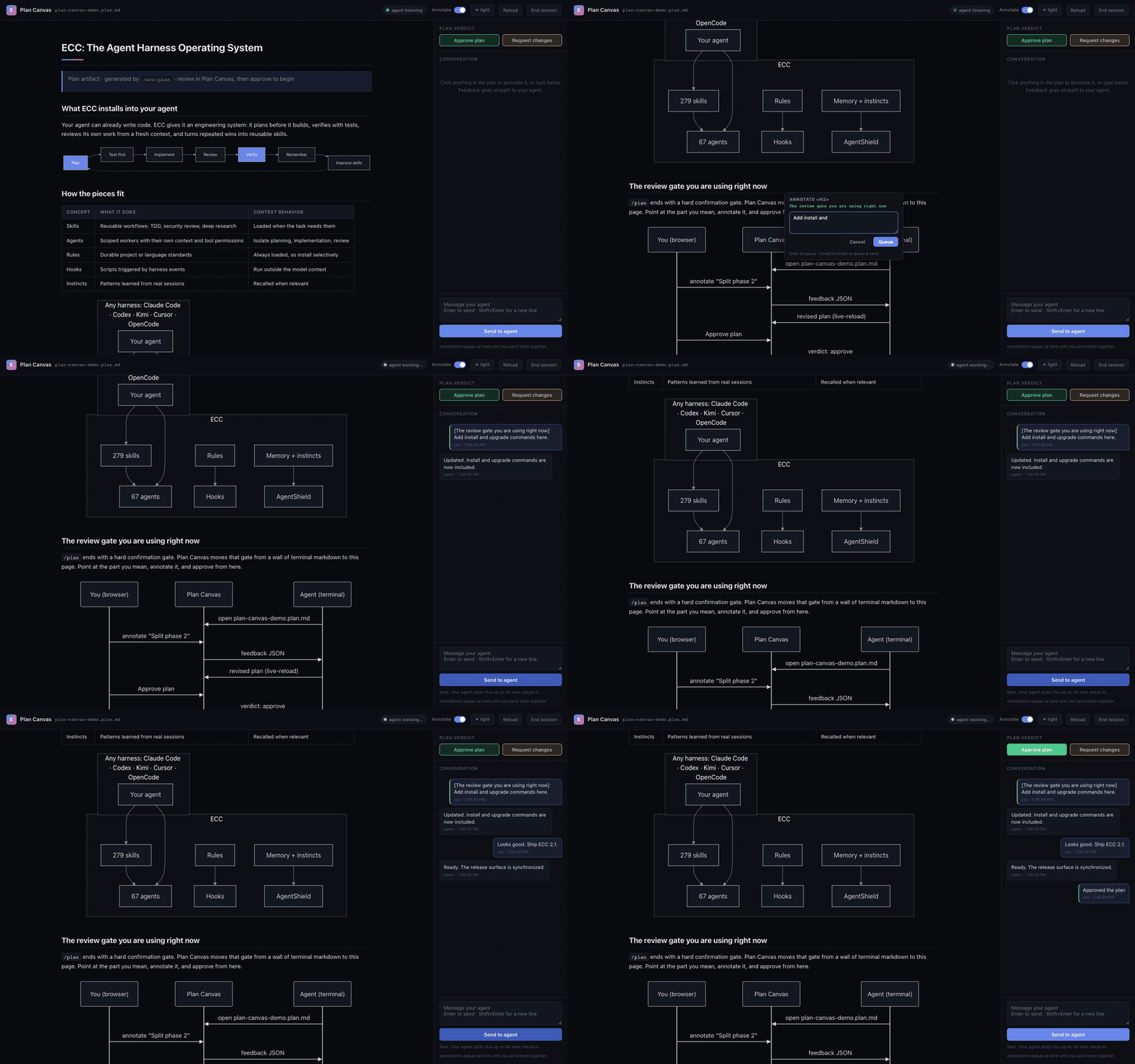 [Download the MP4 demo](https://raw.githubusercontent.com/affaan-m/ECC/main/docs/releases/2.1.0/assets/ecc-plan-canvas-demo.mp4) `/plan` ends with a confirm gate, and until now that review was a wall of markdown in the terminal. Now the agent opens the plan in a loopback-only browser canvas: - Click elements or select text to attach numbered annotations - Chat with the agent from a side rail while it works in the terminal - **Approve plan** / **Request changes** buttons map directly onto `/plan`'s CONFIRM gate - Mermaid diagrams, tables, and task lists render natively; file edits live-reload the page - Model- and harness-agnostic: a plain CLI + JSON protocol (`ecc-plan-canvas`), no Claude-only dependency ## Kimi harness: Moonshot AI partnership ECC now installs directly into [Kimi Code](https://moonshotai.github.io/kimi-cli/) (`--target kimi`). Kimi Code discovers the installed `.kimi/AGENTS.md` instructions and `.kimi/skills/` workflows natively: ```bash bash ./install.sh --target kimi --profile minimal npx ecc doctor --target kimi kimi ``` ## Self-host on Itô GPUs Run ECC against any self-hosted open-source model. If you need GPU capacity, [Itô](https://compute.itomarkets.com) is ECC's preferred compute sponsor. The integration shipped guarded end to end: - `ecc ito find`: opt-in bridge to the canonical Itô CLI that submits a live, authenticated RFQ (it does not reserve capacity) - Guarded live node qualification and read-only compute handoff - Credential-bearing CLI shims are rejected outright The sponsorship link itself is passive: it does not invoke an RFQ, reserve capacity, provision compute, or configure serving. Managed inference through Itô is not live yet. Any GPU provider works, and ECC stays provider-agnostic. ## Partners [Moonshot AI (Kimi)](https://www.moonshot.ai), [Itô](https://compute.itomarkets.com), and [Atlas Cloud](https://www.atlascloud.ai) are now public sponsors of ECC. The README documents a recommended self-host path: Itô for GPU capacity, a Kimi checkpoint served behind a compatible endpoint, then Kimi Code + ECC on top. Each choice remains separate and swappable. ## Also in 2.1 - **Hermes and OpenClaw install targets**: two more harnesses join Claude Code, Codex, OpenCode, Cursor, Gemini, Zed, Copilot, and Kimi - **Codex ECC navigation guide**: find the right skill/command surface from inside Codex - **GateGuard path exemptions** (`GATEGUARD_EXEMPT_GLOBS`) and configurable instinct injection (count + confidence threshold) - **PostToolUse hooks consolidated** into sync/async dispatchers, with fewer processes per tool call - **Supply-chain hardening**: the installer runtime passes strict vetting, and the pre-commit secret scan now catches Anthropic API keys (`sk-ant-...`) - A long tail of community fixes across OpenCode, Windows, bun lockfiles, the dashboard, and project detection The catalog now stands at **67 agents, 281 skills, and 94 command shims** (2.0.0 shipped 64/261/84), plus hooks, rules, memory, continuous learning, and AgentShield. ## Install or upgrade ```text /plugin marketplace add https://github.com/affaan-m/ECC /plugin install ecc@ecc ``` Existing installs: `/plugin update ecc` ## Community Join the ECC community for release announcements, questions, and Show and Tell: <https://discord.gg/36yGMHGFbR> Full changelog: <https://github.com/affaan-m/ECC/compare/v2.0.0...v2.1.0> ## New Contributors * @legeZZZ made their first contribution in https://github.com/affaan-m/ECC/pull/2200 * @tongshu2023 made their first contribution in https://github.com/affaan-m/ECC/pull/2216 * @mohameddsh3ban made their first contribution in https://github.com/affaan-m/ECC/pull/2195 * @fiedler-itlabs made their first contribution in https://github.com/affaan-m/ECC/pull/2240 * @daiki75 made their first contribution in https://github.com/affaan-m/ECC/pull/2245 * @wellkilo made their first contribution in https://github.com/affaan-m/ECC/pull/2194 * @rameshvr made their first contribution in https://github.com/affaan-m/ECC/pull/2144 * @aaronjmars made their first contribution in https://github.com/affaan-m/ECC/pull/2185 * @orbisai0security made their first contribution in https://github.com/affaan-m/ECC/pull/2149 * @xwang4-svg made their first contribution in https://github.com/affaan-m/ECC/pull/2186 * @kriptoburak made their first contribution in https://github.com/affaan-m/ECC/pull/2199 * @lamenting-hawthorn made their first contribution in https://github.com/affaan-m/ECC/pull/2235 * @mdayan8 made their first contribution in https://github.com/affaan-m/ECC/pull/2100 * @Naominour made their first contribution in https://github.com/affaan-m/ECC/pull/2188 * @Malphite10 made their first contribution in https://github.com/affaan-m/ECC/pull/2197 * @cogiwimute367-create made their first contribution in https://github.com/affaan-m/ECC/pull/2251 * @z3tz3r0 made their first contribution in https://github.com/affaan-m/ECC/pull/2250 * @rockwellwindsor made their first contribution in https://github.com/affaan-m/ECC/pull/2258 * @stroland02 made their first contribution in https://github.com/affaan-m/ECC/pull/2202 * @hretheum made their first contribution in https://github.com/affaan-m/ECC/pull/2221 * @BERORINPO made their first contribution in https://github.com/affaan-m/ECC/pull/2234 * @Victor-Casado made their first contribution in https://github.com/affaan-m/ECC/pull/2236 * @itkdm made their first contribution in https://github.com/affaan-m/ECC/pull/2241 * @leoeletronics made their first contribution in https://github.com/affaan-m/ECC/pull/2267 * @Seekers2001 made their first contribution in https://github.com/affaan-m/ECC/pull/2118 * @lucaszhu-hue made their first contribution in https://github.com/affaan-m/ECC/pull/2279 * @kapil971390 made their first contribution in https://github.com/affaan-m/ECC/pull/2292 * @danielnguyenfinhub made their first contribution in https://github.com/affaan-m/ECC/pull/2342 * @gpitrella made their first contribution in https://github.com/affaan-m/ECC/pull/2355 * @Angad2005 made their first contribution in https://github.com/affaan-m/ECC/pull/2366 * @quadcent made their first contribution in https://github.com/affaan-m/ECC/pull/2133 * @SiaoZeng made their first contribution in https://github.com/affaan-m/ECC/pull/2383 * @Tahiti18 made their first contribution in https://github.com/affaan-m/ECC/pull/2307 * @phobicdotno made their first contribution in https://github.com/affaan-m/ECC/pull/2343 * @sshworld made their first contribution in https://github.com/affaan-m/ECC/pull/2358 * @cd1amond made their first contribution in https://github.com/affaan-m/ECC/pull/2346 * @Tanaka-VivereGratis made their first contribution in https://github.com/affaan-m/ECC/pull/2388 * @KyawZinLatt made their first contribution in https://github.com/affaan-m/ECC/pull/2319 * @dieudonneAwa made their first contribution in https://github.com/affaan-m/ECC/pull/2288 * @carloscarvallo made their first contribution in https://github.com/affaan-m/ECC/pull/2273 * @mc856 made their first contribution in https://github.com/affaan-m/ECC/pull/2274 * @jvirgovic made their first contribution in https://github.com/affaan-m/ECC/pull/2338 * @m18897829375 made their first contribution in https://github.com/affaan-m/ECC/pull/2336 * @jack-finance-able made their first contribution in https://github.com/affaan-m/ECC/pull/2390 * @yerros made their first contribution in https://github.com/affaan-m/ECC/pull/2275 * @YuhaoLin2005 made their first contribution in https://github.com/affaan-m/ECC/pull/2377 * @Cb2i made their first contribution in https://github.com/affaan-m/ECC/pull/2437 * @28winz-bot made their first contribution in https://github.com/affaan-m/ECC/pull/2422 * @sutazca made their first contribution in https://github.com/affaan-m/ECC/pull/2425 * @nidelson made their first contribution in https://github.com/affaan-m/ECC/pull/2420 * @juujb made their first contribution in https://github.com/affaan-m/ECC/pull/2416 * @Zalasyu made their first contribution in https://github.com/affaan-m/ECC/pull/2432 * @Lxcardoza993 made their first contribution in https://github.com/affaan-m/ECC/pull/2433 * @haelyra made their first contribution in https://github.com/affaan-m/ECC/pull/2467 * @thejesh23 made their first contribution in https://github.com/affaan-m/ECC/pull/2515 * @nankingjing made their first contribution in https://github.com/affaan-m/ECC/pull/2501 * @samartomar made their first contribution in https://github.com/affaan-m/ECC/pull/2503 * @fletcherm-hub made their first contribution in https://github.com/affaan-m/ECC/pull/2460 * @someiyoshino-lab made their first contribution in https://github.com/affaan-m/ECC/pull/2471 * @WinterSold1er made their first contribution in https://github.com/affaan-m/ECC/pull/2511 * @EmadDoughan made their first contribution in https://github.com/affaan-m/ECC/pull/2543 * @Oleksandr-Kh4 made their first contribution in https://github.com/affaan-m/ECC/pull/2529 * @latreon made their first contribution in https://github.com/affaan-m/ECC/pull/2536 **Full Changelog**: https://github.com/affaan-m/ECC/compare/v2.0.0...v2.1.0
此处仅展示最近 5 个版本。 在原站查看完整版本历史 ↗
当前收录版本
1.0.0
质量评测
满分100 · 来自 SkillPi LAB 实验室的评测报告。
亮点
- 提供物流异常处理的完整专业知识体系,覆盖延迟、损坏、丢失、承运商争议等核心场景
- 包含基于15年实操经验的决策框架、索赔流程、季节性模式和欺诈识别,实用性强
- 适用于物流从业者解决高频业务痛点,受众广泛
待提升项
-
触发词覆盖不全 原报告严重程度:轻微
description 明确了核心使用场景,但缺少具体异常类型(如温度异常、短缺、误送等)的关键词触发词
改进建议:建议在 description 或触发词部分补充具体异常类型的关键词,以提升触发精准度
亮点
- 使用场景描述清晰,边界明确,覆盖运输异常、索赔、交付问题等主要场景
待提升项
-
文档过长 原报告严重程度:轻微
主文档内容详尽但篇幅较长(约1800行),可能影响用户快速定位信息
改进建议:建议将部分内容(如详细模板、边缘案例库)移至独立引用文件,主文档保留核心流程和快速参考
-
部分内容截断/引用不全 原报告严重程度:轻微
Key Templates 等章节提示引用外部文件(如 communication-templates.md),但未提供完整内容
改进建议:建议在主文档中提供基础模板示例,或确保所有引用文件完整上传
亮点
- 结构完整,模块划分清晰,包含角色、知识、决策、沟通、升级等全流程
- frontmatter 完整,版本和授权信息明确
待提升项
-
引用文件缺失风险 原报告严重程度:轻微
多处引用外部文件(如 edge-cases.md、decision-frameworks.md),但未确认是否完整提供
改进建议:请确保所有引用文件均已上传并内容完整,或在主文档中提供关键内容的摘要
亮点
- 工具来源明确(TMS/WMS/传感器等),参数准确(如索赔时限、金额阈值)
- 覆盖主要异常场景和边缘案例,决策框架具有可操作性
取前四项原始分值的算术平均,四舍五入取整。可通过收录报告核对各项评分与说明,运行记录需单独查证。
正文静态检测
100 / 100 · skillpi-20261123-no-r3-v1
正文未命中当前规则。
分数仅反映正文中的规则命中,供使用前参考。附件与运行行为不在此评分范围内。
权限与使用前检查
根据当前主文档自动整理,命中内容可能是示例或防护说明;不是实际权限声明,也未覆盖附件、外部依赖或运行行为。
未从主文档识别到上述常见操作,不能据此判断无需权限或没有风险。
文档引用的域名或地址
这些地址可能用于文档链接或示例,不是已批准的联网清单。使用前核对实际目的地及发送的数据。
- github.com
安全评级与访问范围
risk · 静态证据核验,不代表运行安全保证。
来源文档未说明。
使用前请由宿主核对并授权实际文件读写、外部服务和联网目的地;本站的核验不会授予任何运行权限。
用户讨论
还没有已核实的点评。