
redis-patterns
预览截图
安装方式
先用 Prompt 核对来源与依赖。也可下载安装包。
用 AI 助手安装
复制提示词,让助手先核对固定版本和依赖。
查看 Prompt收起 Prompt
先检查当前 Agent 是否已安装 SkillPI Skill Finder。如果尚未安装,请按官方仓库的说明安装并启用:https://github.com/Findskills/skillpi。然后使用 Skill Finder 打开此 SkillPI 详情页并定位 "redis-patterns":https://skillpi.com/zh/skills/deepskill-83fa0d4b6bb03fe81bab5edae10f984c1470e2d17f48586de82df0e44b76fd07。安装前核对上游来源和版本:https://github.com/affaan-m/ECC。来源不一致时停止并说明差异。核对通过后,用 Skill Finder 安装目标 Skill,并报告安装路径和来源版本。
来源与配置
github.com
配置方式待核实
请查看原始来源中的适用工具、依赖和权限要求。
安装实测待补充
Redis 应用模式:涵盖 Redis 数据结构模式、缓存策略、分布式锁、限流、发布/订阅以及连接管理,适用于生产环境中添加缓存、分布式锁或限流等场景。
介绍来源: third_party · affaan-m · 0.0.1 参考来源
SkillPi 解读
- 能完成的任务
- Redis数据结构模式,缓存策略,分布式锁,速率限制,pub/sub,以及生产应用的连接管理. 添加缓存、 分布式锁定、 速率限制、 或带有 Redis 的 pub/ sub 时使用, 或者当关键设计需要审查时使用 。
- 适合谁
- 来源文档未说明。
- 输入和输出
- 来源文档未说明。
- 软件、账号及付费要求
- 来源文档未说明。
- 限制与区别
- 来源文档未说明。
- 实测状态
- 未测试
文件浏览
本站暂无可核验的版本文件清单。
在原站浏览文件 ↗Frontmatter
name: redis-patterns
description: Redis data structure patterns, caching strategies, distributed locks, rate limiting, pub/sub, and connection management for production applications. Use when adding caching, a distributed lock, rate limiting, or pub/sub with Redis, or when key design needs review.
metadata:
  origin: ECC
Redis Patterns
Quick reference for Redis best practices across common backend use cases.
How It Works
Redis is an in-memory data structure store that supports strings, hashes, lists, sets, sorted sets, streams, and more. Individual Redis commands are atomic on a single instance; multi-step workflows require Lua scripts, MULTI/EXEC transactions, or explicit synchronization to stay atomic. Data is optionally persisted via RDB snapshots or AOF logs. Clients communicate over TCP using the RESP protocol; connection pools are essential to avoid per-request handshake overhead.
When to Activate
- Adding caching to an application
- Implementing rate limiting or throttling
- Building distributed locks or coordination
- Setting up session or token storage
- Using Pub/Sub or Redis Streams for messaging
- Configuring Redis in production (pooling, eviction, clustering)
Data Structure Cheat Sheet
| Use Case | Structure | Example Key |
|---|---|---|
| Simple cache | String | product:123 |
| User session | Hash | session:abc |
| Leaderboard | Sorted Set | scores:weekly |
| Unique visitors | Set | visitors:2024-01-01 |
| Activity feed | List | feed:user:456 |
| Event stream | Stream | events:orders |
| Counters / rate limits | String (INCR) | ratelimit:user:123 |
| Bloom filter / HLL | HyperLogLog | hll:pageviews |
Core Patterns
Cache-Aside (Lazy Loading)
import redis
import json

r = redis.Redis(host='localhost', port=6379, decode_responses=True)

def get_product(product_id: int):
    cache_key = f"product:{product_id}"
    cached = r.get(cache_key)

    if cached:
        return json.loads(cached)

    product = db.query("SELECT * FROM products WHERE id = %s", product_id)
    r.setex(cache_key, 3600, json.dumps(product))  # TTL: 1 hour
    return product
Write-Through Cache
def update_product(product_id: int, data: dict):
    # Write to DB first
    db.execute("UPDATE products SET ... WHERE id = %s", product_id)

    # Immediately update cache
    cache_key = f"product:{product_id}"
    r.setex(cache_key, 3600, json.dumps(data))
Cache Invalidation
# Tag-based invalidation — group related keys under a set
def cache_product(product_id: int, category_id: int, data: dict):
    key = f"product:{product_id}"
    tag = f"tag:category:{category_id}"
    pipe = r.pipeline(transaction=True)
    pipe.setex(key, 3600, json.dumps(data))
    pipe.sadd(tag, key)
    pipe.expire(tag, 3600)
    pipe.execute()

def invalidate_category(category_id: int):
    tag = f"tag:category:{category_id}"
    keys = r.smembers(tag)
    if keys:
        r.delete(*keys)
    r.delete(tag)
Session Storage
import time
import uuid

def create_session(user_id: int, ttl: int = 86400) -> str:
    session_id = str(uuid.uuid4())
    key = f"session:{session_id}"
    pipe = r.pipeline(transaction=True)
    pipe.hset(key, mapping={
        "user_id": user_id,
        "created_at": int(time.time()),
    })
    pipe.expire(key, ttl)
    pipe.execute()
    return session_id

def get_session(session_id: str) -> dict | None:
    data = r.hgetall(f"session:{session_id}")
    return data if data else None

def delete_session(session_id: str):
    r.delete(f"session:{session_id}")
Rate Limiting
Fixed Window (Simple)
def is_rate_limited(user_id: int, limit: int = 100, window: int = 60) -> bool:
    key = f"ratelimit:{user_id}:{int(time.time()) // window}"
    pipe = r.pipeline(transaction=True)
    pipe.incr(key)
    pipe.expire(key, window)
    count, _ = pipe.execute()
    return count > limit
Sliding Window (Lua — Atomic)
-- sliding_window.lua
local key = KEYS[1]
local now = tonumber(ARGV[1])
local window = tonumber(ARGV[2])
local limit = tonumber(ARGV[3])

redis.call('ZREMRANGEBYSCORE', key, 0, now - window)
local count = redis.call('ZCARD', key)

if count < limit then
    -- Use unique member (now + sequence) to avoid collisions within the same millisecond
    local seq_key = key .. ':seq'
    local seq = redis.call('INCR', seq_key)
    redis.call('EXPIRE', seq_key, math.ceil(window / 1000))
    redis.call('ZADD', key, now, now .. '-' .. seq)
    redis.call('EXPIRE', key, math.ceil(window / 1000))
    return 1
end
return 0
sliding_window = r.register_script(open('sliding_window.lua').read())
def allow_request(user_id: int) -> bool:
key = f"ratelimit:sliding:{user_id}"
now = int(time.time() * 1000)
return bool(sliding_window(keys=[key], args=[now, 60000, 100]))Distributed Locks
Distributed Lock (Single Node — SET NX PX)
import uuid

def acquire_lock(resource: str, ttl_ms: int = 5000) -> str | None:
    lock_key = f"lock:{resource}"
    token = str(uuid.uuid4())
    acquired = r.set(lock_key, token, px=ttl_ms, nx=True)
    return token if acquired else None

def release_lock(resource: str, token: str) -> bool:
    release_script = """
    if redis.call('get', KEYS[1]) == ARGV[1] then
        return redis.call('del', KEYS[1])
    else
        return 0
    end
    """
    result = r.eval(release_script, 1, f"lock:{resource}", token)
    return bool(result)

# Usage
token = acquire_lock("order:payment:123")
if token:
    try:
        process_payment()
    finally:
        release_lock("order:payment:123", token)
For multi-node setups use the
redlock-pylibrary which implements the full Redlock algorithm.
Pub/Sub & Streams
Pub/Sub (Fire-and-Forget)
# Publisher
def publish_event(channel: str, payload: dict):
    r.publish(channel, json.dumps(payload))

# Subscriber (blocking — run in separate thread/process)
def subscribe_events(channel: str):
    pubsub = r.pubsub()
    pubsub.subscribe(channel)
    for message in pubsub.listen():
        if message['type'] == 'message':
            handle(json.loads(message['data']))
Redis Streams (Durable Queue)
# Producer
def emit(stream: str, event: dict):
    r.xadd(stream, event, maxlen=10000)  # Cap stream length

# Consumer group — guarantees at-least-once delivery
try:
    r.xgroup_create('events:orders', 'processor', id='0', mkstream=True)
except Exception:
    pass  # Group already exists

def consume(stream: str, group: str, consumer: str):
    while True:
        messages = r.xreadgroup(group, consumer, {stream: '>'}, count=10, block=2000)
        for _, entries in (messages or []):
            for msg_id, data in entries:
                process(data)
                r.xack(stream, group, msg_id)
Prefer Streams over Pub/Sub when you need delivery guarantees, consumer groups, or replay.
Key Design
Naming Conventions
# Pattern: resource:id:field
user:123:profile
order:456:status
cache:product:789

# Pattern: namespace:resource:id
myapp:session:abc123
myapp:ratelimit:user:123

# Pattern: resource:date (time-bound keys)
stats:pageviews:2024-01-01
TTL Strategy
| Data Type | Suggested TTL |
|---|---|
| User session | 24h (86400) |
| API response cache | 5–15 min |
| Rate limit window | Match window size |
| Short-lived tokens | 5–10 min |
| Leaderboard | 1h–24h |
| Static/reference data | 1h–1 week |
Always set a TTL. Keys without TTL accumulate indefinitely and cause memory pressure.
Connection Management
Connection Pooling
from redis import ConnectionPool, Redis

pool = ConnectionPool(
    host='localhost',
    port=6379,
    db=0,
    max_connections=20,
    decode_responses=True,
    socket_connect_timeout=2,
    socket_timeout=2,
)

r = Redis(connection_pool=pool)
Cluster Mode
from redis.cluster import RedisCluster

r = RedisCluster(
    startup_nodes=[{"host": "redis-1", "port": 6379}],
    decode_responses=True,
    skip_full_coverage_check=True,
)
Sentinel (High Availability)
from redis.sentinel import Sentinel

sentinel = Sentinel(
    [('sentinel-1', 26379), ('sentinel-2', 26379)],
    socket_timeout=0.5,
)
master = sentinel.master_for('mymaster', decode_responses=True)
replica = sentinel.slave_for('mymaster', decode_responses=True)
Eviction Policies
| Policy | Behavior | Best For |
|---|---|---|
noeviction |
Error on write when full | Queues / critical data |
allkeys-lru |
Evict least recently used | General cache |
volatile-lru |
LRU only among keys with TTL | Mixed data store |
allkeys-lfu |
Evict least frequently used | Skewed access patterns |
volatile-ttl |
Evict soonest-to-expire | Prioritize long-lived data |
Set via redis.conf: maxmemory-policy allkeys-lru
Anti-Patterns
| Anti-Pattern | Problem | Fix |
|---|---|---|
| Keys with no TTL | Memory grows unbounded | Always set TTL |
KEYS * in production |
Blocks the server (O(N)) | Use SCAN cursor |
| Storing large blobs (>100KB) | Slow serialization, memory pressure | Store reference + fetch from object store |
| Single Redis for everything | No isolation between cache & queue | Use separate DBs or instances |
| Ignoring connection pool limits | Connection exhaustion under load | Size pool to workload |
| Not handling cache miss stampede | Thundering herd on cold start | Use locks or probabilistic early expiry |
FLUSHALL without thought |
Wipes entire instance | Scope deletes by key pattern |
Cache Miss Stampede Prevention
import threading

_locks: dict[str, threading.Lock] = {}
_locks_mutex = threading.Lock()

def get_with_lock(key: str, fetch_fn, ttl: int = 300):
    cached = r.get(key)
    if cached:
        return json.loads(cached)

    with _locks_mutex:
        if key not in _locks:
            _locks[key] = threading.Lock()
        lock = _locks[key]
    with lock:
        cached = r.get(key)  # Re-check after acquiring lock
        if cached:
            return json.loads(cached)
        value = fetch_fn()
        r.setex(key, ttl, json.dumps(value))
        return value
Note: for multi-process deployments, replace the in-process lock with
acquire_lock/release_lockfrom the Distributed Locks section above.
Examples
Add caching to a Django/Flask API endpoint:
Use cache-aside with setex and a 5-minute TTL on the response. Key on the request parameters.
Rate-limit an API by user:
Use fixed-window with pipeline(transaction=True) for low-traffic endpoints; use sliding-window Lua for accurate per-user throttling.
Coordinate a background job across workers:
Use acquire_lock with a TTL that exceeds the expected job duration. Always release in a finally block.
Fan-out notifications to multiple subscribers: Use Pub/Sub for fire-and-forget. Switch to Streams if you need guaranteed delivery or replay for late consumers.
Quick Reference
| Pattern | When to Use |
|---|---|
| Cache-aside | Read-heavy, tolerate slight staleness |
| Write-through | Strong consistency required |
| Distributed lock | Prevent concurrent access to a resource |
| Sliding window rate limit | Accurate per-user throttling |
| Redis Streams | Durable event queue with consumer groups |
| Pub/Sub | Broadcast with no delivery guarantees needed |
| Sorted Set leaderboard | Ranked scoring, pagination |
| HyperLogLog | Approximate unique count at low memory |
Related
- Skill:
postgres-patterns— relational data patterns - Skill:
backend-patterns— API and service layer patterns - Skill:
database-migrations— schema versioning - Skill:
django-patterns— Django cache framework integration - Agent:
database-reviewer— full database review workflow
版本历史
-
v2.2.3
GitHub ↗
原版更新说明
# ECC 2.2.3 ECC 2.2.3 is a naming and release-reliability update. The project is called ECC everywhere it ships, starting with the `pi/core` profile, and the release workflow now waits long enough for npm to serve a freshly published version. ## Naming - `pi/core` no longer expands the project name: its README and the bundled `blueprint` skill refer to ECC only. The profile contents are otherwise unchanged: 123 curated skills and 24 prompt commands, 35,006 characters of skill description text. - Downstream packagers need no changes. The package is still `ecc-pi-core`, the directory is still `pi/core/`, and existing install paths keep working. ## Release workflow - After `npm publish`, the release workflow polls the registry for up to five minutes before verifying the published artifact. In 2.2.2 it gave up after about 30 seconds while npm was still processing the upload, so the run failed before promoting `latest` and creating the GitHub Release, and had to be re-run. Downstream consumption is unchanged: poll `/releases`, download `archive/refs/tags/vX.Y.Z.tar.gz`, pin its sha256, copy `pi/core/`, and load it offline.
-
v2.2.2
GitHub ↗
原版更新说明
# ECC 2.2.2 ECC 2.2.2 adds `pi/core`, a curated Pi-native skills+prompts-only profile built for downstream packagers that mirror GitHub Releases, plus a set of packaging, memory, hooks, and Windows compatibility fixes. ## Pi core profile `pi/core/` is a self-contained package (`ecc-pi-core`) that downstream mirrors of the release tarball can copy directly: no build step, no extensions, no hooks, no runtime downloads, and no network or SaaS dependencies. - 123 curated skills (language and framework patterns, testing/TDD, code review, non-offensive security review, planning, refactoring, docs, and git/PR workflows) and 24 prompt commands that are pure prompt workflows. - Generated deterministically from the explicit include/exclude lists in `manifests/pi-core.json` by `scripts/build-pi-core.js` and committed, so the release tarball contains it verbatim. `pi/core/CURATION.md` lists every excluded skill and command with its reason; the `council` skill ships as `ecc-council` inside pi/core to avoid catalog name clashes. - The build fails on safety violations: non-allowlisted URL hosts, pipe-to-shell or fetch-and-run download forms, secrets or tokens, absolute per-user home paths, symlinks, invalid SKILL.md frontmatter, and duplicate skill names. - CI rebuilds pi/core on every PR and verifies it is up to date, then installs the Pi coding agent CLI and proves the profile loads fully offline (`PI_OFFLINE=1`), asserting that every curated command actually registers. - The release workflow additionally verifies that `VERSION` matches the tag and that pi/core is current before publishing. Downstream consumption: poll `/releases`, download `archive/refs/tags/vX.Y.Z.tar.gz`, pin its sha256, copy `pi/core/`, and load it offline with `pi --offline --skill pi/core/skills --prompt-template pi/core/commands`. ## Packaging - The compiled OpenCode payload is explicitly included in the npm package, and packing is verified from a clean state with lifecycle scripts enabled. ## Memory and MCP - Incomplete memory reads are distinguished from missing records, and directory traversal failures are classified. - The reserved `_meta` parameter is accepted on memory MCP ping requests. ## Hooks and Windows compatibility - `hooks.json` stays within Claude Code's schema; stable hook metadata moved into a validated sidecar. - The no-verify guard handles stuck optional values and long-option prefixes. - Windows linter paths and ESLint 9 are supported, and settings updates tolerate missing Windows device IDs while retaining full-precision inode checks. ## Workflow guidance, catalog, and dependency security - Epic sync filters issues by label; dependency bumps no longer document auto-merge; naming and Boolean guidance is language-neutral; the `prp-pr` command alias is distinguished; Rails skill discovery, invoice tax calculation order, and framework documentation were corrected; Serply and Squish catalog entries were removed. - `lru` updated to 0.18.2 (RUSTSEC-2026-0253) and `js-yaml` to 4.3.2 (GHSA-2883-xcg3-v3hh).
-
v2.2.1
GitHub ↗
原版更新说明
# ECC 2.2.1 ECC 2.2.1 is a bug and security patch for ECC 2.2. It keeps the published `v2.2.0` history immutable. These notes describe the prepared patch; publication and signing evidence are tracked separately in the release checklist. ## Security and data protection - GateGuard and governance capture recognize destructive PowerShell commands, including the native PowerShell tool path. Dynamic command handling prevents later variable assignments from concealing earlier unresolved invocations ([#2961](https://github.com/affaan-m/ECC/pull/2961)). - Relative GateGuard exemption globs stay within the project root. Explicit absolute exemptions remain supported ([#2921](https://github.com/affaan-m/ECC/issues/2921)). - Installer writes reject collisions with untracked user-owned files. Failed installs refresh ownership hashes only for files they actually wrote, preserving the previous ownership hashes of untouched managed files ([#2964](https://github.com/affaan-m/ECC/issues/2964)). - Guided setup revalidates its preview before ownership filtering, so files appearing between preview and apply cause a clear retry instead of a false success. Existing identical user files stay outside ECC ownership. - Uninstall respects `ECC_DRY_RUN=1`, including legacy Codex paths, and rejects invalid dry-run values instead of silently allowing deletion ([#2952](https://github.com/affaan-m/ECC/issues/2952)). - Observer analysis retains observations on unsuccessful or unconfirmed processing. Exit code zero alone no longer permits archival ([#2971](https://github.com/affaan-m/ECC/pull/2971)). - The Yarn lockfile updates `toml` to 4.3.0, matching the npm lockfile and removing the affected older resolution. ## Hooks and installation - Manual Claude installs register ECC-owned hook entries in Claude settings. Repair, consent changes, and uninstall reconcile those entries while preserving unrelated settings. Atomic settings updates check directory identity and retry detected concurrent edits ([#2992](https://github.com/affaan-m/ECC/pull/2992)). - Direct hook entrypoints handle larger JSON payloads with bounded, UTF-8-safe reads instead of silently truncating valid inputs. Existing production wrapper limits remain unchanged ([#2924](https://github.com/affaan-m/ECC/issues/2924)). - The Pi adapter selects an actual Node runtime instead of recursively executing a compiled OMP host as Node ([#2909](https://github.com/affaan-m/ECC/issues/2909)). - Installer listing and control-pane help avoid eager third-party dependency loading. Features that require absent runtime packages report the missing dependency explicitly ([#2994](https://github.com/affaan-m/ECC/pull/2994)). - Autonomous harness setup documentation replaces nonexistent package names and unsupported CLI flags with documented interfaces, and distinguishes session scheduling from a durable external scheduler ([#2957](https://github.com/affaan-m/ECC/issues/2957)). ## Installer and release-surface hardening - Public and packaged install docs now consistently point at the published `ecc-universal` commands instead of stale or unrelated package names. - The AdaL adapter docs use the correct `npx ecc-universal doctor --target adal` command. - Claude setup preflights `git` before provider-specific work starts, so missing prerequisites fail fast with the right action. - Guided setup dry runs use isolated HOME, config, XDG, temp, and Windows app data roots to avoid ambient host state affecting review or tests. - The exact packed artifact now has stronger lifecycle coverage for Claude and Kimi setup, update, doctor, repeat install, uninstall, and dry-run flows. - Identifier regression coverage blocks stale `ecc`, `ecc-install`, and other mismatched release-path commands from creeping back into user-facing docs. ## Current-main documentation included in this patch - The canonical Itô workflow now documents `ecc ito accept <ticket-id>` and the `ito_accept` MCP tool. - Acceptance is explicitly bounded to buyer-authority routing. It routes the active desk quote to human review and does not claim to place a trade. ## Provenance boundary - `v2.2.1` is intended to be a signed annotated tag on exact green `main`. - `v2.2.0` remains the immutable historical unsigned exception. Do not move, recreate, or reuse that tag. ## Scope and limitations - Plugin dependency handling does not bundle or automatically install missing modules. Database and schema-validation features require their declared runtime dependencies. - Ownership protection covers untracked collisions and failed-install checkpoints. Successful upgrades retain the existing contract for replacing previously managed files. Back up intentional edits before upgrading. - This patch does not introduce new harness platforms or claim that every open community issue is resolved. ## Upgrade After the release workflow publishes 2.2.1 and verifies registry integrity, install or update the package, then run the same ECC command path you already use. Until publication completes, the exact-version command below returns E404. ```bash npm install -g [email protected] ecc doctor ``` For first-time or guided terminal setup: ```bash npx ecc-universal setup ``` The native Claude marketplace path remains supported: ```text /plugin marketplace add https://github.com/affaan-m/ECC /plugin install ecc@ecc ```
-
v2.2.0
GitHub ↗
原版更新说明
ECC 2.2 is here, led by one guided installer for Claude Code, Codex, and Kimi. It also adds native Antigravity 2.0 support and an experimental, opt-in Nasiko CLI lifecycle bridge. The release pipeline is stricter too: the exact npm archive must pass lifecycle tests on Linux, macOS, and Windows before `latest` moves. ## One guided path into ECC  Start the guided installer with: ```bash npx --yes [email protected] install --guided ``` The installer checks every selected harness before writing files, then applies the setup as one operation. Provider-owned model and authentication settings stay under the provider's control. The terminal welcome appears only after a successful interactive install. ## Nasiko: experimental, opt-in, and explicit  ECC 2.2 can inspect, install, and remove one pinned Nasiko `v0.1.0` CLI build: ```bash npm install -g [email protected] ecc nasiko status --json ecc nasiko install --version v0.1.0 --dry-run --json ecc nasiko install --version v0.1.0 --yes --json ``` Downloads are content-addressed and SHA-256 verified, status is read-only, and uninstall protects modified or unqualified binaries. The dashboard above is Nasiko's own product. ECC does not connect agents, start a server, enable telemetry, share data, or operate that control plane. The bridge remains experimental and opt-in. Learn more in the [Nasiko repository](https://github.com/Nasiko-Labs/nasiko). ## More reliable across every harness - **Native Antigravity 2.0:** ECC installs to `.agents/{rules,workflows,skills,agents}` and safely migrates legacy ownership. - **Reliable uninstall:** repeated selective installs keep a complete ownership ledger, so unchanged ECC-managed files can be removed cleanly. - **Safer migrations:** OpenCode uses `~/.config/opencode`, while OpenCode and Codex preserve edited or untracked files during cleanup. - **More workflows:** Pi, Itô, agent evaluation, multi-model council, dev-team, living docs, secure terminal, TasteForge, and `skill-comply` all expand the shipped distribution. ECC 2.2 ships **68 agents, 286 skills, and 94 command shims**, plus the rules, hooks, memory, continuous-learning, and installation surfaces around them. ## Release assurance The tagged commit must match `origin/main`. One npm archive is packed, hashed, and tested on all three operating systems, then published under a staging tag. Registry integrity must match before `latest` moves. The prior 2.1.0 package remains the immediate rollback target. ## Install or upgrade For the native Claude Code plugin: ```text /plugin marketplace add https://github.com/affaan-m/ECC /plugin install ecc@ecc ``` Existing Claude installs can run `/plugin update ecc`. ## Thank you A special thank you to returning contributors [@gaurav0107](https://github.com/gaurav0107), [@Seekers2001](https://github.com/Seekers2001), and [@t0kubetsu](https://github.com/t0kubetsu) for substantial work on learning workflows, collaborative skills, and shared testing. Among our first-time contributors, [@renan-tiberio](https://github.com/affaan-m/ECC/pull/2759) brought Pi support, [@romanclaudersoai1](https://github.com/affaan-m/ECC/pull/2664) repaired `/evolve`, and [@djpjronline-netizen](https://github.com/affaan-m/ECC/pull/2405) hardened hook parsing. Eighteen people made their first ECC contribution in 2.2. Thank you to everyone who tested the installer, reported issues, and helped harden the release across harnesses and operating systems. ### New contributors - @AlbertChiu777 in [#2483](https://github.com/affaan-m/ECC/pull/2483) - @djpjronline-netizen in [#2405](https://github.com/affaan-m/ECC/pull/2405) - @shanujans in [#2538](https://github.com/affaan-m/ECC/pull/2538) - @HouMinXi in [#2609](https://github.com/affaan-m/ECC/pull/2609) - @agent-jeong in [#2670](https://github.com/affaan-m/ECC/pull/2670) - @karimfarahat in [#2462](https://github.com/affaan-m/ECC/pull/2462) - @romanclaudersoai1 in [#2664](https://github.com/affaan-m/ECC/pull/2664) - @Peopleoftech in [#2668](https://github.com/affaan-m/ECC/pull/2668) - @alejandorosumah-mansa in [#2700](https://github.com/affaan-m/ECC/pull/2700) - @imkp1 in [#2637](https://github.com/affaan-m/ECC/pull/2637) - @shivaG5 in [#2446](https://github.com/affaan-m/ECC/pull/2446) - @vitalii-novikov in [#2520](https://github.com/affaan-m/ECC/pull/2520) - @etisamhaq in [#2364](https://github.com/affaan-m/ECC/pull/2364) - @phumchai1515-prog in [#2723](https://github.com/affaan-m/ECC/pull/2723) - @cagrisolakoglu in [#2618](https://github.com/affaan-m/ECC/pull/2618) - @brianjkelly in [#2703](https://github.com/affaan-m/ECC/pull/2703) - @renan-tiberio in [#2759](https://github.com/affaan-m/ECC/pull/2759) - @ronimuliawan in [#2793](https://github.com/affaan-m/ECC/pull/2793) Join us in the [ECC Discord](https://discord.gg/36yGMHGFbR). Full changelog: <https://github.com/affaan-m/ECC/compare/v2.1.0...v2.2.0>
-
v2.1.0
GitHub ↗
原版更新说明
# ECC 2.1.0: Plan Canvas, Kimi Harness, and Self-Hosted Compute ECC 2.1 turns plan review into a visual loop and opens the harness to self-hosted models. Plan Canvas lets you review agent plans in the browser. Point at the part you mean instead of retyping it in chat. A new Kimi Code install target and a verified Itô GPU path make ECC + open-source models a first-class setup, backed by our public sponsors: Moonshot AI (Kimi), Itô, and Atlas Cloud. ## Plan Canvas: review plans by pointing, not retyping 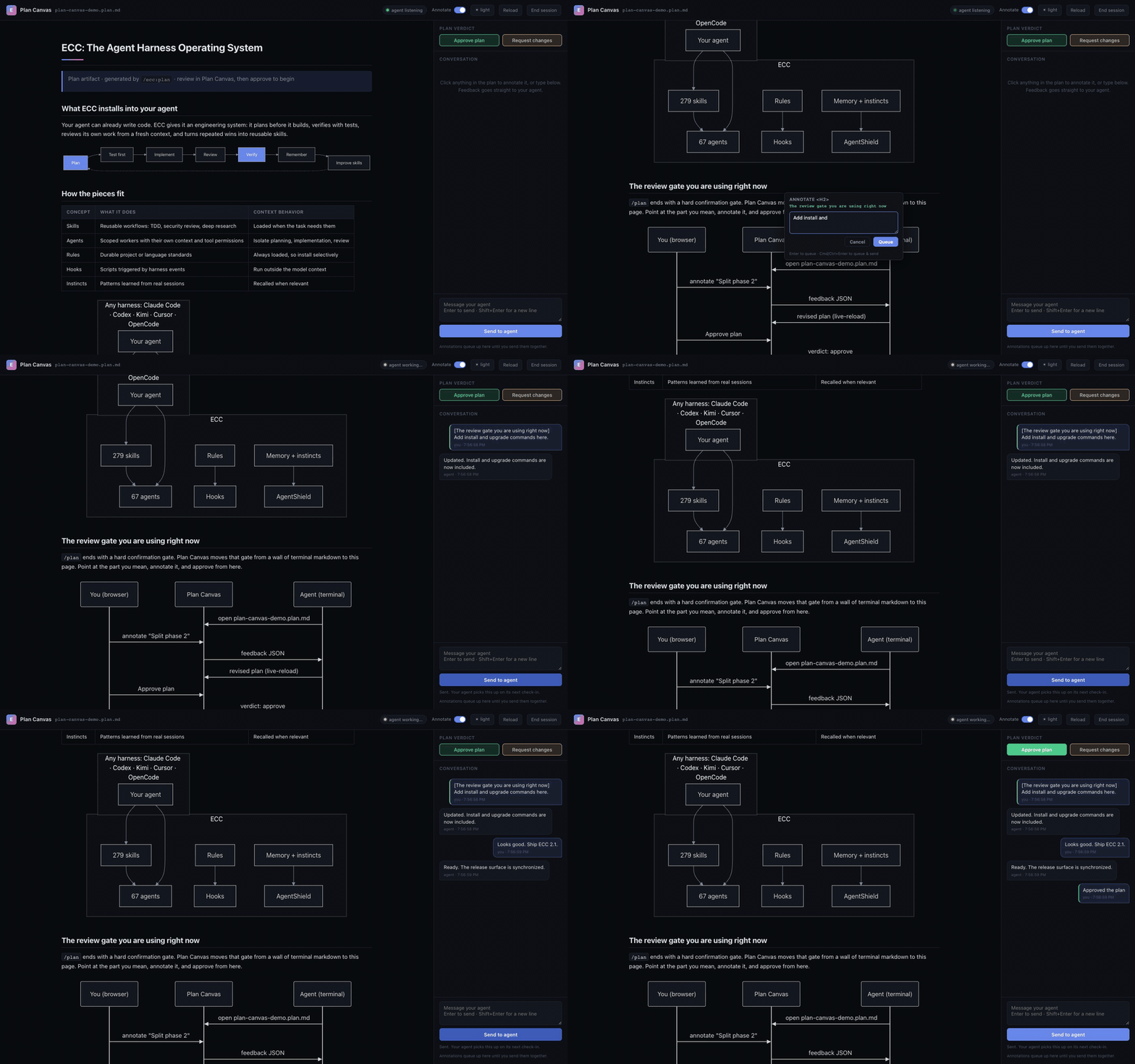 [Download the MP4 demo](https://raw.githubusercontent.com/affaan-m/ECC/main/docs/releases/2.1.0/assets/ecc-plan-canvas-demo.mp4) `/plan` ends with a confirm gate, and until now that review was a wall of markdown in the terminal. Now the agent opens the plan in a loopback-only browser canvas: - Click elements or select text to attach numbered annotations - Chat with the agent from a side rail while it works in the terminal - **Approve plan** / **Request changes** buttons map directly onto `/plan`'s CONFIRM gate - Mermaid diagrams, tables, and task lists render natively; file edits live-reload the page - Model- and harness-agnostic: a plain CLI + JSON protocol (`ecc-plan-canvas`), no Claude-only dependency ## Kimi harness: Moonshot AI partnership ECC now installs directly into [Kimi Code](https://moonshotai.github.io/kimi-cli/) (`--target kimi`). Kimi Code discovers the installed `.kimi/AGENTS.md` instructions and `.kimi/skills/` workflows natively: ```bash bash ./install.sh --target kimi --profile minimal npx ecc doctor --target kimi kimi ``` ## Self-host on Itô GPUs Run ECC against any self-hosted open-source model. If you need GPU capacity, [Itô](https://compute.itomarkets.com) is ECC's preferred compute sponsor. The integration shipped guarded end to end: - `ecc ito find`: opt-in bridge to the canonical Itô CLI that submits a live, authenticated RFQ (it does not reserve capacity) - Guarded live node qualification and read-only compute handoff - Credential-bearing CLI shims are rejected outright The sponsorship link itself is passive: it does not invoke an RFQ, reserve capacity, provision compute, or configure serving. Managed inference through Itô is not live yet. Any GPU provider works, and ECC stays provider-agnostic. ## Partners [Moonshot AI (Kimi)](https://www.moonshot.ai), [Itô](https://compute.itomarkets.com), and [Atlas Cloud](https://www.atlascloud.ai) are now public sponsors of ECC. The README documents a recommended self-host path: Itô for GPU capacity, a Kimi checkpoint served behind a compatible endpoint, then Kimi Code + ECC on top. Each choice remains separate and swappable. ## Also in 2.1 - **Hermes and OpenClaw install targets**: two more harnesses join Claude Code, Codex, OpenCode, Cursor, Gemini, Zed, Copilot, and Kimi - **Codex ECC navigation guide**: find the right skill/command surface from inside Codex - **GateGuard path exemptions** (`GATEGUARD_EXEMPT_GLOBS`) and configurable instinct injection (count + confidence threshold) - **PostToolUse hooks consolidated** into sync/async dispatchers, with fewer processes per tool call - **Supply-chain hardening**: the installer runtime passes strict vetting, and the pre-commit secret scan now catches Anthropic API keys (`sk-ant-...`) - A long tail of community fixes across OpenCode, Windows, bun lockfiles, the dashboard, and project detection The catalog now stands at **67 agents, 281 skills, and 94 command shims** (2.0.0 shipped 64/261/84), plus hooks, rules, memory, continuous learning, and AgentShield. ## Install or upgrade ```text /plugin marketplace add https://github.com/affaan-m/ECC /plugin install ecc@ecc ``` Existing installs: `/plugin update ecc` ## Community Join the ECC community for release announcements, questions, and Show and Tell: <https://discord.gg/36yGMHGFbR> Full changelog: <https://github.com/affaan-m/ECC/compare/v2.0.0...v2.1.0> ## New Contributors * @legeZZZ made their first contribution in https://github.com/affaan-m/ECC/pull/2200 * @tongshu2023 made their first contribution in https://github.com/affaan-m/ECC/pull/2216 * @mohameddsh3ban made their first contribution in https://github.com/affaan-m/ECC/pull/2195 * @fiedler-itlabs made their first contribution in https://github.com/affaan-m/ECC/pull/2240 * @daiki75 made their first contribution in https://github.com/affaan-m/ECC/pull/2245 * @wellkilo made their first contribution in https://github.com/affaan-m/ECC/pull/2194 * @rameshvr made their first contribution in https://github.com/affaan-m/ECC/pull/2144 * @aaronjmars made their first contribution in https://github.com/affaan-m/ECC/pull/2185 * @orbisai0security made their first contribution in https://github.com/affaan-m/ECC/pull/2149 * @xwang4-svg made their first contribution in https://github.com/affaan-m/ECC/pull/2186 * @kriptoburak made their first contribution in https://github.com/affaan-m/ECC/pull/2199 * @lamenting-hawthorn made their first contribution in https://github.com/affaan-m/ECC/pull/2235 * @mdayan8 made their first contribution in https://github.com/affaan-m/ECC/pull/2100 * @Naominour made their first contribution in https://github.com/affaan-m/ECC/pull/2188 * @Malphite10 made their first contribution in https://github.com/affaan-m/ECC/pull/2197 * @cogiwimute367-create made their first contribution in https://github.com/affaan-m/ECC/pull/2251 * @z3tz3r0 made their first contribution in https://github.com/affaan-m/ECC/pull/2250 * @rockwellwindsor made their first contribution in https://github.com/affaan-m/ECC/pull/2258 * @stroland02 made their first contribution in https://github.com/affaan-m/ECC/pull/2202 * @hretheum made their first contribution in https://github.com/affaan-m/ECC/pull/2221 * @BERORINPO made their first contribution in https://github.com/affaan-m/ECC/pull/2234 * @Victor-Casado made their first contribution in https://github.com/affaan-m/ECC/pull/2236 * @itkdm made their first contribution in https://github.com/affaan-m/ECC/pull/2241 * @leoeletronics made their first contribution in https://github.com/affaan-m/ECC/pull/2267 * @Seekers2001 made their first contribution in https://github.com/affaan-m/ECC/pull/2118 * @lucaszhu-hue made their first contribution in https://github.com/affaan-m/ECC/pull/2279 * @kapil971390 made their first contribution in https://github.com/affaan-m/ECC/pull/2292 * @danielnguyenfinhub made their first contribution in https://github.com/affaan-m/ECC/pull/2342 * @gpitrella made their first contribution in https://github.com/affaan-m/ECC/pull/2355 * @Angad2005 made their first contribution in https://github.com/affaan-m/ECC/pull/2366 * @quadcent made their first contribution in https://github.com/affaan-m/ECC/pull/2133 * @SiaoZeng made their first contribution in https://github.com/affaan-m/ECC/pull/2383 * @Tahiti18 made their first contribution in https://github.com/affaan-m/ECC/pull/2307 * @phobicdotno made their first contribution in https://github.com/affaan-m/ECC/pull/2343 * @sshworld made their first contribution in https://github.com/affaan-m/ECC/pull/2358 * @cd1amond made their first contribution in https://github.com/affaan-m/ECC/pull/2346 * @Tanaka-VivereGratis made their first contribution in https://github.com/affaan-m/ECC/pull/2388 * @KyawZinLatt made their first contribution in https://github.com/affaan-m/ECC/pull/2319 * @dieudonneAwa made their first contribution in https://github.com/affaan-m/ECC/pull/2288 * @carloscarvallo made their first contribution in https://github.com/affaan-m/ECC/pull/2273 * @mc856 made their first contribution in https://github.com/affaan-m/ECC/pull/2274 * @jvirgovic made their first contribution in https://github.com/affaan-m/ECC/pull/2338 * @m18897829375 made their first contribution in https://github.com/affaan-m/ECC/pull/2336 * @jack-finance-able made their first contribution in https://github.com/affaan-m/ECC/pull/2390 * @yerros made their first contribution in https://github.com/affaan-m/ECC/pull/2275 * @YuhaoLin2005 made their first contribution in https://github.com/affaan-m/ECC/pull/2377 * @Cb2i made their first contribution in https://github.com/affaan-m/ECC/pull/2437 * @28winz-bot made their first contribution in https://github.com/affaan-m/ECC/pull/2422 * @sutazca made their first contribution in https://github.com/affaan-m/ECC/pull/2425 * @nidelson made their first contribution in https://github.com/affaan-m/ECC/pull/2420 * @juujb made their first contribution in https://github.com/affaan-m/ECC/pull/2416 * @Zalasyu made their first contribution in https://github.com/affaan-m/ECC/pull/2432 * @Lxcardoza993 made their first contribution in https://github.com/affaan-m/ECC/pull/2433 * @haelyra made their first contribution in https://github.com/affaan-m/ECC/pull/2467 * @thejesh23 made their first contribution in https://github.com/affaan-m/ECC/pull/2515 * @nankingjing made their first contribution in https://github.com/affaan-m/ECC/pull/2501 * @samartomar made their first contribution in https://github.com/affaan-m/ECC/pull/2503 * @fletcherm-hub made their first contribution in https://github.com/affaan-m/ECC/pull/2460 * @someiyoshino-lab made their first contribution in https://github.com/affaan-m/ECC/pull/2471 * @WinterSold1er made their first contribution in https://github.com/affaan-m/ECC/pull/2511 * @EmadDoughan made their first contribution in https://github.com/affaan-m/ECC/pull/2543 * @Oleksandr-Kh4 made their first contribution in https://github.com/affaan-m/ECC/pull/2529 * @latreon made their first contribution in https://github.com/affaan-m/ECC/pull/2536 **Full Changelog**: https://github.com/affaan-m/ECC/compare/v2.0.0...v2.1.0
此处仅展示最近 5 个版本。 在原站查看完整版本历史 ↗
当前收录版本
0.0.1
质量评测
满分100 · 来自 SkillPi LAB 实验室的评测报告。
亮点
- 涵盖 Redis 缓存、分布式锁、速率限制、Pub/Sub、连接管理等生产级核心场景
- 提供多种实现模式(Cache-Aside、Write-Through、Sliding Window 等)及代码示例
- 包含反模式提醒和最佳实践,显著提升后端开发效率
亮点
- 触发词精准覆盖常见 Redis 使用场景(缓存、限流、锁、会话存储等)
- When to Activate 明确列出具体激活条件,边界清晰
亮点
- 结构清晰,分章节详述数据结构、核心模式、键设计、连接管理等
- 包含大量端到端代码示例和快速参考表,便于查阅和使用
亮点
- 提供多种实现方式(Python、Lua),参数正确,覆盖主要异常场景
- 包含连接池、集群、哨兵等生产环境配置,可靠性高
取前四项原始分值的算术平均,四舍五入取整。可通过收录报告核对各项评分与说明,运行记录需单独查证。
正文静态检测
100 / 100 · skillpi-20261123-no-r3-v1
正文未命中当前规则。
分数仅反映正文中的规则命中,供使用前参考。附件与运行行为不在此评分范围内。
权限与使用前检查
根据当前主文档自动整理,命中内容可能是示例或防护说明;不是实际权限声明,也未覆盖附件、外部依赖或运行行为。
未从主文档识别到上述常见操作,不能据此判断无需权限或没有风险。
安全评级与访问范围
safe · 静态证据核验,不代表运行安全保证。
来源文档未说明。
使用前请由宿主核对并授权实际文件读写、外部服务和联网目的地;本站的核验不会授予任何运行权限。
用户讨论
还没有已核实的点评。