
Generate styling feedback from outfit photos
Step-by-step concept: prepare outfit images and moodboard samples, use a vision model to extract garments/ materials/labels, normalize results, then feed them to Codex to generate playful captions, tags and moodboard-aligned style notes you can package as a Skill. Includes prerequisites and verification points.
Image Analysis
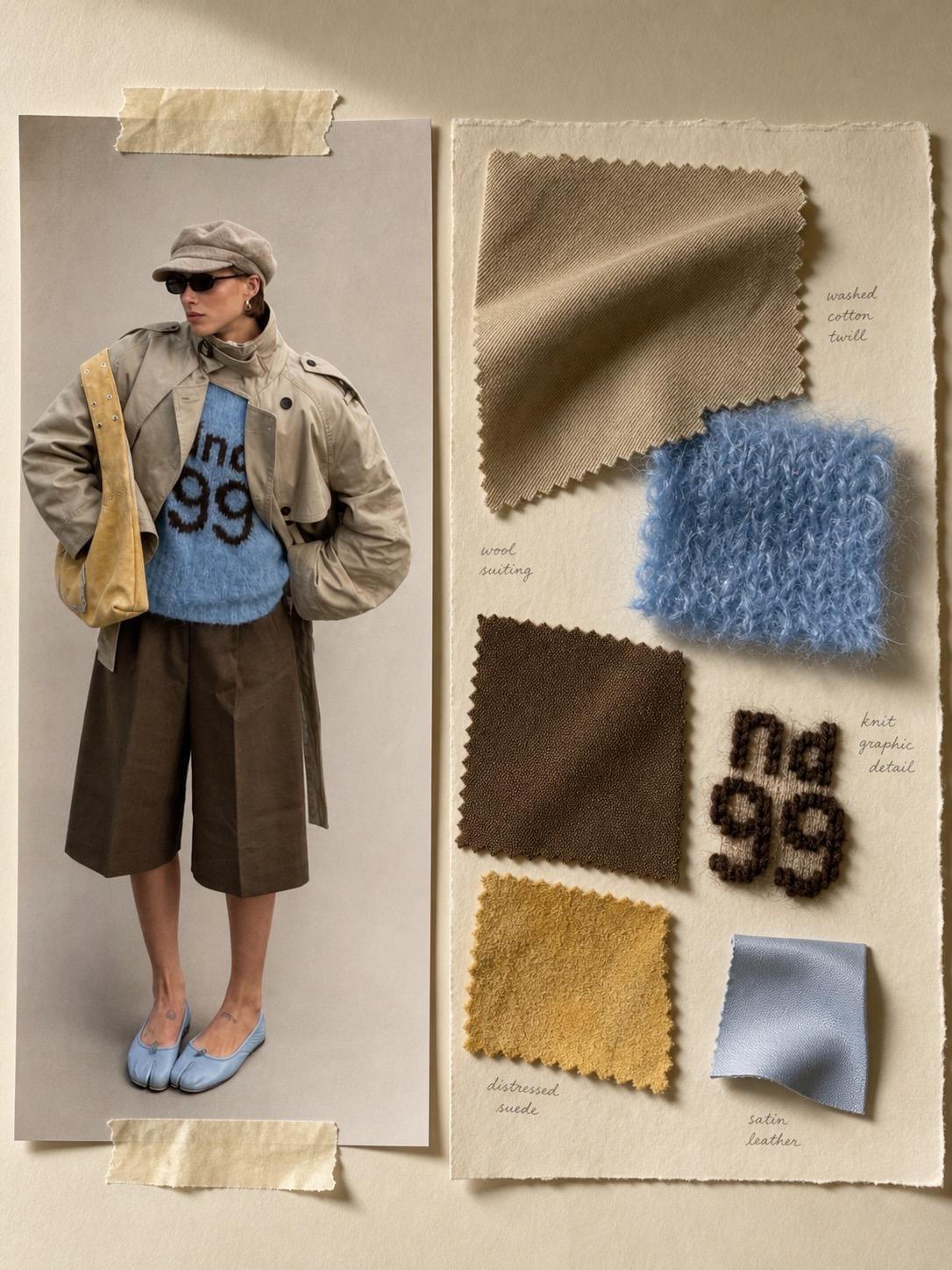
Image 1 — Evidence summary
1. Readable text (approximate positions):
- Top of the right paper near a light brown fabric swatch: washed cotton twill
- Below-left of a light-blue fuzzy fabric swatch (near upper center): wool suiting
- Right-center near a brown knit graphic swatch: knit graphic detail
- Lower-right-center near a yellow suede sample: distressed suede
- Bottom-right near a light-blue sheen sample: satin leather
2. Interface steps / chart data
- No interface steps (not a UI screenshot); no chart data.
3. Visible facts (objective observations):
- Overall layout: a vertical portrait photo on the left, and on the right a moodboard/sample board with multiple fabric swatches and handwritten labels attached to paper.
- Left photo (person details):
- Outfit: light beige cap/beret, dark sunglasses, short beige trench or jacket, light-blue fuzzy knit sweater (with darker graphic/text detail), dark brown wide trousers or culotte-style skirt-pants, light-blue split-toe shoes (tabi-like), shoulder yellow/golden suede bag.
- Accessories: hoop earrings, sunglasses.
- The portrait appears 'taped' to the background paper with visible tape at top and bottom (collage visual).
- Two small round marks or tattoos are visible on the top of the model's feet near the insteps.
- Right moodboard (swatches labeled top-to-bottom, left-to-right):
- Top: light-brown / khaki fabric swatch (pinked edge) labeled “washed cotton twill.”
- Upper right-center: light-blue fuzzy knit yarn swatch (square, fluffy texture).
- Middle left: dark brown fabric swatch (square, pinked edge) labeled “wool suiting.”
- Middle right: 3D brown knit graphic/text swatch labeled “knit graphic detail.”
- Bottom left: yellow/tan suede-like swatch (square, pinked edge) labeled “distressed suede.”
- Bottom right: light blue-gray sheen fabric sample (small piece, folded, satin-like) labeled “satin leather.”
- The moodboard background is light beige textured paper with irregular torn edges; many swatches have pinked edges typical of fabric samples.
- The overall palette is beige, khaki, brown, light blue, and yellow, presenting a fabric pairing reference.
4. Uncertain / unreadable items (locations and reasons):
- Brown text/graphic on the sweater (left portrait, light-blue knit): character shapes resemble “na99” or “nagg” but are blurred and knitted, so exact letters/numbers cannot be confirmed — marked as uncertain.
- The brown knit graphic swatch (near “knit graphic detail”) may contain similar unclear characters; individual character recognition is uncertain.
- No identity inference (facial expression, age, identity) is made for the model in the photo.
- Fine handwritten strokes may be unclear at this resolution, though the main sample labels listed above are generally legible.
5. Inference (clearly labeled as inference, not fact):
- The image likely represents a fashion/fabric moodboard or a product display board based on the sample-board layout and handwritten labels.
- Tape, torn paper edges, and pinked swatch edges appear to be intentional collage design elements to show sample relationships.
- The shoes resemble Japanese tabi-style split-toe footwear, possibly chosen to echo the light-blue knit.
6. Other notes
- The image contains a real person; no identity inference or personal data analysis was performed.
- For higher-precision text recognition (e.g., to confirm sweater characters), a higher-resolution or zoomed crop would be required.
SkillPI Creation Analysis
Purpose and interpretation:
- Purpose: The referenced item is a concept Skill aimed at styling creators — the Skill accepts outfit images and produces playful, stylistic feedback such as tags, moodboard-aligned descriptions, or social copy snippets based on detected garments, materials, and colors.
Key image evidence:
- The composition pairs a model portrait with a labeled fabric sample board; readable fabric labels (washed cotton twill, wool suiting, knit graphic detail, distressed suede, satin leather) provide explicit cues that can be used as ground truth for material/texture recognition or prompt examples.
- Garment-level details (hat, short trench/jacket, fuzzy knit with graphic, culottes, split-toe shoes, yellow suede bag) are useful target items for automatic detection and tagging.
Reproducible workflow (conceptual steps to implement — adapt to your stack):
1. Prepare dataset: collect outfit photos and corresponding sample boards/labels; ensure legal usage rights and model release where required.
2. Visual analysis: run image-recognition/OCR to detect garment types, colors, textures, and any readable labels on the moodboard.
3. Normalize outputs: convert detections into structured fields (e.g., garment:type, color, material, accessory, moodboard:labels).
4. Text generation: feed the structured description into Codex or a text-generation engine via designed prompts/templates to produce playful feedback — e.g., short captions, style notes, moodboard explanations, or hashtag/tag suggestions.
5. Package Skill outputs: return generated copy, tags, and optional annotated images as the Skill’s deliverables for the creator’s workflow.
Prerequisites for reproduction:
- A capable vision pipeline (OCR and garment/material classification) to extract structured descriptors from images.
- Access to Codex or a text/code-generation API; if multi-modal capability is required, confirm the chosen model can accept the visual-derived description as input.
- Adequate image resolution or zoomed crops to read small text (e.g., sweater graphic) and moodboard labels.
- Permissions and privacy handling for images featuring people.
Items that require verification:
- Whether Codex can directly accept images as input in your environment; if not, a visual model must first convert images into structured text that Codex can consume.
- Exact readable characters on the sweater and the knit graphic — current resolution is insufficient for reliable OCR; higher-resolution crops are needed for confirmation.
- Runtime and deployment constraints (API rate limits, latency, media upload limits) for the target hosting platform.
- Output style and safety filtering: evaluate generated text for tone, brand alignment, and potential sensitive content.
Notes:
- This interpretation is based solely on the supplied summary and image evidence; no end-to-end execution of the Skill has been performed here. Implementation requires validating the specific vision + text generation capabilities and addressing image consent/privacy issues.