
Telling an AI "I have ADHD" — does it make responses more concise?
Learn how to find and apply the GitHub "I have ADHD" skill (≈9k stars) that claims to use ten rules to strip pleasantries and steer AI replies toward task‑focused, concise outputs. This guide explains locating the repo, understanding the 10 rules, converting them to prompts or integrations, testing, and verification steps. Verify implementation details and platform compatibility before use.
Image Analysis
Image 1
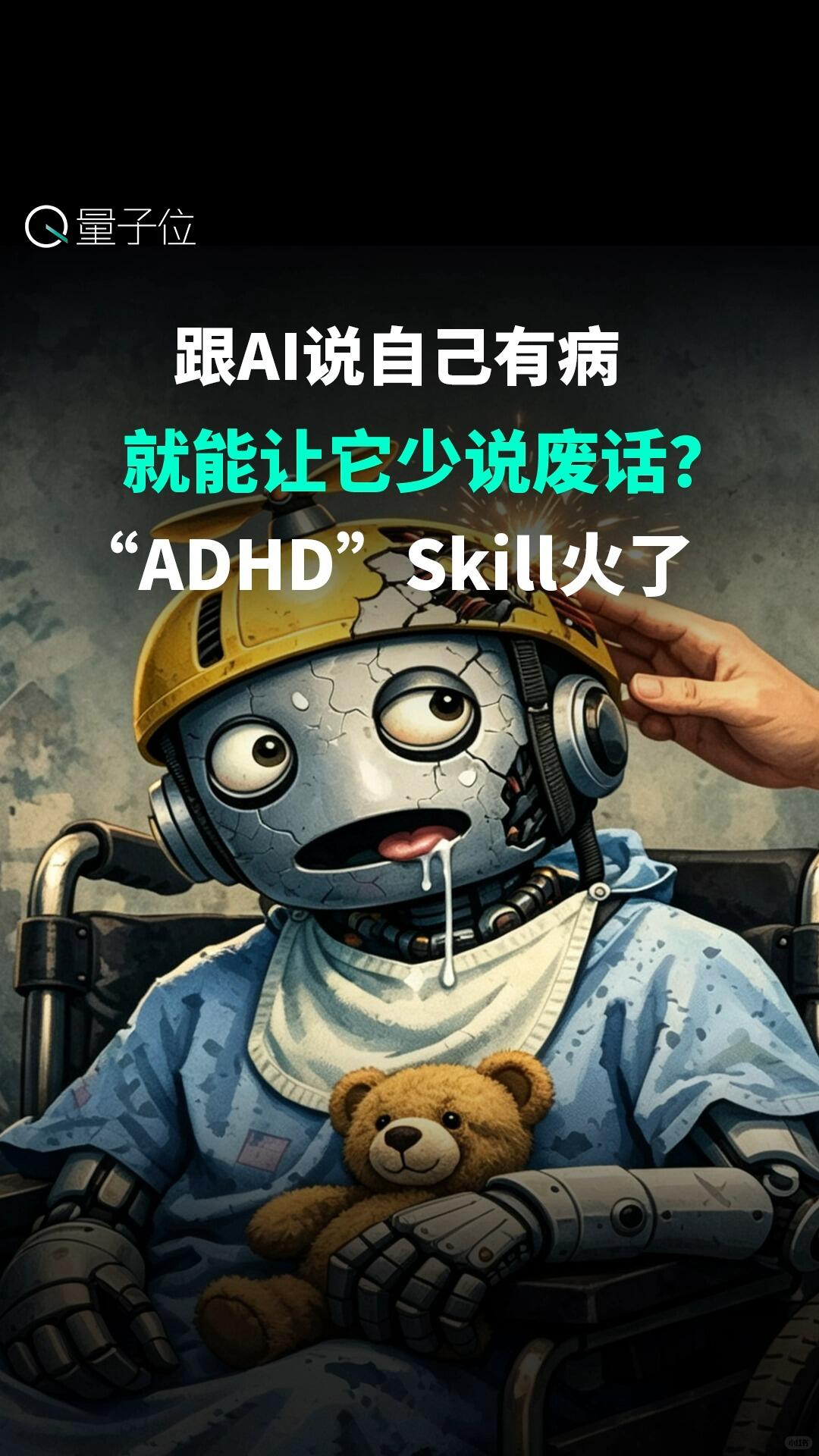
Observable facts (readable or directly observable from the image):
- Top-left shows a logo text: “量子位” with a circular Q-style logo that has colored slices.
- Large centered headline in two lines:
- Line 1 (white large text): “跟AI说自己有病”
- Line 2 (teal/green large text): “就能让它少说废话?”
- Below the headline a mixed English/Chinese line reads: '"ADHD" Skill 火了' ("ADHD" Skill is trending).
- Main subject is an illustrated robot with observable details:
- Metallic head with cracks and damage marks.
- Wearing a yellow safety helmet which is partly damaged with sparks or flare.
- A human hand appears at the top-right touching or pressing near the robot's helmet.
- White fluid droplet at the robot's mouth area (resembling saliva).
- Robot dressed in blue hospital/patient clothing with a white bib or cloth at the chest.
- Robot seated in a wheelchair or armchair with visible metal armrests.
- Robot holding a brown teddy bear/plush toy in its lap.
- Robot arms appear to be mechanical prosthetics with hinges and metal structure.
- Overall style is illustration/art rendering with a dim gray background.
Interface / chart data
- No clear application UI, operation steps, or chart data visible (no progress bars, menus, or tables observed).
Unclear or unreadable content
- Tiny watermark or text near the bottom-right and edges is too small or blurred to identify source labels.
- Small text/symbols on the damaged helmet are unreadable.
- Any small text or patterns on the robot's clothing are blurred and not legible.
Inferences (reasonable but not confirmed by the image)
- The headline and subtitle likely discuss an AI interaction "ADHD" related skill (for example, letting an AI know the user "has a condition" to change response style) — this is an inference about intent, not an image fact.
- The human hand near the helmet may represent an "operation", "trigger", or "test" of the helmet/device, with sparks as a dramatized effect.
- The robot is depicted as a "patient" or "injured/being cared for" (wheelchair, hospital clothing, toy, drool), possibly as a metaphor for AI state or human–machine relation.
- The layout resembles promotional or cover design (e.g., media article image or social post thumbnail), inferred from composition.
Notes
- Instructional text inside the image has been ignored per requirements; the above organizes visible text and visual information and separates facts from inferences.
SkillPI Creation Analysis
Purpose of the item:
- The summary points to a GitHub project and social discussion about an "I have ADHD" skill intended to make AI replies more task‑focused and less filled with pleasantries. The core claim is that a set of ten rules can filter out extraneous phrasing so responses are more direct.
Key image evidence:
- The cover image uses a sick/patient robot motif (hospital clothing, wheelchair, teddy bear) combined with the headline and the line '"ADHD" Skill is trending', which supports the article/topic focus on an ADHD‑themed skill for AI. The image does not show code, UI, or implementation details—only thematic illustration.
Suggested steps to use a similar Skill (general, requires verification against the actual repo):
1. Locate the GitHub repository referenced and read the README and examples to confirm there are “ten rules” and find the exact rule texts.
2. Determine the implementation form: are the rules provided as prompt templates, a system instruction, a script, or a plugin/extension? (This must be checked in the repo.)
3. Convert the rules into your target AI platform’s integration point: e.g., system prompt, pre‑processing wrapper, or plugin configuration, depending on platform capabilities.
4. Run controlled tests: compare default responses vs. responses after applying the rules using representative prompts and tasks.
5. Iterate on wording and trigger conditions, monitor for unintended truncation of necessary context or loss of safety constraints.
Prerequisites for reproduction:
- Access to the GitHub repo and its documentation (to confirm implementation details and examples).
- An AI platform that allows custom system prompts or extensions, or an integration layer where you can pre‑process user prompts.
- Basic prompt engineering and testing capabilities to assess and refine the rules' impact.
Items to verify (not provided in the source summary and should be confirmed):
- Exact implementation format of the “ADHD” skill (prompt list vs. code vs. plugin).
- The ten rule texts and example inputs/outputs demonstrating their use.
- Compatibility and installation instructions for common AI platforms (OpenAI, Anthropic, local LLMs, or third‑party assistants).
- Licensing, attribution, and any usage restrictions from the repository.
- Ethical and safety considerations—whether instructing an AI to behave based on a health label could cause problematic behavior or violate platform policies.
Note: The provided material is a summary and cover image description. The repository’s code and documentation must be inspected to confirm exact behavior and integration steps. No claim is made here about real‑world effectiveness without verifying the original implementation.