
Want to remove the 'machine' feel from AI-written text? Many people only swap words.
Learn sepia's approach to humanizing AI text: apply a three-pass workflow (narrative structure, section progression, sentence/style) plus a 30-item diagnostic rubric to fiction and professional documents. Use its review/refactor/recreate modes to generate model-specific correction checklists (supports use as an Agent Skill on platforms referenced in the source). Tool is experimental—verify repo and rubrics before production use.
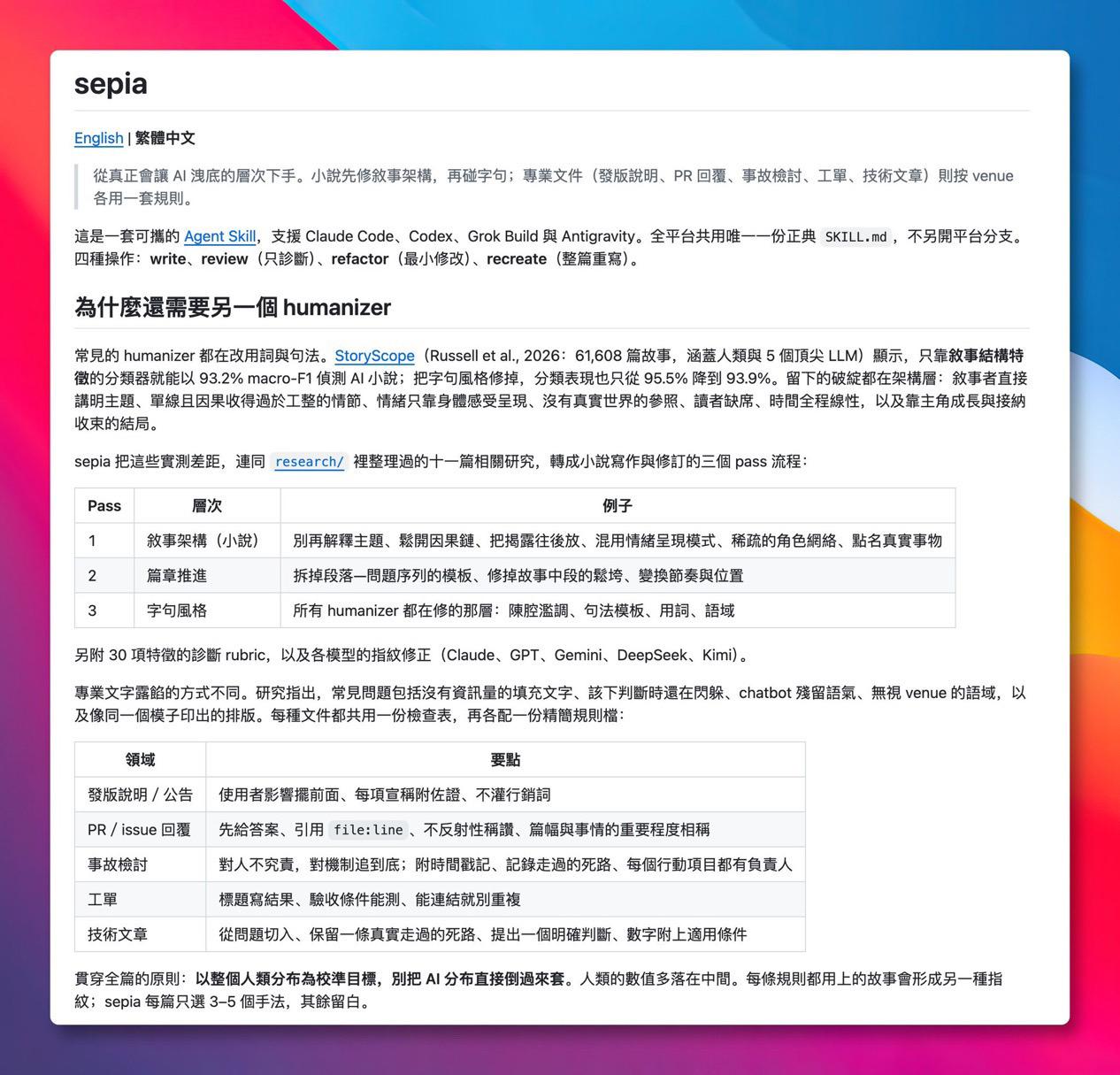
Image Analysis
1. Overall interface and visible phenomena (facts)
- Top page title: sepia
- Top language switch links: English | 繁體中文
- The page shows a white content panel on a colorful desktop background (looks like macOS wallpaper).
- The content language is Traditional Chinese (article text in Traditional Chinese).
- There are title, subtitle, paragraphs and multiple tables (clear columns and rows).
- Three main paragraph headings are discernible:
- “為什麼還需要另一個 humanizer” (Why another humanizer is needed)
- Table column headers include “Pass”, “層次”, “例子”
- The text contains English words or proper nouns (e.g., Agent Skill, Claude Code, Codex, Grok Build, Antigravity, SKILL.md, write, review, refactor, recreate, StoryScope, research, Claude, GPT, Gemini, DeepSeek, Kimi, file:line).
- At least two tables appear: the first with columns “Pass / 層次 / 例子”, the second with “領域 / 要點”.
- The page lists 3 Pass levels (marked 1,2,3).
- The text cites data and references such as “Russell et. al., 2026: 61,608 stories”, “93.2% macro-F1”, “95.5%”, “93.9%”.
- The page mentions “another 30 diagnostic features (rubric)” and model fingerprint corrections (Claude, GPT, Gemini, DeepSeek, Kimi).
- The “領域 / 要點” table lists domains: release notes/announcements, PR/issue replies, incident reviews, tickets, technical articles (these domain labels are clearly readable).
- In the incident review row the note readable: “do not blame individuals, root system issues; attach timeline, record steps, each action has an owner” (approximate phrasing).
- There is a concluding paragraph near the page bottom (partly readable) with fragments like “sepia 每 ... 3–5 (or 3–5 techniques)”.
2. Line-by-line / block readable excerpts (facts, as precise as possible)
- Title: sepia
- Links: English | 繁體中文
- Opening paragraph (readable fragments):
- “Work from the layer that really makes AI ‘wash brains’. For fiction, fix narrative structure first then break down wording; professional documents (release notes, PR replies, incident reviews, tickets, technical articles) each use a venue-specific set of rules.”
- Next paragraph:
- “This is a portable Agent Skill, supporting Claude Code, Codex, Grok Build and Antigravity. A single canonical SKILL.md is shared across platforms, no separate platform branches.”
- “Four operations: write, review (diagnose only), refactor (minimal edits), recreate (full rewrite).”
- Heading: Why another humanizer is still needed
- Paragraph (readable fragments):
- “Common humanizers change diction and syntax. StoryScope (Russell et. al., 2026: 61,608 stories, covering humans and 5 top LLMs) shows that a classifier using only narrative-structure features can detect AI fiction with 93.2% macro-F1; removing sentence/word style drops classifier performance only from 95.5% to 93.9%. Remaining flaws are in the narrative layer: narrator stating theme directly, single-threaded and overly tidy causal plots, emotion shown only via bodily sensations, lack of real-world anchors, absent reader, linear time, and chapters ending in growth/acceptance.”
- Following paragraph (partly readable):
- “sepia turns these distance measures, together with a related paper gathered in research/, into three pass processes for fiction writing and revision:”
- Table header (readable): Pass / 層次 / 例子
- Table rows (readable points, row by row):
- Pass 1 level: Narrative structure (fiction)
- Example (readable fragments): “Stop explaining the theme, loosen the causal key, put scene later, mix emotion presentation modes, sparse character networks, name real-world objects” (some words may vary)
- Pass 2 level: Section/chapter progression
- Example (readable fragments): “Break paragraph—problem-sequence templates, fix sagging middle of story, vary pacing and placement” (some fragments uncertain)
- Pass 3 level: Sentence & diction style
- Example (readable fragments): “What all humanizers edit: pronouns..., syntactic templates, word choice, register” (some parts unreadable)
- Continued text (readable fragment):
- “Another 30 diagnostic features (rubric), and per-model fingerprint corrections (Claude, GPT, Gemini, DeepSeek, Kimi).”
- Next paragraph (readable fragment):
- “Professional documents follow different patterns. Research notes common problems: lack of persuasiveness; hedged tone where judgement is required; chatbot residue in voice; disregard for venue register; and layout that looks like the same template. Each document type has a checklist and a tailored modification suggestion.”
- Second table (columns readable): domain / key points
- Domains listed (readable): release notes / announcements, PR / issue replies, incident reviews, tickets, technical articles
- Incident review key points readable: “do not blame people, root system issues; attach timeline, record steps, each action item has an owner.”
- Other domain notes are visible but contain many unclear words (see unreadable section below).
- Bottom of page (concluding fragment, readable): mentions “sepia every ... 3–5 techniques, remainder omitted” (specific numbers/phrasing partly blurred).
3. Unreadable or uncertain words/fragments (explicitly listed)
Below are words or fragments I could not clearly read or are uncertain; locations are marked for review:
- In the opening sentence the phrase “從真正會讓 AI 洗腦的層次下手” includes the word “洗腦” which is somewhat uncertain; overall meaning is clear though minor wording may differ.
- The phrase “sepia 把這些差測距,連同 research/ 裡整理過的一篇相關研究,轉成...” contains “差測距” which is uncertain—could be “差別測度”, “差異測距” or similar.
- Specific wording inside table examples (e.g., Pass1’s “點名真實事物”, Pass2’s “拆掉段落—問題序列的模板”) contain unclear or compressed wording; sentence structure lost in places.
- Pass 3 row example’s opening fragment for sentence-style edits is incomplete (some words missing), preventing exact transcription.
- In the second table (domain/key points) the release notes / announcement row has several unclear words (e.g., “users should understand prerequisites, attach evidence for each important item, no marketing words” is approximate and partly guessed).
- The PR / issue replies row has line breaks and blurs; “cite file:line” is readable but the full sentence is not.
- Small-print lines at the bottom are blurred and cannot be fully extracted.
4. Inferences (reasonable context-based guesses, labeled as inference)
- Inference A: The page documents a tool or workflow named sepia that aims to improve “humanizer” methods for AI text by focusing on narrative structure and venue-specific rules for professional documents.
- Inference B: The three Passes in the table map to large-scale structure (narrative), mid-level chapter/section progression (pace/paragraphing), and surface-level sentence/style edits, each with actionable example fixes.
- Inference C: The cited numbers (61,608 stories; 93.2% macro-F1; 95.5%; 93.9%) are presented to support the claim that humanizers focusing only on diction/syntax miss structural cues detectable by narrative-structure classifiers.
- Inference D: The second table lists different professional document types (release notes, PR replies, incident reviews, tickets, tech docs) with domain-specific checklists; incident reviews emphasize chronology, process recording and assigning action owners (this point is relatively readable and thus higher-confidence inference).
- Inference E: The “another 30 diagnostic features (rubric)” likely refers to a set of finer-grained checks used by the system to detect or advise on structural issues in fiction and documents.
5. Other visible UI elements (facts)
- A scrollbar on the right indicates a long page.
- Narrow-column layout with side margins.
- Standard web fonts and table borders/shading between paragraphs.
If you need a full verbatim transcription (including uncertain fragments marked in brackets) or a structured plain-text version of the tables, I can produce a more fine-grained transcription with all uncertain words explicitly annotated based on this image evidence.
SkillPI Creation Analysis
Purpose: The material describes an open-source writing Skill named sepia that aims to humanize AI-generated text by changing underlying narrative structure rather than only surface wording. It targets both fiction and venue-specific professional documents (release notes, PR/issue replies, incident reviews, tickets, technical articles) and produces diagnostic output and model-specific correction lists.
Image evidence summary: The page header is sepia and offers language switch (English | 繁體中文). The UI shows multiple tables including a 3-pass workflow (Pass 1-3), mentions a research citation (Russell et al., 2026) with 61,608 stories and a 93.2% macro-F1 figure, references “another 30 diagnostic features (rubric)”, and lists per-model fingerprint corrections for Claude, GPT, Gemini, DeepSeek and Kimi. The page states four operation modes: write, review, refactor, recreate, and that it can be used as a portable Agent Skill across Claude Code, Codex, Grok Build and Antigravity with a single canonical SKILL.md.
Steps to use the Skill (based on visible workflow and terms; presented as an actionable checklist to prepare for trial):
1) Obtain sepia Skill/ repository (confirm SKILL.md and installation instructions) and collect target text samples (fiction or specific professional documents).
2) Run a review (diagnostic) using sepia to get the 30-item rubric output and identify structural issues; the tool should recommend which Passes to apply.
3) Choose an operation: review only to diagnose; refactor for minimal edits; recreate for full structural rewrite; or write to generate new text.
4) Apply Passes in order: Pass 1 (narrative structure) → Pass 2 (section/chapter progression) → Pass 3 (sentence & diction), following the rubric and model-specific corrections.
5) Re-run diagnostic checks and iterate until the desired reduction in detectable AI-structure signatures is achieved.
Reproduction prerequisites and verification items:
- Access to sepia source or Skill definition and installation instructions (SKILL.md).
- An Agent runtime or adapter for the supported platforms referenced (Claude Code, Codex, Grok Build, Antigravity) if you plan to run it as an Agent Skill.
- Sample texts for the intended domain and a test procedure to measure outcomes.
- To verify research claims (e.g., 93.2% macro-F1 from StoryScope/Russell et al.), the original dataset, evaluation splits and metric definitions must be obtained.
Items that need confirmation (explicitly flagged):
- The exact location and license of the sepia repository and how to install it.
- The full list and decision rules of the “30 diagnostic features (rubric).”
- The concrete per-model correction strategies and rewrite examples for Claude, GPT, Gemini, DeepSeek, Kimi.
- Reproducibility details for the cited research results and any comparative benchmarks versus other humanizer tools.
Caveat: The page itself includes a disclaimer that sepia is experimental and performance varies by text type. The above steps and interpretation are derived from readable page content and reasonable inference; they do not constitute a tested confirmation of sepia’s effectiveness.